
Tom Cruise receives honorary Oscar at Governors Awards

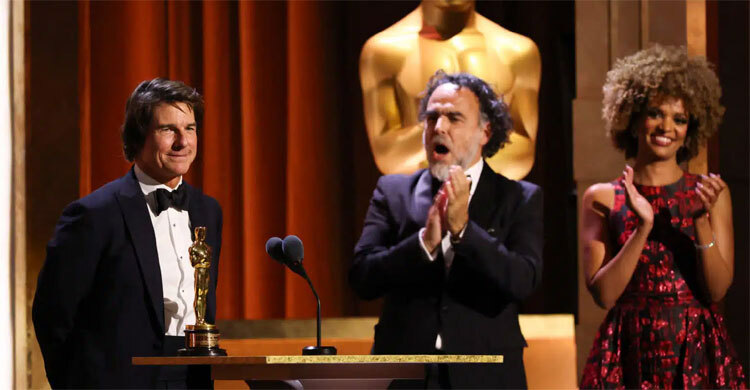
After more than four decades defining blockbuster cinema — and four prior Oscar nominations — Tom Cruise finally held an Academy Award in his hands on Sunday night.
At 63, the enduring movie star accepted the Academy’s Honorary Oscar at the Governors Awards, a non-televised ceremony held at the Ray Dolby Ballroom in Los Angeles. The award recognized his unparalleled contributions to film as an actor, producer, and unwavering champion of the theatrical experience.
“In that theater, we laugh together, we feel together, we hope together,” Cruise said, voice steady but visibly moved, clutching the golden statuette after a two-minute standing ovation. “Making movies is not what I do — it’s who I am.”
Cruise, known for performing his own death-defying stunts and resisting the shift to streaming, was presented the honor by Alejandro G. Iñárritu, his director on the upcoming 2026 film currently shooting in London. Iñárritu offered a prescient tribute: “This may be his first Oscar,” he said, “but from what I’ve seen and experienced, this will not be the last.”
A montage of Cruise’s career — from Taps (1981) to Mission: Impossible – The Final Reckoning — played before he took the stage, highlighting his signature blend of charisma, physical daring, and commitment to the craft. Though nominated for Best Actor for Born on the Fourth of July, Jerry Maguire, and Magnolia, and for Best Picture as producer of Top Gun: Maverick, a competitive Oscar has remained elusive. This honor, however, felt less like a consolation and more like a coronation.
“I will always do everything I can to help this art form,” Cruise added with a wry smile. “To support and champion new voices, to protect what makes cinema powerful. Hopefully, without too many more broken bones.”
The evening also celebrated three other luminaries whose impact on film and culture has been profound.
Debbie Allen: Choreographer, Icon, Mentor
At 75, Debbie Allen — a seven-time Emmy-nominated choreographer of the Oscars, actor, director, and producer — received her first Academy honor. Though never nominated for a competitive Oscar, her fingerprints are on decades of iconic film and television, from Fame to Amistad.
Cynthia Erivo, who called Allen “my aunty,” presented the award with deep reverence. “You have not only shown us the heights dedication to the arts can take us,” Erivo said, “you have fought to bring all of us along with you.”
Allen, visibly emotional, thanked her sister Phylicia Rashad, her husband of 40 years, former NBA star Norm Nixon, and the Academy. “I feel like I just got married,” she said, holding up her statuette. “Sorry, Norman.”
Wynn Thomas: Architect of Visual Storytelling
Production designer Wynn Thomas, one of Hollywood’s first Black production designers, was honored for shaping the visual language of landmark films including A Beautiful Mind, Mars Attacks, and, most notably, Spike Lee’s Do the Right Thing, Malcolm X, and Da 5 Bloods.
Octavia Spencer presented the award as Thomas recounted his journey from a poor Black child in Philadelphia, mocked by local gangs, to a collaborator with some of cinema’s greatest directors. “That sissy grew up to work with some great filmmakers,” he said, drawing laughter and applause.
Dolly Parton: The Heart Behind the Sparkle
Absent due to a long-standing prior commitment — not health concerns, as had been speculated — Dolly Parton was honored with the Jean Hersholt Humanitarian Award for her decades of philanthropy in literacy and education.
Lily Tomlin, her 9 to 5 co-star, delivered a warm, humorous tribute, recalling their slumber parties in baby-doll pajamas and the enduring power of Parton’s anthem. “It’s ironic,” Tomlin said, “that so much artifice surrounds her — because she is the most authentic person I have ever known.”
Parton’s 9 to 5 song, nominated for an Oscar in 1981, became a cultural touchstone — and a symbol of worker solidarity, all while funding countless children’s books through her Imagination Library.
A Night of Legacy, Not Just Awards
The room was filled with potential contenders for the upcoming Oscars — Leonardo DiCaprio, Michael B. Jordan, Sydney Sweeney, Dwayne Johnson, Ariana Grande, Jacob Elordi — underscoring the event’s quiet but potent role as both tribute and industry gathering.
Cruise, ever the meticulous performer, didn’t just thank his fellow honorees — he quoted them. He recalled the exact theater and date he first saw She’s Gotta Have It. He cited Vivian Ayers Allen’s poetry in praise of Debbie. He spoke of Dolly’s “compassion and creativity” as inseparable forces.
And Debbie Allen, in return, didn’t miss a beat: “Honey,” she said to Cruise, “we loved when you slid out in those tighty-whiteys.”
The night closed not with a win, but with a celebration — of craft, courage, and the enduring magic of cinema. For Tom Cruise, it wasn’t just an Oscar moment. It was the culmination of a career that refused to be defined by awards — until now.