
Six more ships burning on Persian Gulf, Strait of Hormuz

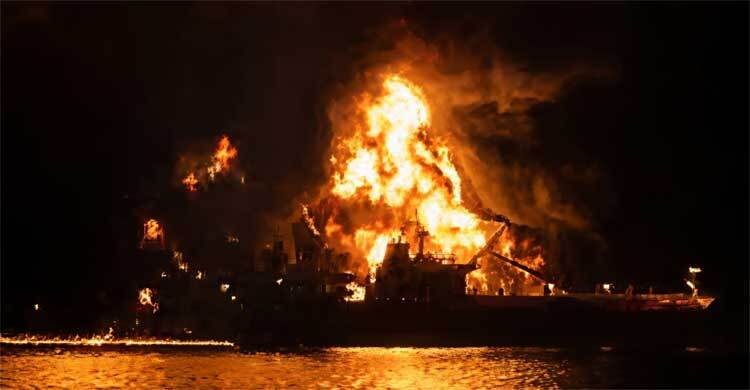
An Iranian boat laden with explosives attacked an oil tanker in Iraqi waters on Wednesday, killing one crew member and sinking two vessels. The incident came shortly after four other ships in the Persian Gulf were struck by projectiles, according to port authorities, maritime security firms and risk analysis companies.
The latest attacks on vessels linked to the United States and Europe are being viewed as a significant escalation in the Iran conflict. The number of ships attacked in the region since hostilities began has now reached at least 16.
Shipping in the Persian Gulf and the narrow Strait of Hormuz has been at a near standstill since the United States and Israel launched attacks on Iran on 28 February. Approximately one-fifth of the world's oil is transported through this route. The heightened tension has sent global oil prices soaring to their highest level since 2022.
Iran's Revolutionary Guards have warned that if attacks on Iran continue, they will not allow "a single litre of oil" to be exported from the Middle East to the United States, Israel or their allies.
US President Donald Trump, for his part, has warned that Washington will strike the country harder if Iran attempts to halt its oil exports. He called on oil companies to utilise the Strait of Hormuz, claiming that "almost all of Iran's navy is now destroyed".
Attacks in Iraqi Waters
According to Iraqi port officials, the two vessels attacked late on Wednesday night were the Marshall Islands-flagged Safesea Vishnu and the Maltese-flagged Zefyros. Both ships were loaded with fuel products from Iraq.
Iraq's state oil marketing company SOMO stated that the Safesea Vishnu was chartered by an Iraqi company that held a contract with them. The Zefyros was carrying fuel products for the Basra Gas Company.
SOMO also confirmed that both ships were attacked whilst transferring goods from one vessel to another within Iraqi waters.
Explosive-laden Iranian boats appear to have attacked the two fuel tankers, setting them ablaze and killing one crew member, following reports that projectiles struck four vessels in Gulf waters.
"We recovered the body of a foreign crew member from the water," one port security official said as Iraqi rescue teams continued searching for missing seafarers.
"A boat belonging to the Iraqi Ports Company rescued 25 crew members from the two vessels, and the fires are still burning on both ships," Farhan al-Fartousi, director general of the state-run General Company for Ports of Iraq, told Reuters.
An Indian crew member on board a United States-owned crude oil tanker was killed when it was attacked near Basra, Iraq, on Wednesday, India's embassy in Baghdad said on Thursday.
In a post on X, the embassy confirmed that the remaining 15 Indian crew members of the Safesea Vishnu have since been evacuated to a safe location.
The embassy stated it is in regular contact with the rescued Indian sailors and Iraqi authorities and is offering all possible assistance.
Al-Fartousi told Iraq's state news agency that oil ports have ceased all operations since the attacks, whilst commercial ports continue to function.
Al Jazeera's correspondent in Baghdad, Mahmoud Abdelwahed, said officials described the attack on the two tankers as sabotage.
"Iraqi officials say this is a flagrant violation of Iraq's sovereignty given the fact that this act, they say, of sabotage has happened in Iraq's territorial waters," Abdelwahed reported.
Unmanned vessels and mining concerns
Reuters reported that accounts of explosive-laden unmanned surface vessels being used, which Ukraine has deployed with considerable effect in its war with Russia, come as Iran has blocked oil shipments from transiting the Strait of Hormuz, through which one-fifth of the world's oil and gas passes, but which has been blocked since the US-Israeli campaign against Iran began.
Reuters, quoting two unnamed sources, also reported on Wednesday that Iran has deployed approximately a dozen mines in the strait, whilst US President Donald Trump said US forces had struck 28 Iranian mine-laying vessels amid warnings of severe repercussions should Iran lay mines in the key waterway for global shipping.
Strait of Hormuz sealed
Iran's Islamic Revolutionary Guard Corps (IRGC) has warned that any ship passing through the Strait of Hormuz will be targeted.
Early on Thursday, the United Kingdom Maritime Trade Operations centre said an unidentified projectile struck a container ship, causing a small fire, 35 nautical miles (64.8km) north of Jebel Ali in the United Arab Emirates. The crew were reportedly safe.
The Thai-flagged Mayuree Naree dry bulk vessel was struck by "two projectiles of unknown origin" while sailing through the strait on Wednesday, causing a fire and damaging the engine room, the ship's Thai-listed operator Precious Shipping said in a statement.
"Three crew members are reported missing and believed to be trapped in the engine room," Precious Shipping said.
"The company is working with the relevant authorities to rescue these three missing crew members," it added, confirming that the remaining 20 crew members had been safely evacuated and were ashore in Oman.
Images shared by the Thai news outlet Khaosod English showed what were reported to be crew members of the ship after their rescue by Oman's navy.
The IRGC said in a statement carried by the semi-official Tasnim news agency that the ship was "fired upon by Iranian fighters", suggesting the first direct engagement by the IRGC, which has previously fired missiles or drones.
Additional vessels struck
The Japan-flagged container ship ONE Majesty also sustained minor damage on Wednesday from an unknown projectile 25 nautical miles (46km) north-west of Ras Al-Khaimah in the UAE, two maritime security firms said. Its Japanese owner Mitsui OSK Lines and a spokesperson for Ocean Network Express, its charterer, said the vessel was struck while at anchor in the Gulf and an inspection of the hull revealed minor damage above the waterline.
All crew members are safe, they said, adding that the vessel remains fully operational and seaworthy. The owner said the cause of the incident remained unclear and was under investigation.
A third vessel, a bulk carrier, was also hit by an unknown projectile approximately 50 nautical miles (93km) north-west of Dubai, maritime security firms said.
The projectile had damaged the hull of the Marshall Islands-flagged Star Gwyneth, the maritime risk management company Vanguard said, adding that the vessel's crew was safe. Owner Star Bulk Carriers said the ship was hit in the hold area while it was anchored. There were no crew injuries and no listing.
US Navy declines escort requests
The US Navy has refused near-daily requests from the shipping industry for military escorts through the Strait of Hormuz since the start of the campaign against Iran, saying the risk of attacks is too high for now, sources familiar with the matter told Reuters.
Donald Trump said there will be support for US vessels and other ships that want to transit the Strait of Hormuz. However, so far, the US Navy has ruled out providing military escorts through the strait.
That is something the US has done in the past, but the navy says it has rejected requests to provide escorts for now.
There is also the question of whether commercial vessels would want to move ahead at all.
Many may struggle to obtain sufficient liability insurance in case something happens. Insurance, of course, is something many companies rely on when operating in risky environments.
The consumer impact of the growing energy crisis is already becoming clear. In the US this morning, crude oil was trading at about $100 per barrel.
Those increases are already feeding through into higher petrol prices, raising concerns among consumers. Political advisers say that ending the war sooner rather than later could help Republicans address mounting affordability concerns in an election year.