
Thorn in the throat: Defaulted loans increase by Tk 4 lakh crore in 5 years

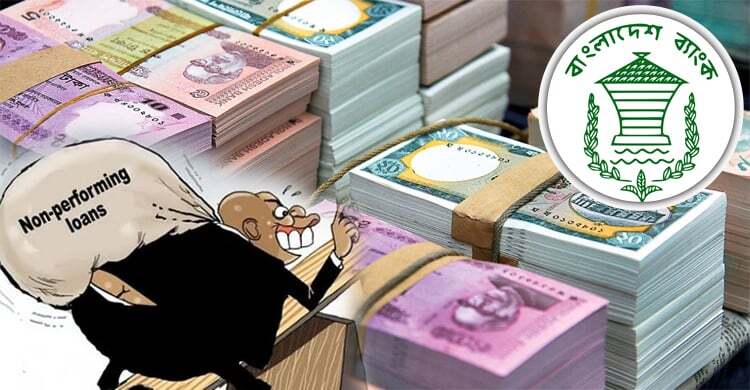
Bangladesh’s banking sector is facing its gravest crisis in decades. What was once a simmering problem of bad debt has, in recent years, exploded into an economic emergency.
Defaulted loans, known as non-performing loans (NPLs), have ballooned by more than Tk 4 lakh crore in just five years.
Economists now warn that this unchecked surge threatens not only the financial system but the very stability of the wider economy.
For years, politically connected borrowers, powerful conglomerates, and shell institutions have thrived by taking out massive loans with little intention of repayment.
The result is a banking system that increasingly resembles a leaking vessel – ordinary depositors pour in their savings, only to see funds siphoned off into the pockets of defaulters.
“Defaulted loans have become like a thorn in the throat,” lamented one senior banker. “You cannot swallow, you cannot spit out.”
A sharp rise in defaults
The numbers are staggering. At the end of June 2025, total defaulted loans stood at Tk 5,30,428 crore—more than a quarter of all outstanding credit in the country’s banking sector. Just five years earlier, in December 2021, the figure was Tk 1,03,274 crore. In other words, defaults have multiplied more than fivefold in barely half a decade.
The year-by-year figures tell the story of a system in freefall. In December 2021, defaulted loans stood at Tk 1,03,274 crore, or 7.93 per cent of total loans. By December 2022, the amount had inched up to Tk 1,20,656 crore (8.16 per cent), rising further to Tk 1,45,633 crore (9 per cent) in December 2023. The pace then accelerated sharply, with defaults soaring to Tk 3,45,765 crore, or 20.2 per cent, by December 2024. Just six months later, in June 2025, the figure had rocketed to Tk 5,30,428 crore, representing 27.09 per cent of all loans in the banking sector.
The steepest escalation came between 2023 and 2025, when defaults quadrupled within just two and a half years.
How the problem grew
Economists and Bangladesh Bank insiders argue that the explosion in non-performing loans is less a technical accident than a product of entrenched corruption and political capture.
Loans were routinely handed out to fake or nameless institutions with little or no scrutiny, while political patronage ensured that powerful borrowers could access credit under the shield of ruling party influence.
Defaulters exploited rescheduling loopholes to indefinitely roll over their debts, and large business groups siphoned vast sums abroad through money laundering.
To make matters worse, the Awami League government extended selective benefits and protection to favoured entities, embedding a culture of impunity that allowed willful default to flourish unchecked.
Particular concern has been raised about several Shariah-based banks, including Islami Bank, First Security Islami Bank, Global Islami Bank, Union Bank and Social Islami Bank, where defaults have risen alarmingly.
Hidden defaulters and court shields
Even the official figures understate the problem. A Bangladesh Bank report this year revealed that another Tk 1,63,000 crore is tied up in loans that technically cannot be declared as defaults due to court injunctions. Over 27,000 loans, held by just 1,086 borrowers, are being shown as “regular” despite being unrecoverable.
If these hidden defaults are factored in, the true scale rises to nearly Tk 6,93,577 crore – about 39 per cent of all bank loans. In plain terms, almost two out of every five takas lent by banks may never be recovered.
“The real picture of defaulted loans was not being sent to Bangladesh Bank before,” admitted Arif Hossain Khan, Executive Director and spokesperson of the central bank. “Now, with stronger monitoring, the correct figures are surfacing. Work is also under way to retrieve assets laundered abroad, including through international legal channels.”
A fragile future
The implications for Bangladesh’s economy are dire. Non-performing loans erode banks’ capital bases, forcing them to set aside higher provisions. This in turn reduces their appetite for lending to businesses, stifling private investment.
“The financial capacity of banks will be threatened by the provision deficit,” warned economist M Helal Ahmed Johnny, research fellow at Change Initiative. “If banks hesitate to lend, investment will shrink and liquidity pressures will cascade through the entire economy. Ultimately, depositors will lose trust in the system.”
Loss of confidence is perhaps the gravest danger. A banking sector lives and dies on trust – once savers begin to doubt that their deposits are safe, panic withdrawals can quickly spiral into a systemic collapse.
The challenge of recovering laundered money
Part of the problem is that much of the defaulted money has already left Bangladesh. Bangladesh Bank has hired international lawyers to track and recover laundered assets. But experts caution that this is a daunting task.
Former World Bank Chief Economist Dr Zahid Hossain is blunt: “If the host government cooperates, recovery is possible. Otherwise, it is almost impossible. Still, even symbolic actions such as seizing domestic assets of launderers could send a strong deterrent message.”
Policy paralysis and political influence
Underlying the crisis is a chronic failure of governance. For decades, successive governments have tolerated, and at times encouraged, the culture of willful default. Politically connected borrowers were routinely granted rescheduling facilities or shielded by court orders.
Loan classification rules were bent and statistics massaged to understate the extent of defaults. This culture of impunity has entrenched the perception that default is not a shame but a strategy. In some cases, large conglomerates have reportedly built entire empires on borrowed money they never intended to repay.
What needs to change
Economists are nearly unanimous on the remedies – though less confident about political will. The key measures include: Strict enforcement of bankruptcy laws to ensure that defaulters cannot indefinitely avoid accountability. Curtailing rescheduling loopholes, which allow bad borrowers to stay afloat on paper. Strengthening Bangladesh Bank’s independence, insulating the regulator from political interference. Boosting international cooperation to pursue laundered assets and choke off illicit channels. And, restoring a culture of repayment, making clear that default carries consequences.
As Dr Zahid Hossain notes, “Bangladesh Bank must be allowed to act independently, free from the influence of the government and powerful groups. Otherwise, the same cycle will repeat endlessly.”
A crisis that cannot be ignored
The Tk 4 lakh crore surge in defaults over five years is not simply an accounting problem – it is the most visible symptom of deep-rooted dysfunction in Bangladesh’s financial system. Left unchecked, it could undermine the country’s hard-won growth gains and trigger a crisis of confidence that spreads far beyond the banks.
For now, the thorn in the throat remains lodged. Whether the interim government and central bank can finally dislodge it, or whether the problem festers into full-blown disaster, will determine the future health of Bangladesh’s economy.