
Bangladesh seeks OIC’s tech backing to boost halal certification industry

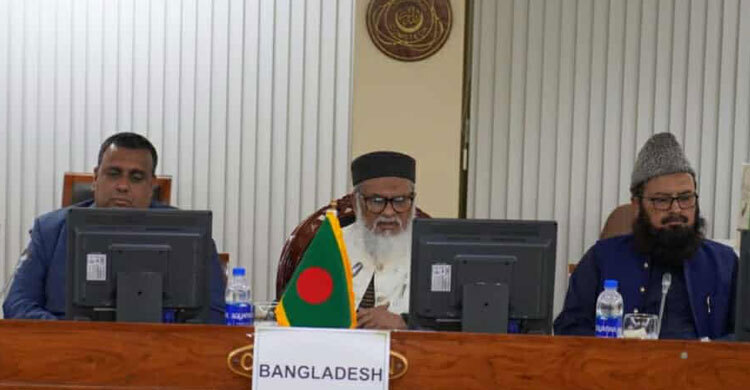
In a strategic move to strengthen Bangladesh’s position in the global halal economy, Religious Affairs Adviser Dr AFM Khalid has formally requested technical and institutional support from the Organisation of Islamic Cooperation (OIC) to enhance the country’s halal certification capabilities, a critical gateway to the $2.3 trillion global halal market.
Dr Khalid made the appeal during a high-level engagement with OIC officials on Thursday at the Standing Committee on Scientific and Technological Cooperation (COMSTECH) Centre in Islamabad, Pakistan.
The visit underscores Bangladesh’s ambition to professionalise and standardise its halal ecosystem, from food and pharmaceuticals to cosmetics and logistics, with international credibility.
“Bangladesh is committed to building a robust, globally recognised halal certification framework,” Dr Khalid told OIC officials. “While we’re already receiving valuable cooperation from Turkey and Saudi Arabia, we now seek OIC’s structured technical assistance to train our officials, harmonise standards, and scale capacity.”
The adviser also voiced Bangladesh’s support for the proposed establishment of a Halal Institute in Uganda under OIC guidance, a move that signals Dhaka’s intent to play a leadership role in expanding halal infrastructure across the Muslim world.
Halal as economic catalyst
Though often framed as a religious compliance mechanism, halal certification is increasingly viewed by policymakers as a trade enabler and export accelerator. With Muslim consumers demanding traceability and authenticity, Bangladesh, home to 170 million Muslims and a growing agro-processing sector, sees halal certification as a non-tariff passport to markets in the Middle East, Southeast Asia, and beyond.
Dr Khalid’s outreach comes as Bangladesh’s Islamic Foundation ramps up its certification operations, but industry insiders say the system still lacks international accreditation, digital traceability, and skilled manpower — gaps the OIC partnership aims to fill.
Beyond certification: Scholarships, skills & ummah unity
The adviser also thanked the OIC for awarding 100 scholarships to Bangladeshi students at Lahore University, a programme he hopes will be expanded to include madrasa graduates with deep grounding in Quran and Hadith. “These students can become future halal auditors, bioethicists, and Sharia-compliant product developers bridging faith and industry in medicine, engineering, and technology,” he said.
In his remarks, Dr Khalid tied economic collaboration to broader Islamic solidarity: “Our advancement in science, AI, climate resilience, and poverty reduction depends on unity under the banner of the Ummah, as directed by the Quran and Hadith. Disunity is our greatest barrier to progress.”
Accompanying him were Bangladesh’s High Commissioner to Pakistan, Md Iqbal Hossain Khan; Private Secretary Sadek Ahmed; and Counselor (Press) Mohammad Taiyeb Ali.
What’s next?
Industry watchers say OIC’s involvement could fast-track Bangladesh’s halal infrastructure potentially leading to mutual recognition agreements with major halal markets, training academies, and even a national Halal Authority.
With global halal trade projected to hit $3 trillion by 2027, Bangladesh’s timely push could position it not just as a consumer, but as a certifier, exporter, and thought leader in the Islamic economy.
As Dr Khalid put it: “This isn’t just about labels on food packets. It’s about sovereignty, standards, and strategic economic positioning.”