
Seven years, no train: Sirajganj-Bogura rail link still just on paper

Published: 17 September 2025, 04:32 PM
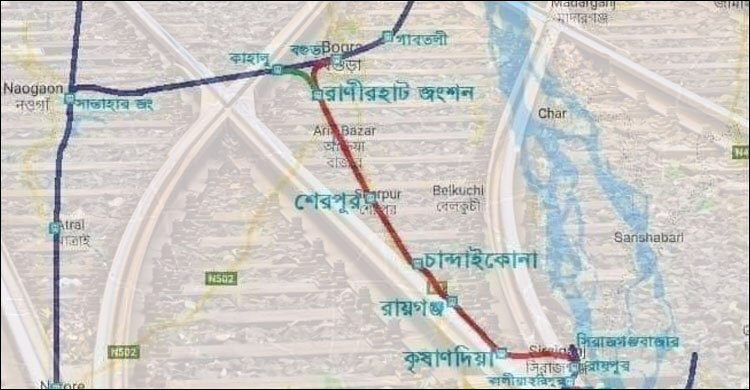
What was meant to be a transformative rail corridor linking North Bengal to Dhaka in just five hours, slashing 130 km off the journey and saving four hours, has instead become a seven-year saga of bureaucratic delays, financing failures, and missed opportunities.
Approved by the Executive Committee of the National Economic Council (ECNEC) on October 30, 2018, the Sirajganj-Bogura Railway Project, envisioned as a game-changer for regional connectivity and economic integration, has seen less than 1% financial progress to date.
Originally slated for completion in four years under a $379 million Indian Line of Credit (LoC), the project was plagued by cost overruns (ballooning to $679 million), repeated deadline extensions, and finally, complete cancellation of Indian funding.
Now, the interim government and Bangladesh Railway are scrambling to secure alternative financing, with the Asian Infrastructure Investment Bank (AIIB) emerging as the most serious contender, offering “special priority” status to the stalled mega-project.
Why this project matters: More than just a rail line
This is not just about trains, it is about economic lifelines.
• Eight districts of North Bengal including Sirajganj, Bogura, Natore, Pabna, and Rajshahi stand to benefit directly.
• The route will serve as a “socio-economic corridor”, boosting agriculture, trade, tourism, and labour mobility.
• More than 50 daily trains could run if built as a double track doubling capacity and slashing wait times.
• Travel time from Bogura to Dhaka would drop from 9+ hours to just five hours.
• Fares would remain low, making it accessible to millions.
“This is not a luxury. It’s infrastructure justice for North Bengal,” says an official from the Railway Planning Department, speaking anonymously. “We’ve been ignored for decades. This line changes everything.”
The double-line debate: Economy vs politics
From day one, railway engineers and regional stakeholders demanded the project be built as a double-track line not dual-gauge, as initially pushed by political leadership under pressure from India.
Why? Because:
Double track = 2x train frequency → higher revenue, better service
Costs 25% less than the current dual-gauge plan (Tk 9,100 crore)
Future-proof — avoids costly retrofitting later
Matches Jamuna Bridge capacity — already double-tracked
“Dual-gauge was a political compromise. Double-track is an economic necessity,” says Additional Director General (Operations) Nazmul Islam. “If we want railways to earn, we must build for volume, not symbolism.”
Land acquired, financing pending
In a rare bright spot, Tk 1,900 crore was allocated in June 2024 for land acquisition and it is being done according to double-track specifications.
Project Director Engineer Monirul Islam Firozi confirms: “Land acquisition is nearly complete. We’re technically ready. The moment financing is confirmed, we move to tender.”
The project scope is massive:
• 95.6 km main line + 37.49 km loops & yards
• Two major river bridges (Karatoa, Ichhamati)
• 25 minor bridges, 91 culverts, one rail flyover, one road overpass
• Eight new stations — Sirajganj Junction, Krishnadia, Raiganj, Chandaikona, Chonka, Sherpur, Aria Bazar, Ranirhat
• Computerised signalling at 11 stations
India withdraws, AIIB steps in
India’s LoC funding, once seen as a symbol of regional cooperation, never materialised. “No disbursement in six years,” admits a senior railway official. Despite formal requests for additional loans, India “did not give a proper answer.”
Enter AIIB, which has signalled strong interest in financing the project under revised, cost-efficient double-track parameters. Other multilateral and bilateral financiers are also reportedly in talks.
What’s at stake?
Delaying this project is not just inefficient, it is economically suicidal.
• Lost productivity: Hours wasted in transit = lost income for workers, farmers, traders
• Missed trade potential: No efficient link between Dhaka and North Bengal’s agro-processing hubs
• Railway revenue stagnation: Without double-tracking, train frequency — and ticket sales — remain capped
• Regional disparity: North Bengal continues to lag behind central and southern zones
Bottom line
The Sirajganj-Bogura railway is more than steel and sleepers, it is a promise to 30 million people. A promise of faster travel, cheaper freight, better jobs, and inclusion in the national economy.
Seven years of delays are enough. With land ready and AIIB at the table, Bangladesh must act decisively, transparently, and without political interference.
The double-track dream is alive. Now, it’s time to lay the first rail.