
Teachers collapse on hunger strike, bureaucrats stay unmoved

Under the shadow of the Central Shaheed Minar, the sound of slogans is growing weaker — not because the demands have softened, but because the teachers’ voices are fading.
For a week, MPO-affiliated teachers of private educational institutions have been on the streets.
After days of sit-ins and marches, they have now resorted to a hunger strike, demanding what they call their “right to survive” — a 20 per cent house rent allowance.
But as their bodies weaken under the autumn sun, the bureaucratic heart of power remains cold.
The hunger strike began at 2 pm on Friday, October 17.
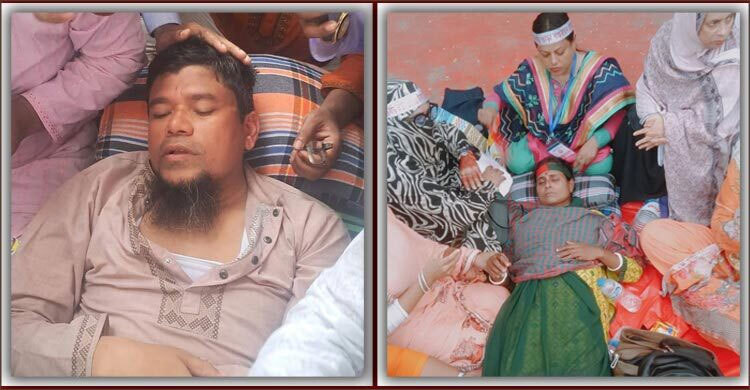
As of Saturday evening, nearly 27 hours later, many teachers have already collapsed. Among them is Principal Delwar Hossain Azizi, a key leader of the movement, and Jharna Gain, a schoolteacher from Barisal’s Wazirpur. Both fell unconscious during the protest. Jharna, still frail and unable to stand, is receiving treatment near the protest site.
At least five teachers and a journalist covering the protest have fallen ill from heat and hunger. “Teachers are dying on the streets,” Azizi said, his voice hoarse from fasting. “But the bureaucrats are not losing their calm — as if our suffering amuses them. We asked only for 20 percent. Even when we said, give 10 percent now and the rest in the next budget, their hearts didn’t melt. Who sealed their humanity?”
Negotiation turns into indifference
After several rounds of talks, the Education Ministry forwarded the teachers’ proposal to the Finance Ministry. But the response came as a bitter blow — only 5 percent or a minimum of Tk 2,000.
“More than this is impossible for the government right now,” said an official of the Finance Ministry, speaking on condition of anonymity. “The education advisor is still trying, but the Finance Ministry won’t go beyond that figure.”
Behind closed doors, officials remain composed and methodical. But outside, teachers — many of them middle-aged women — lie under makeshift tents, fanning each other as paramedics move in and out. One teacher murmurs, “We taught the children of these bureaucrats. Today, they can’t even hear our plea.”
From classrooms to pavement
On October 5, World Teachers’ Day, a Finance Ministry circular raised teachers’ rent allowance by just Tk 500. The symbolic increase enraged educators nationwide. By October 12, they had gathered in front of the National Press Club, only to be met with police batons and barricades. By afternoon, they regrouped at the Central Shaheed Minar — the symbolic heart of national protest — and vowed not to leave until justice was served.
Since October 13, about 30,000 MPO-affiliated schools, colleges, madrasas, and technical institutions have remained under an indefinite strike. No classes, no exams — a quiet crisis spreading across Bangladesh’s education system.
As night falls over Dhaka, the teachers’ tent glows faintly under streetlights. The air smells of sweat, saline, and protest. From the Shaheed Minar steps, a weak voice rises once more: “We’re teachers, not beggars. But how long can one teach on an empty stomach?”