
63% quota in govt school admission draws objections

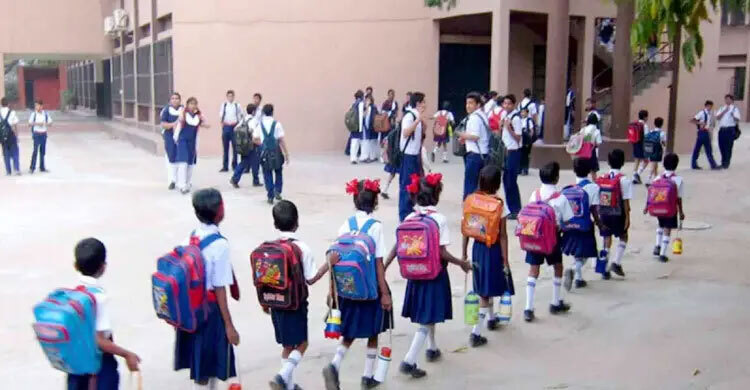
The admission of students to government schools will once again take place through a lottery system this year. As the lottery process is inherently uncertain, students and parents often worry about securing a place in a good school. Although the lottery system is intended to reduce unhealthy competition, students and guardians have raised objections to the inclusion of various quotas.
According to the admission policy published on Thursday, the 63 per cent quota system will be followed again this year. Of this, 40 per cent has been allocated under the catchment area quota. Many parents, especially those living temporarily in Dhaka for work, have expressed dissatisfaction with this quota and are calling for its removal.
Officials from the Ministry of Education and the Directorate of Secondary and Higher Education (DSHE) argue that the catchment area quota helps avoid chaos and public inconvenience. It allows children to attend schools in their surrounding neighborhoods. They also claim that the remaining quotas are limited in number.
The newly published admission policy specifies that 40 per cent of the total vacant seats will be reserved under the catchment area quota. This quota is meant for children residing in areas surrounding the school. To secure admission under this quota, guardians must obtain a verification certificate from the local ward councilor's office. For many tenants, obtaining this certificate can be a significant challenge.
Fahmidul Haque, a resident of a rented house in Malibagh, Dhaka, tried to enroll his child in a preferred school through the lottery last year but was unsuccessful. He plans to apply again this year and said he faced difficulties last year due to the catchment area quota.
Speaking to Jago News, he said, “Many people commit fraud under this quota. Despite living in different areas, they choose a more favorable catchment area when applying online. If their children are selected in the lottery, they then obtain the verification certificate by paying a large amount of money. This is a kind of fraud.”
According to the admission policy, the remaining 23 per cent of seats are reserved as follows: 5 per cent for children of freedom fighters, 1 per cent for children of officials and employees of the Ministry of Education and its subordinate offices and agencies, 10 per cent for former students of government primary schools, 2 per cent for students with special needs, and 5 per cent for twins and siblings of currently enrolled students.
Additionally, for admission to class six, 10 per cent of seats are reserved for students who have passed class five from government primary schools.
Beyond the official guidelines, an unwritten quota also exists: 5 per cent of seats are reserved for children of government officials and employees who have been transferred from distant locations. Children of teachers and employees of government high schools also receive quota benefits in those institutions.
A DSHE secondary division official, speaking on condition of anonymity, told Jago News that although he is an officer of the education cadre, he personally believes the quota for children of officials of the Ministry of Education and its subordinate bodies is unnecessary, even though it is small in proportion. He added that there have been many discussions about the catchment area quota and that evidence of fraud exists. “If the rules are followed strictly, the negative aspects of this quota can be eliminated,” he said.
When contacted, DSHE Director General (Additional Charge) B M Abdul Hannan told Jago News that the admission policy was finalised in a meeting of the Secondary and Higher Education Division of the Ministry of Education. “This year’s admissions will be conducted according to the policy through a lottery system. If there are objections now or in the future, the ministry will address them through discussion,” he said.