
Hulhulia: The village that healed itself and became Bangladesh’s quietest revolution

Published: 19 November 2025, 09:39 PM
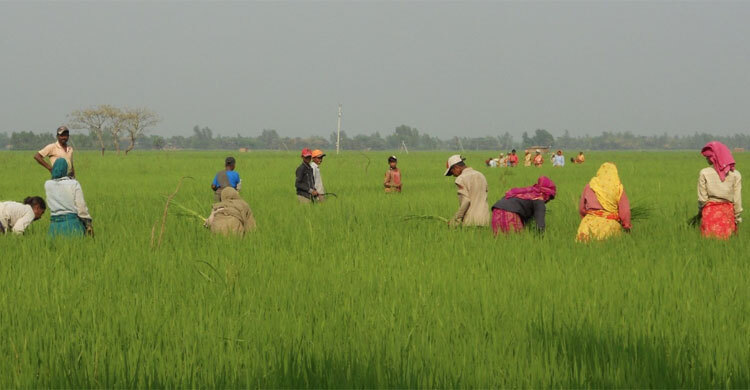
On a mist-filled winter morning in northern Bangladesh, when the sun rises slowly through the fog of Chalanbil, casting soft gold across fields of paddy, the village wakes with a peculiar calm – a kind of silence that feels deliberate, almost earned. The sounds that follow – children hurrying to school, cows being led to pasture, the rhythmic thud of rice being sifted – tell only part of the story.
It’s a village where every child goes to school, where no girl is married off early, and where no citizen has filed a lawsuit in a hundred years. A place where people resolve disputes not through the police or courts, but through mutual respect, shared responsibility, and century-old commitments written into a community-made constitution.
Welcome to Hulhulia, the small, serene settlement in Chougram Union under Singra of Natore, which has quietly become one of the most extraordinary models of self-governance and social harmony in the country.
What they don’t tell is that this unassuming village carries within it one of the most remarkable social experiments in the country.
A century-long effort in collective discipline.
A determined pursuit of education.
And a quiet, persistent belief that a village can fix itself – without waiting for anyone else.
Most visitors come to Hulhulia expecting a typical rural settlement. They leave grappling with a simple question: How did this small village achieve what entire administrations struggle to do?
A century ago, the water rose, but the people rose higher
Every extraordinary story begins with a moment of breaking.
For Hulhulia, that moment came around 1914 or 1915, when the wetlands of Chalanbil overflowed, punishing Hulhulia with one of the worst floods in its memory. Aman crops were wiped out. Seed stores washed away. Farmers watched their fields turn to wasteland. Hunger crept into every home, and many families considered leaving everything behind.
Instead of giving up, the village’s headman, Masir Uddin Mridha, did something radical.
He gathered one representative from every household and made a simple plea: “Those who have even a handful of rice must give to those who have none.”
“Give,” Masir Uddin said, “because if one house falls, soon all houses fall.”
There were no records kept, no debts created, no conditions attached. No one expected anything back.
Just trust. Humanity. And the belief that a village survives only when its people stand together.
That moment became Hulhulia’s turning point.
Fields were replanted. Families regained strength.
A culture of compassion took root—one that still defines the village today.
Elders still speak of that moment in hushed tones.
“That flood,” says 82-year-old Fazlur Rahman, “made us understand something: our survival depends on each other.”
From that shared suffering grew something deep – an instinct for unity so strong that it would eventually shape every institution the village built.
A charter long before the country had one
In 1940 – long before Bangladesh was born or Indian sub-continent got divided – Hulhulia did something astonishing.
It wrote its own charter.
Masir Uddin formalised what the village had learned since the flood: disputes must not be allowed to divide people, education must be universal, leaders must be accountable, and justice must be swift and fair.
The Hulhulia Samajik Unnayan Parishad (Social Development Council) was created with 23 representatives drawn from across the village.
To this day, it handles almost every conflict that arises – whether land disputes, marital disagreements, inheritance issues, or neighbourhood quarrels.
The result?
Not a single lawsuit from Hulhulia has gone to state courts in a hundred years.
Police rarely step foot inside the village.
Court fees are non-existent.
Feuds don’t fester.
“We solve our problems before they grow,” says current Council chairman Aminul Haque Mandal. “And whatever the Council decides – people accept.”
One could call it hyperlocal democracy.
One could call it wisdom.
Hulhulia simply calls it survival.
Where a mosque unites, not divides
Many Bangladeshi villages have multiple mosques – symbols of religious devotion but often also of factional identity.
Hulhulia refused that path.
“One mosque is enough,” the founders decided. “And one graveyard.”
The logic was simple: why give people a reason to split?
Even today, residents speak with pride: “We pray together. We bury together. We live as one family.”
In a country where fractures often run along political, religious, or social lines, Hulhulia’s insistence on singularity feels quietly radical.
When education became a rule, not a choice
Perhaps the village’s greatest triumph lies in education.
Here, every child must finish at least SSC.
Not a single resident is illiterate.
Families who cannot afford school fees receive help from the village’s Poor Fund Committee –financed by contributions from wealthier households and successful alumni.
“It’s not charity,” says retired teacher Selina Yasmin.
“It’s an investment. When that child grows up, they help another child.”
The results are astonishing:
Over 200 engineers
More than 100 MBBS doctors
17 university professors
11 judges
Hundreds more in government service, the military, banking, IT, and research
Hulhulia’s most celebrated son, Mohammad Hanif Uddin Mia, the country’s first computer programmer and former chairman of the Bangladesh Atomic Energy Commission, is honoured on a national postage stamp. But villagers will tell you he is “only one of many.”
Perhaps the most touching detail: Graduation ceremonies here aren’t just for individuals – they’re for the whole village.
When a student earns a degree, neighbours visit with sweets, elders bless them, and the Council publicly acknowledges the achievement, reminding young children: “This is your future too.”
Clubs, committees, and a culture of care
Walk through Hulhulia, and you’ll find a web of community-led organisations:
The Hulhulia Diamond Club, established in 1942
The Pramanik Club
Service groups like Shekar and Batabriksha
They fund scholarships, run charity drives, organise training, and coordinate cultural events.
There is no hierarchy – every club plays a role.
“Other villages compete,” says a Diamond Club member. “We cooperate.”
The effect is visible everywhere: Children confidently reciting lessons, elderly women receiving support, farmers sharing machinery, and young engineers returning home on weekends to mentor schoolchildren.
A digital hub in a rural heartland
In 2016, a government-funded Digital Hub worth Tk 2.76 crore rose in the village centre.
It looks more like a small campus than a rural facility: Computer labs, digital ECG facilities, multimedia classrooms, and training rooms.
Students take computer lessons.
Farmers access agricultural databases.
Villagers receive online services without traveling to the upazila headquarters.
Hulhulia even maintains its own website – updated by local youth.
The hub didn’t modernise the village.
It simply provided tools for a community that already knew how to organize itself.
The police admire, the administration applauds
Ask the authorities what they think of Hulhulia, and they’ll smile.
“The villagers barely need us,” says Singra Police Station OC Mominuzzaman. “They solve everything with fairness.”
Upazila Nirbahi Officer Mazharul Islam calls it “a model of social harmony” and “a remarkable lesson in community governance.”
What makes Hulhulia different?
It is tempting to view Hulhulia as an anomaly.
But the village offers something more important: a blueprint.
Its success rests on three simple pillars:
1. Collective Responsibility
The belief that no problem belongs to one family alone.
2. Consensus-Based Justice
A system that prioritizes restoration over punishment.
3. Education as Destiny
A non-negotiable commitment to literacy and opportunity.
These ideas are simple.
Their results are extraordinary.
The village that refused to break
When the great flood came a century ago, Hulhulia could have disappeared – another rural tragedy swallowed by the waters of Chalanbil.
Instead, its people chose each other.
They rebuilt, not with money, but with trust.
They educated their children as if the future depended on them.
They wrote their own rules when none existed.
They stayed united when the world around them fractured.
This is not just a story about a village.
It is a story about what a community can become when it decides that division is not an option.
Hulhulia is not wealthy.
It is not famous.
It does not seek attention.
But it stands quietly as one of Bangladesh’s most extraordinary success stories – proof that progress does not always come from cities, ministries, or foreign donors.
Sometimes, it begins in a small village where people refuse to let each other fall.