
Music heals! When was the last time you sang like no one was listening?

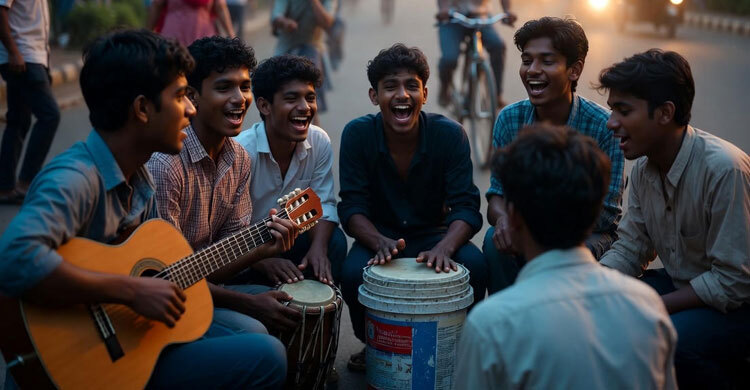
Late into a Dhaka evening, when the heat finally breaks and the city exhales, you’ll hear them first: a ragged circle of boys under a banyan tree in Dhanmondi, or on the cracked pavement outside North End Coffee in Gulshan, guitars slung low, one battered dholak keeping time. They’re singing old Aurthohin riffs, a bit of Lalon, maybe a banged-up version of “Paranoid” that somehow still works.
Passers-by slow down, phones come out, someone tosses a fifty-taka note into an upturned cap. Most of us smile, record thirty seconds for Instagram Stories, and keep walking.
We’re missing the point.
Those boys – sweaty, half-shy, voices cracking on the high notes – aren’t just performing. They’re running the cheapest, most powerful health clinic Dhaka has ever seen. And entry is free if you’re willing to open your mouth and join in.
Because while we chase protein shakes and morning runs around Hatirjheel, science has been quietly proving that group singing, the messier the better, does things to a human body and brain that no supplement bottle can touch.
Your lungs, choking on brick-dust and bus fumes all day, suddenly remember how to breathe properly. “Singing is a physical activity and may have some parallel benefits to exercise,” says Adam Lewis, associate professor of respiratory physiotherapy at the University of Southampton. His studies found that a proper singing session hits the same cardio zone as a brisk 30-minute walk – except you’re standing still, laughing between verses, and no one’s trying to sell you activewear.
Your immune system throws a party. Saliva tests on choir members (and yes, those street circles count) show protective antibodies shooting up and stress hormones crashing down, all because the vagus nerve gets massaged every time you hold a long note.
Your brain rewires itself on the spot. Neurologists watch entire networks light up like Shakrain fireworks – language, emotion, memory, movement – all talking to each other at once. Stroke patients who can’t remember their grandchildren’s names suddenly belt out the chorus of “Bhromar Koiyo Giya”. Parkinson’s voices stop trembling for the length of a song. Dementia wards hush when someone starts an old Hemanta Mukherjee tune, because melody lives deeper than words.
“It suddenly brings an equality into the room,” says Alex Street from the Cambridge Institute for Music Therapy Research, who has watched caregivers and patients, rich and poor, doctor and sweeper, all reduced to the same beautiful incompetence in front of a single chord. “Caregivers are no longer caregivers… everyone is just singing the same song in the same way. There isn’t really much else that does that.”
Keir Philip, the Imperial College London respiratory specialist who turned opera warm-ups into medicine for breathless long-Covid patients, says it simply: “Some singing-based approaches help… the rhythm and the depth of breathing, which can improve symptoms.” Six weeks of those exercises and people who couldn’t cross a room were walking to the bazaar again.
Pain fades. Endorphins flood. Loneliness – that quiet killer that creeps into too many Dhaka flats after maghrib – evaporates the moment thirty strangers decide the next chorus is worth shouting together.
We Bangladeshis have never needed permission to do this.
Our grandfathers sang Baul under mango trees. Our mothers still hum Lalon while cooking. 1971 didn’t march on speeches alone; it marched on songs that made strangers feel like brothers. The haors, the tea gardens, the rivers – all of them carry melodies older than the country itself.
Enter Teppo Särkämö, professor of neuropsychology at the University of Helsinki, who’s mapped how singing staves off cognitive fog. His senior choir studies show participants acing memory tests, reporting fewer mental slips, and syncing brainwaves for sharper auditory processing. “There is a gradually growing evidence base for the cognitive benefits of singing in older adults,” Särkämö says.
But he’s clear-eyed: “We still know little though about the potential of singing to actually slow or prevent cognitive decline as this would require large-scale studies with years of follow-up.” In early dementia, though, it’s a star: “Especially stimulating and engaging activities, such as singing, seem to be very promising for maintaining memory functioning in the early stages of dementia.”
Yet somewhere between school assemblies and adult embarrassment we decided our voices weren’t good enough.
Next time you spot those boys under the streetlight – guitars out of tune, drummer using an empty paint bucket, lead singer blushing every time he forgets a line – don’t just film them.
Walk over. Ask what they’re playing. When they shrug and say “Bas, gaibo?” – sing.
Your voice will probably crack. Someone will laugh. It will be perfect.
Because in that circle, under the sodium glow and the smell of frying singara, something ancient switches back on. Hearts sync. Breathing falls into the same rhythm. For three minutes the city isn’t divided by class, postcode, or politics.
Just voices. Just humans.
And every single one of them leaves healthier than they arrived.
Music heals. Dhaka already knew. We just forgot to join in.
Source: BBC