
Inside Hyderabad House: Where a £170 million palace, a diamond paperweight, and Vladimir Putin collide

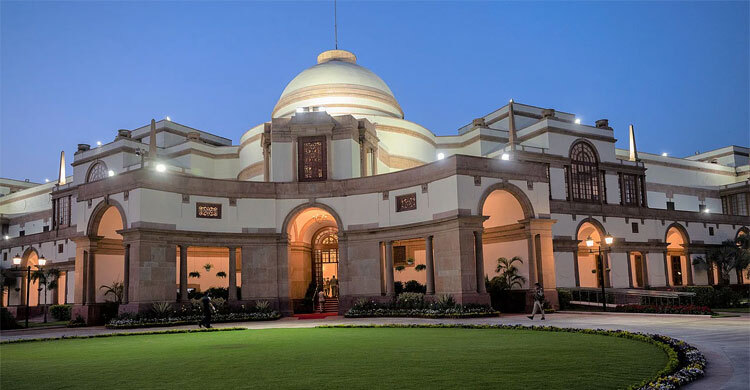
If palaces could gossip, Hyderabad House would never sleep.
Tonight, under Delhi’s hazy winter sky, its sandstone dome glows like a lantern lit for emperors. Motorcades roll in. Security men speak into their cuffs. Somewhere inside, Vladimir Putin is sipping chai from a gold-rimmed cup, as if this were just another Thursday.
But nothing about Hyderabad House is “just another” anything.
This is the palace that history forgot to make a movie about — built by the richest man on Earth, abandoned by an empire, ignored by generations, resurrected by diplomats, and now host to the world’s most powerful people.
Pull up a chair. This story has everything: ridiculous wealth, architectural revenge, lost diamonds, royal drama, and the most extravagant real-estate flex India has ever seen.
The man who could buy the British empire and still have change
Before Dubai existed, before Musk launched rockets, before Bezos plotted Mars, there was Mir Osman Ali Khan, the Seventh and Last Nizam of Hyderabad.
In the 1930s, he wasn’t just rich – he was absurdly, cosmically, history-bendingly rich.
Time magazine put him on its cover in 1937 and simply declared him:
“The Richest Man in the World.”
His numbers sound made up, but they’re not:
• $230 billion in today’s money
• 97% of Hyderabad State under his personal control
• Diamond mines that spat out legends
• Pearls collected by the tonne
• Mansions by the dozen
• A 175-foot dining table to seat 101 guests
• But he ate alone, at one end, listening to the day’s news read aloud
And because he lived in a world where reality bent toward his whims, when the British invited Indian princes to build houses in their shiny new capital, the Nizam didn’t come to participate.
He came to dominate.
He wanted the plot right next to the Viceroy’s House – the most powerful address in the empire. A location so prestigious it would make the British wake up clutching their pearls.
The British said: “Er… perhaps something a little farther away, Your Exalted Highness.”
The Nizam said: “Fine. But I’m still going to build something that will make your Viceroy jealous.”
He meant it.
“Make it big enough that he notices”
Enter Sir Edwin Lutyens, the man designing the Viceroy’s own palace (now Rashtrapati Bhavan).
The Nizam hired him with the kind of brief only ultra-rich monarchs dare to give: Make it magnificent. Make it enormous. And make it absolutely impossible to ignore.
Lutyens, delighted by the sheer drama of the assignment, dug out one of his rarest architectural concepts – the “butterfly plan” – and then took it to the gym until it was enormous.
Over the next few years, an 8.2-acre wonder rose from the Delhi dust:
• A grand dome soaring nearly 90 feet
• Thirty-six palatial rooms
• Corridors and staircases wide enough for elephants
• Pink Jaipur stone wings unfurling like a butterfly mid-flight
• Marble floors so perfectly patterned they seem to ripple like water
• A ballroom ceiling painted in real gold
• And a zenana (ladies’ wing) so strange it left the British speechless
One Viceroy wrote home: “Tiny cells with one window and a tap that pours either boiling or freezing water directly onto the occupant. I cannot imagine a less comfortable existence.”
And yet the Nizam’s wives lived in those cells. Dozens of them. Along with hundreds of concubines.
Hyderabad House was less a home and more a statement – a whispered insult wrapped in marble: “Look what I can build when I feel like annoying an empire.”
The diamond in the window
Hyderabad House’s most outrageous story didn’t happen during a banquet or a ball.
It happened one sleepy afternoon in the 1930s, when an Australian mining engineer wandered through the accounts office. There, propping open a window, was a dull grey stone the size of a fist.
He picked it up.
“How much is this paperweight?” he asked.
The accountant shrugged.
“Oh, that? It’s some diamond His Exalted Highness uses when the breeze is strong.”
The engineer nearly fainted.
It was the Jacob Diamond – 184 carats of pure brilliance, worth £50 million then, around £3 billion today.
A window stopper.
In a dusty office.
Because the breeze was strong.
This was the Nizam’s world.
The silent palace
After India’s independence – and the dramatic annexation of Hyderabad in 1948 – the Nizam visited the house only once more.
Hyderabad House went quiet.
The ballroom darkened.
The courtyards emptied.
The taps in the zenana stopped steaming and freezing water.
Shadows gathered under arches that once glittered with diamonds.
For decades, it stood like a forgotten monument to a forgotten era.
Until someone in the Ministry of External Affairs had the most brilliant real-estate idea in New Delhi:
“Why are we booking hotels for world leaders when we have THIS lying around?”
And just like that, Hyderabad House returned to life.
Enter the power players
The palace became India’s ultimate stage for diplomacy.
• Bill Clinton tasted vegetarian banquets here
• George W Bush asked if the dome was real gold
• Barack Obama stood transfixed by the marble floor illusion
• Angela Merkel, Xi Jinping, Macron, and countless others joined the guest list
And today – Vladimir Putin walks its echoing halls, sits under its golden chandeliers, and eats from plates finer than anything in the Kremlin.
A palace built out of royal pride is now the room where the world negotiates, argues, shakes hands, signs deals, and quietly gossips about geopolitics.
If walls could roll their eyes, Hyderabad House would do it constantly.
The Nizam still smirks
And so here we are.
A palace born from a billionaire’s bruised ego.
A diamond used as a doorstop.
A ladies’ wing fit for a dystopian novel.
A forgotten building resurrected as a global stage.
Tonight, as Putin raises a cup of tea beneath that towering dome, history loops back on itself.
Because although Mir Osman Ali Khan has been gone for decades, it’s impossible not to imagine his spirit drifting through the marble corridors, twirling a pearl the size of a golf ball and smirking: “Still got it.”
Hyderabad House isn’t just a building.
It’s a ghost story, a flex, a joke, a treasure chest, a warning, and a piece of living history.
And it remains – as it always was – the strangest, richest, most unforgettable house in Delhi.