
Israel begins intercepting Global Sumud Flotilla as convoy nears Gaza

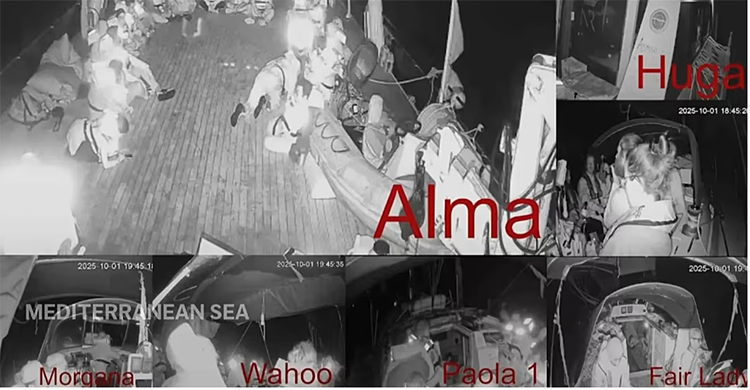
The Israeli navy has begun intercepting vessels from the Global Sumud Flotilla, activists and news agencies report, as the convoy of more than 40 civilian boats pressed closer to the Gaza coast to deliver humanitarian aid and challenge Israel’s naval blockade.
Organisers say at least two ships — the Alma and the Sirius — have been approached or boarded and that several live camera feeds from the flotilla have gone offline, reports Al Jazeera.
A statement from the Global Sumud Flotilla said its “vessels are being illegally intercepted,” adding that cameras had been disabled and that military personnel were on board some boats as organisers worked to confirm the safety and status of participants.
The Israeli Foreign Ministry has released a video purportedly showing an Israeli navy officer telling the flotilla to change its course to the Israeli port of Ashdod “where the aid will undergo a security inspection” before being transferred to Gaza.
The Global Sumud Flotilla released its own video showing a response from steering committee member Thiago Avila.
“You say that we are entering an active warzone. You are saying that we are entering a place where you are committing war crimes,” Avila said. “This is against international law. Once again, the International Court of Justice made a provisional ruling that any attempt to hinder a humanitarian mission to Gaza is prohibited by international law, and [the flotilla] is complying with the request to make you accountable for the crime of genocide.”
“It is our moral duty to refuse any attempt of an occupying force to control humanitarian aid for the Palestinian people in Gaza who have … the right to control their own borders,” he added. “Therefore, we do not recognise you as a legitimate agent to bring aid to the Palestinian people in Gaza.”
Activists making a live broadcast before contact was lost said they had sailed into what they called a “high-risk zone” roughly 150 nautical miles (about 278 km) from Gaza — an area where previous flotillas were stopped or attacked.
Israel has maintained that it will stop the Gaza-bound convoy, describing attempts to approach Gaza as an effort to “breach a lawful naval blockade” and offering instead to transfer aid through so-called safe channels. Flotilla organisers rejected that approach, saying the mission’s purpose is to challenge what they call an unlawful siege and to draw attention to severe shortages in Gaza.
International figures and rights bodies have urged restraint. UN Special Rapporteur Francesca Albanese and Colombian President Gustavo Petro demanded the flotilla be allowed to proceed unharmed, while other UN experts and humanitarian organisations warned any interdiction could violate international law when carried out in international waters.
The flotilla has livestreamed footage and position data as a safety measure and to document events at sea.
Bangladeshi activist Shahidul Alam, who is on board the boat Conscience on the flotilla, wrote on Facebook, “Conscience passengers watch intently as news of the attack by IDF on Alma, the vessel at the forefront of the fleet takes place. Conscience, a bigger boat that is determined to break the siege, brings up the rear.”
The Sumud mission recalls earlier attempts to break the Gaza blockade, including Freedom Flotilla missions in the last decade that were intercepted by Israeli forces in international waters. Media outlets have published maps and trackers showing how far individual vessels have sailed across the central Mediterranean toward Gaza.
Reports from the scene say communications were disrupted for multiple boats and that activists on the Alma described Israeli ships circling their vessel as they waited to be boarded.
Governments in Europe — which provided diplomatic and limited naval escorts earlier in the voyage — urged caution and called for the safety of civilians on all sides to be guaranteed. International coverage is ongoing and details remain fluid as authorities and organisers exchange contradictory accounts.
What to watch next: whether Israel detains crew or seizes ships, whether live feeds are restored, and whether international naval escorts or diplomatic interventions alter the standoff as the flotilla approaches Gaza.