
Milestone after tragedy: No bells, no laughter, only eerie of silence

Tuesday should have been like any other school day at Milestone School and College in Uttara.
Classrooms would have buzzed with chatter. The playground would echo with laughter. Teachers would rush between periods, parents would drop off forgotten lunch boxes, and bells would ring on time –like clockwork.
But not today.
There are no students in class. No shouts on the field. No laughter spilling from corridors. Just silence. Heavy, suffocating silence.
The school gates stand open but not for learning. Not for life. For mourning.
Just one day earlier, on Monday, July 21, around 1:00pm., the sky turned violent. A military jet plunged into Haider Ali Bhaban – the building housing primary classrooms. In an instant, innocence was incinerated. Twenty-five children lost their lives. Nearly a hundred more were injured. Some still fight for survival in hospitals across Dhaka.
And now, the campus breathes sorrow.
Around 10:00am on Tuesday, July 22, the grounds were filled – not with students rushing to class, but with ghosts of what once was. Current and former students wandered aimlessly, some still in uniform, ID cards dangling lifelessly around their necks. Others sat alone, staring blankly at the charred remains of the building where their friends had last smiled, last raised their hands, last said “here” during roll call.
Parents stood frozen in front of the wreckage – some weeping silently, others trembling too hard to cry. One man, Sagar, uncle of missing Class III student Raisa Monir, spoke through cracked lips: “We’ve searched eight hospitals. All night. Raisa’s mother collapsed from exhaustion. Her father hasn’t eaten. I came here hoping… praying she might be found. But no one knows anything. Not the fire service. Not the hospital. Not the school. My niece is gone – and no one can tell us where.”
His voice broke. And with it, something inside all of us listening.
Teachers roamed the courtyard like shadows. Some sat on benches, heads buried in hands. Others leaned against trees, eyes hollow. No one could speak clearly. No one wanted to.
A teacher named Afrin whispered, “The junior teachers… they’re missing too. I heard one didn’t make it.” She paused. “How do you teach tomorrow when today took your children?”
Another said, “Our buildings are separate – we don’t even know everyone from the primary section. How many died? How many survived? We don’t know. Only the administration does. But they’re broken too.”
Indeed, the administrative offices were eerily empty. No answers. No announcements. Just silence echoing down hallways that once rang with energy.
Russell Talukder, Director of Milestone College, stood near Building One, his voice heavy with grief:
“The teachers are mentally shattered,” he admitted. “This isn’t just an accident. This is a massacre of hope. So many children gone. So many families destroyed. We cannot accept it. We may never accept it.”
He announced the opening of a help desk under Building One – where teachers, red-eyed and exhausted, sit with notebooks, trying to piece together names, numbers, fates. Parents come and go, clutching photos, begging for news.
“We’re gathering information from hospitals, the ministry, fire services,” Talukder said. “But every number we write down – it’s someone’s child. Someone’s future erased.”
Students who survived speak in fragments.
Shanto, Kabyo, and Sumisha Akhter, all Class XI students, say the death toll is higher than officials claim. “They’re not counting right,” Shanto said bitterly. “We know who was there. We saw them go in. They didn’t come out.”
Class IV student Jahin trembled as he recalled the moment: “I was on the field after lunch break. Then –BOOM. The sound threw me back. I thought the world ended. My best friend was in that room. He didn’t make it.”
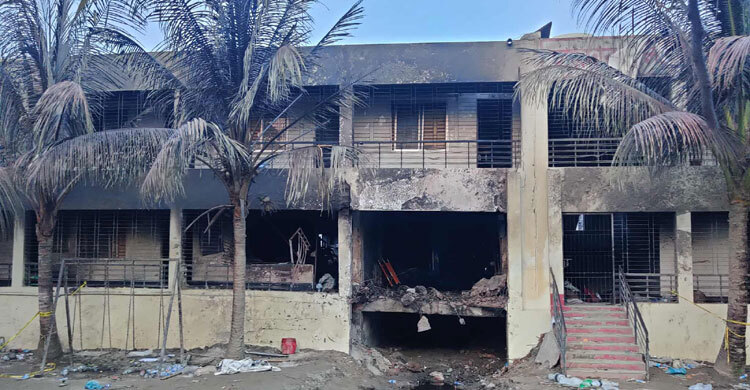
The Haider Ali Building is gone. Reduced to rubble and ash. Security forces guard the perimeter, keeping back journalists, mourners, the curious. But nothing can keep out the memories.
Six rooms. Two floors. Once full of dreams. Now only twisted metal and blackened walls remain. The classroom on the ground floor, left side facing the city, was where the jet struck. The door is gone. The windows—gone. Inside, scattered books. A single shoe. A torn notebook with a child’s handwriting: “Ami pori, ami likhi.” (I read, I write.)
Nearby, parent Shihabul stared at the ruins and asked the question hanging over every heart: “Yes, maybe life will go on. Maybe classes will resume. But these children? They won’t come back. Whose fault is this? Who allowed fighter jets to fly over a school? Who failed to protect our kids? Let someone answer. Let someone be held accountable.”
For now, there is no closure. Only grief. Only questions.
At Milestone, the bells aren’t ringing.
And they may never ring the same again.