
Yunus pledges support for young Olympians as Bangladesh celebrates academic talent

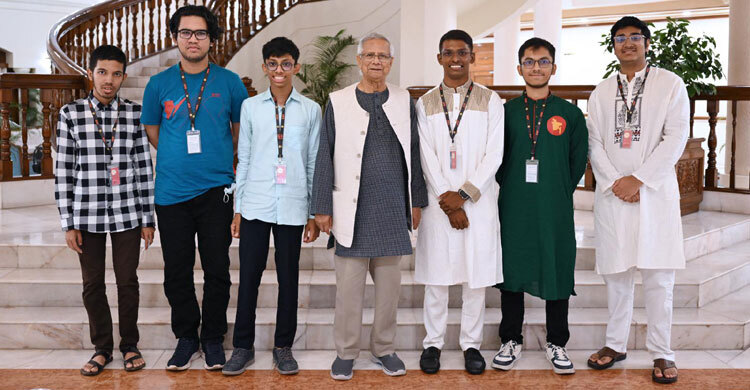
In a quiet but deeply symbolic meeting at the state guest house Jamuna, six young bronze medalists from Bangladesh’s latest International Olympiad teams sat face to face with Chief Adviser Professor Muhammad Yunus not as distant officials and awardees, but as kindred spirits in a shared dream: to see Bangladesh’s brightest minds rise on the world stage.
On Monday afternoon, the room buzzed not with political tension, but with youthful energy and quiet pride.
Ariz Anas, Ha-Mim Rahman, Farabid Bin Faisal, Jitendra Barua, Jawad Hamim Chowdhury, and Tahsin Khan, all bronze medalists in the 2025 International Mathematics and Biology Olympiads, shared their journeys with the Chief Adviser, who listened intently, asked thoughtful questions, and, most importantly, promised action.
“These students didn’t just win medals,” Yunus said, his voice warm with admiration. “They’ve shown us what’s possible when passion meets perseverance. It’s not just their achievement — it’s a message to the entire nation: Talent exists everywhere, even in the most unexpected corners.”
A nation’s pride in six young minds
The six students represent a quiet revolution in Bangladesh’s academic landscape. From South Point School to Chattogram’s Baklia Government College, from Notre Dame to Mymensingh Zilla School, they come from diverse backgrounds, urban and rural, elite and public institutions, yet united by a rare intellectual fire.
They competed against the best under-20 students from over 80 countries in grueling, 4.5-hour exams held over two consecutive days, a test not just of knowledge, but of endurance, creativity, and problem-solving under pressure.
And while they returned with bronze, the real victory, as Yunus noted, lies in the journey:
“You didn’t just go abroad to compete. You went to represent a country that has long underestimated its own potential. And you did it with dignity, intelligence, and grace.”
The unsung heroes behind the medals
But the story doesn’t begin with the medals. It begins in classrooms, coaching camps, and late-night study sessions driven not by government funding, but by volunteerism, passion, and sheer willpower.
Professor Mohammad Kaikobad, President of the Bangladesh Mathematics Olympiad Committee and Distinguished Professor at BRAC University, revealed that this year 70,000 students participated in the first round — all online.
From that pool, 25,000 advanced. The top candidates were brought to Dhaka for intensive training camps, problem-solving sessions, and mock exams, all organised and funded by volunteers.
“We raise every taka ourselves,” Kaikobad said. “Registration, travel, accommodation — even a private bank’s support isn’t enough. We do this because we believe in these students. Because someone once believed in us.”
Dr Rakhhari Sarkar, President of the Bangladesh Biology Olympiad Committee and Supernumerary Professor at Dhaka University, echoed the sentiment: “We started with 10,000 students across primary, secondary, and higher secondary levels. Through rigorous selection, we narrowed it to four. They competed with 80 nations. They brought home bronze — but more importantly, they brought back hope.”
And yet, the financial burden falls entirely on the committees and their volunteers — university students and professors who give their time, energy, and often their own money to nurture the next generation.
A system struggling to keep up
Education Adviser CR Abrar reminded the gathering that a Bangladeshi student recently won a gold medal in the Math Olympiad, competing against 111 countries — a historic moment that went largely uncelebrated.
“This is our pride,” he said. “But pride alone doesn’t pay for plane tickets or training camps. If we truly want more golds, we need more support — structured, sustained, and national.”
Primary and Mass Education Advisor Bidhan Ranjan Roy Poddar highlighted a painful truth: many talented students from remote areas never make it to Dhaka due to poverty.
He praised the university student volunteers who, without pay, grade exam scripts, design questions, and run camps — “the invisible engine of Bangladesh’s academic excellence.”
A new chapter for talent?
Yunus, visibly moved, turned to the Olympiad committees and said: “You’ve done this all on your own. But you shouldn’t have to. The government has a role — not to take over, but to enable.”
He announced that the interim government would explore ways to formally support and promote talented youth, both nationally and internationally.
He called the students’ initiative “a very positive event” — but more than that, he called it a wake-up call.