
The city that never cools: Dhaka's faster warming and lethal nights

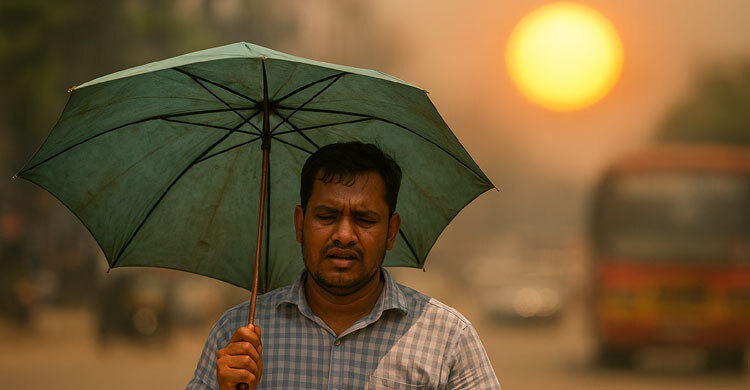
Dhaka, one of the world’s fastest-growing megacities, is heating up at an alarming and accelerating pace, transforming from a bustling metropolis into a pressure cooker of rising temperatures, vanishing greenery, and dangerous nighttime heat.
New data reveals that between 1980 and 2023, Dhaka’s maximum temperature rose by 1.4°C, significantly outpacing the national average increase of 1.1°C.
But the real danger lies in what scientists call the “heat index” - how hot it actually feels to the human body. In Dhaka, that index climbed 2.9°C (7.7%) over the same period, at a steady rate of 0.07°C per year, according to a new report of the World Bank Group – “An Unsustainable Life The Impact of Heat on Health and the Economy of Bangladesh” released on Tuesday.
Yet the most disturbing trend? Since 2015, the heat index in Dhaka has been surging at more than four times that rate — 0.3°C per year. That’s faster than the national average and signals a city spiraling into an urban heat emergency.
Why Dhaka heats up so fast? The urban heat island effect
The culprit? The Urban Heat Island (UHI) effect, a phenomenon where concrete, asphalt, and steel absorb and trap heat, turning cities into furnaces.
Dhaka’s explosive, unplanned growth has stripped the city of its natural cooling systems:
• Green space collapse: Between 1989 and 2020, Dhaka lost 47% of its dense vegetation. Healthy green cover shrank from 17% (5,202 hectares) to just 2% (612 hectares).
• Population boom: While the city’s land area grew 19% between 2001–2017, its population exploded by 77%, cramming more people into heat-trapping structures.
• Corrugated sheet roofs and concrete jungles: Many low-income residents live under tin roofs, which can make indoor temperatures up to 4°C hotter than outside, especially at night.
• Nighttime danger: Without cool nights, the human body can’t recover from daytime heat exposure — leading to heat stress, organ strain, and even death.
Peak heat in July, false reprieve in November
July remains Dhaka’s hottest month consistent with global and national trends. But November offers a deceptive twist: while maximum temperatures rose by 0.82°C since 1980, the heat index actually dropped by 0.7°C thanks to a 9 percentage point plunge in humidity.
But don’t be fooled. Lower humidity doesn’t mean relief, it means the heat is becoming drier, dustier, and harder on respiratory systems. And with humidity expected to fluctuate unpredictably due to climate change, future Novembers could swing violently in the opposite direction.
A city losing its breathing space
Satellite imagery and land-use studies paint a grim picture:
• Urban settlements expanded rapidly after 1999.
• By 2020, green spaces were fragmented and sparse, covering just 5,600 hectares — down from 12,745 hectares in 1989.
• Heat-absorbing materials like concrete and metal now dominate the skyline.
• Air circulation is stifled by tightly packed buildings and choked streets.
What can be done?
Experts urge immediate, science-backed interventions:
Mandate heat-resilient building codes — reflective roofs, cross-ventilation, shaded windows.
Reclaim green corridors — parks, rooftop gardens, tree-lined streets to cool neighborhoods.
Invest in nighttime cooling centers — especially for vulnerable populations.
Monitor micro-climates — deploy sensors to track heat disparities block by block.
Public heat-health warnings — linked to real-time temperature and humidity data.
The bottom line
Dhaka is not just warming, it’s being rebuilt to be hotter. Without urgent redesign and restoration of its natural environment, the city risks becoming unlivable for millions.
“The data doesn’t lie,” says climate economist Dr. Farhana Yasmin. “If we don’t cool Dhaka now, we’ll be paying for it in hospital beds, lost wages, and lives cut short.”
Dhaka’s future hangs in the balance between concrete and canopy, between profit and survival. The time to act is before the next heatwave hits.