
The last artisans: Can Rupganj's 200-year-old amulet casing craft be saved?

Published: 17 September 2025, 06:15 PM | Updated: 17 September 2025, 06:27 PM
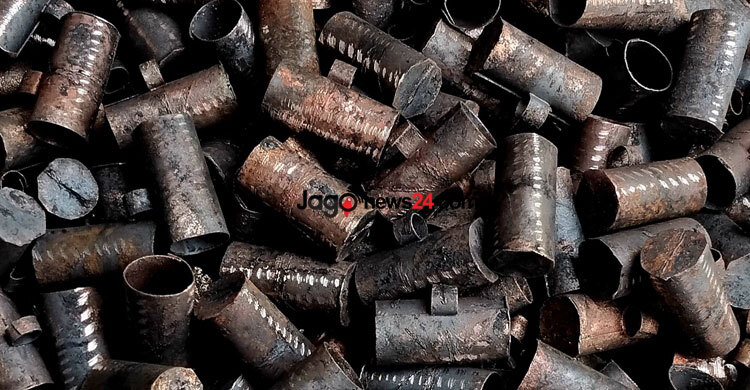
In the quiet alleys of Chorab, Tan Mushri, Bhingrab and Dakshinbagh, tucked away in Rupganj Upazila of Narayanganj, the rhythmic clang of hammers still echoes. But it’s a fading song.
For two centuries, this corner of Narayanganj has been the beating heart of Bangladesh’s tawiz-dani or maduli, amulet casing craft. Once a thriving trade that clothed sacred verses in brass, copper, and silver, it now gasps for breath caught between rising metal prices, vanishing faith, and a generation turning its back on ancestral hammers.
When amulets ruled hearts and markets
In the 1980s and 90s, amulets weren’t just spiritual accessories, they were lifelines.
Written by hakims, pirs, and kabirajs, these talismans promised protection from disease, misfortune, and evil eyes. They carried verses from the Quran, sacred numbers, mystical symbols, whispered prayers sealed in metal. And Rupganj? It was their armour-maker.
At its peak, over 500 artisans hammered out thousands of casings each month — Sambu, Bambu, Pai, Baro Majla — each name a dialect of devotion. Markets from Chattogram to Khulna, even India and the Middle East, clamoured for Rupganj’s handiwork.
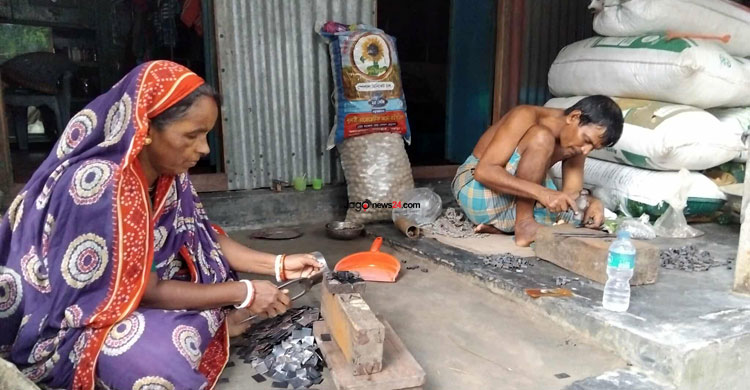
“Back then,” says 80-year-old Priya Bala Rani, her fingers still nimble around a copper sheet, “every household had an amulet. And every amulet needed our casing. We were the keepers of people’s peace.”
The slow fade: Faith, finance, and fear
But time, technology, and theology turned against them.
Modern medicine replaced folk remedies. Education questioned superstition. Religious scholars declared many amulets shirk – associating partners with God. Demand crumbled.
Raw materials, copper, brass, zinc, now cost Tk 500-700 per kg. A single casing costs 80 paisa to Tk 1 to make but middlemen pay just Tk 1.20-1.70, squeezing out profit. Artisans who once exported across continents now struggle to feed their families.
“We make 6,000 to 8,000 casings a month,” says Sirajul Islam, sweat glistening on his brow as he solders a tiny Mastul. “But even if every hand in the house works – men, women, children – it’s not enough.”
The new generation? They’re leaving. “Why hammer metal when you can tap a screen?” asks Dilip Mandal, whose family has shaped amulets for seven generations. “No capital. No future. Just tradition – and tradition doesn’t pay bills.”
Hands that won’t let go
Yet, in over 200 households, the fire still burns.
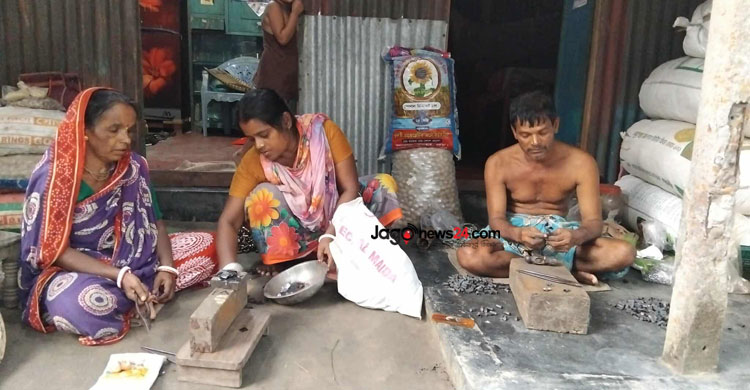
Women bend over anvils beside their husbands. Teenagers polish casings after school. Elders whisper stories of bustling bazaars and foreign buyers. This isn’t just work, it’s identity.
“I continue my in-laws’ craft,” says Priya Bala, her voice soft but firm. “It’s in my blood.”
Ramprasad Adhikari dreams of independence: “If we could sell directly, without middlemen, we’d get Tk 1.50 to Tk 2 per piece. That’s survival.”
Nurul Haque still travels to Bogura, Barishal, Cumilla with suitcase full of casings, hope heavier than metal. “People still believe. Just… fewer.”
A call to preserve the unseen
Religious leaders draw a line: Sharia-compliant amulets? Permissible. Magical charms? Forbidden. But for artisans, the distinction is survival.
“Whether it’s faith or folklore, this craft is part of our cultural DNA,” says former chairman Abdul Matin Bhuiyan. “Let’s not wait until the last hammer falls silent.”
Enter the government.
Upazila Nirbahi Officer Saiful Islam has taken notice. “I’ll meet the artisans. We’ll explore loans, marketing support, heritage recognition. This can’t vanish on our watch.”
Can tradition outlive modernity?
The amulet casing of Rupganj is more than metal, it’s memory. It’s the clink of belief in a changing world. It’s the last stand of a craft older than the British Raj, older than partition, older than modern Bangladesh itself.
Without intervention, this 200-year-old whisper in copper and brass may soon be lost, not with a bang, but with the quiet sigh of a cooling forge.
But while hammers still rise in Rupganj, there’s hope.
The question isn’t whether the craft deserves saving but whether we still believe in the things it once protected.