
Navy deploys 17 warships to protect hilsa during spawning season

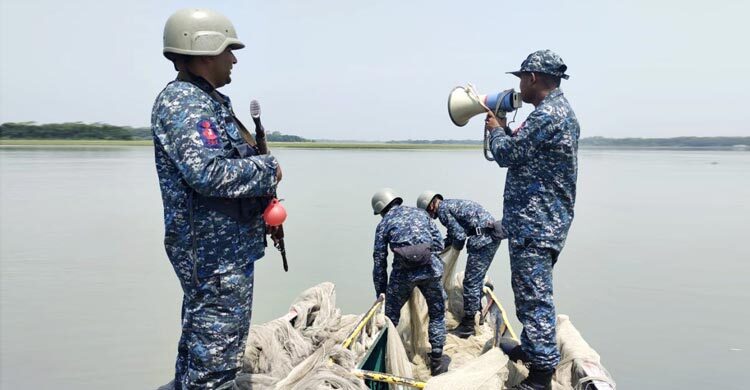
In a dramatic show of force to protect Bangladesh's most cherished aquatic resource, Bangladesh Navy has deployed 17 warships, patrol boats, and state-of-the-art maritime aircraft in a nationwide campaign to safeguard the hilsa, the country’s national fish, during its critical spawning period.
The Mother Hilsa Conservation Campaign-2025, a 22-day initiative launched on October 4, enforces a complete ban on the harvesting, transportation, storage, sale, purchase, and exchange of hilsa until October 25.
The prohibition also extends to all marine fishing activities in designated breeding zones, including the Bay of Bengal and major river systems like the Padma, Meghna, and Jamuna.
According to a statement issued by the Inter-Services Public Relations (ISPR), the Bangladesh Navy is operating under the mandate of “In Aid to Civil Power”, working in close coordination with the Coast Guard, fisheries authorities, local administrations, and naval police to enforce the ban.
Naval assets mobilised across key breeding grounds
Warships have been strategically stationed across nine riverine and coastal districts known as vital hilsa spawning corridors:
• Chandpur: BNS Dhansiri/Shaheed Farid and BNDB Gangchil
• Cox’s Bazar: BNS Atandra, Shaheed Mohibullah, Durjoy, Sagar, and Shaheed Daulat
• Khulna: BNS Meghna and Chitra/Titas
• Bagerhat: BNS Karatoya and Abu Bakar/Durgam
• Pirojpur & Barguna: BNS Salam and Kushiyara
• Barishal: BNS Padma and Chitra/Titas
• Patuakhali: LCVP-013
These vessels, supported by round-the-clock aerial surveillance, are tasked with preventing illegal fishing by both domestic and foreign trawlers, particularly from neighbouring India, whose fleets often operate in the shared deltaic waters of the Ganges-Brahmaputra-Meghna system.
A national treasure under threat
The hilsa, a silvery, herring-like fish famed for its rich flavour, is not just a culinary icon but a vital economic asset. Millions of Bangladeshis depend on it for livelihood and nutrition, and prices in Dhaka markets can soar to Tk 2,200 per kilogram (approx. $18.40).
However, overfishing, especially during spawning season, has severely threatened hilsa populations in recent decades. Compounding the crisis are ecological disruptions in the low-lying delta region, including altered river flows, pollution, and climate change-induced sea-level rise.
While the government’s enforcement drive has drawn praise for its ambition, some experts have raised concerns about its methods.
Md Abdul Wahab, former head of the Eco Fish project at WorldFish, warned that heavy naval activity could disturb the very fish it aims to protect. “Hilsa need calm and undisturbed waters to spawn successfully,” he told AFP, suggesting alternatives like drones and remote sensors for monitoring.
Support for affected fishermen
Recognising the hardship faced by fishing communities during the ban, the government is providing 25 kilograms of rice per affected household as compensation.
“For us, these three weeks are very difficult,” said Sattar Majhi, a 60-year-old fisherman from Barisal. “We have no other means of survival.”
Despite the challenges, authorities remain resolute. The ISPR emphasised that the navy’s mission is not only about enforcement but also about ensuring the long-term sustainability of hilsa stocks.
“The Bangladesh Navy is dedicated to protecting the breeding grounds of hilsa, creating opportunities for free reproduction, and conserving mother hilsa as a national economic asset,” the statement read.
With hilsa symbolising both cultural identity and food security, this high-stakes marine operation underscores Bangladesh’s determination to balance ecological preservation, economic interest, and national pride, one patrol at a time.
Source: ISPR, AFP, BSS