
Natural disasters displace 5m Bangladeshis internally, finds IOM
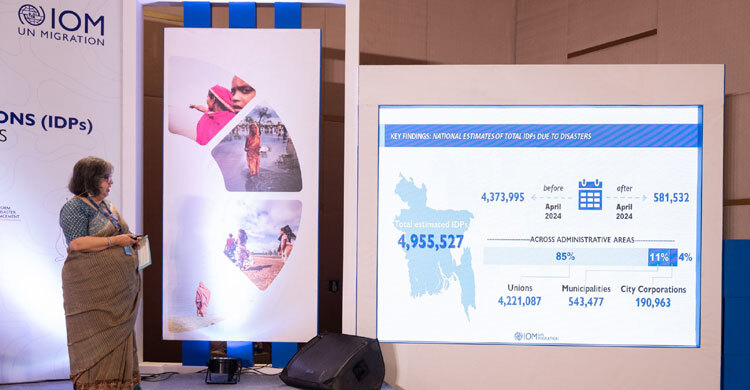
Bangladesh is grappling with an unprecedented displacement crisis, with more than 49.5 lakh people forced from their homes by natural disasters, according to the country’s first-ever nationwide assessment of disaster-induced displacement released by the International Organization for Migration (IOM).
The landmark estimate – 4,955,527 internally displaced persons (IDPs) – provides the most authoritative picture to date of how cyclones, floods, river erosion and other climate-linked hazards continue to reshape lives and livelihoods across one of the world’s most vulnerable nations.
Unveiled in Dhaka on Wednesday, the assessment was conducted jointly by IOM, the Government of Bangladesh and development partners. Despite Bangladesh’s long battle with annual natural hazards, a verified national figure for disaster displacement had never been established until now.
To bridge this gap, IOM undertook an exhaustive data-gathering exercise across all eight divisions, 64 districts, 4,579 unions, 329 municipalities and 480 city corporation wards. More than 29,000 key informants were interviewed during 5,388 field visits, making it the largest and most detailed displacement assessment ever carried out in the country.
“This understanding of the scale of displacement is vital for effective disaster management and long-term planning,” said Lance Bonneau, IOM Bangladesh’s Chief of Mission. “These findings give national authorities, local leaders and development partners a shared foundation to act with far greater clarity and coordination.”
A crisis long in the making
The report reveals that displacement in Bangladesh is overwhelmingly protracted.
63 per cent of IDPs were uprooted before April 2020, suggesting years – in some cases decades – of unresolved and ongoing vulnerability.
Another 25 per cent were displaced between April 2020 and April 2024, reflecting the continued impact of recent cyclones, storm surges, flooding and erosion.
Where displacement is hitting hardest
The highest concentration of displaced people is in Chattogram Division, home to 1.21 million IDPs.
It is followed by:
Dhaka Division: 0.79 million
Rajshahi Division: 0.66 million
Four districts alone – Chattogram, Sirajganj, Bhola and Noakhali – account for one in every four displaced people.
A striking 85 per cent of IDPs currently live in rural union areas, underscoring the compounded impacts on agriculture-dependent communities.
Government backs push for better data
Government officials praised the assessment as a major step towards operationalising the National Strategy on Internal Displacement Management, which mandates regular and systematic monitoring of displaced populations.
Chief guest Aleya Akter, Secretary of the Statistics and Informatics Division, joined the launch virtually. Senior officials from the Ministry of Disaster Management and Relief, the Ministry of Environment, Forest and Climate Change, and representatives from the European Union also addressed the event.
The programme included a detailed methodology briefing, the formal unveiling of the report, and a panel discussion featuring the DDM, DoE, BBS and development partners on incorporating IDP data into national planning systems.
A crucial milestone for future policy
IOM said the new estimate marks a critical milestone in Bangladesh’s efforts to understand and respond to internal displacement at scale. The data will guide future policies on:
disaster preparedness
planned relocation
climate adaptation
social protection
long-term development planning
As Bangladesh confronts increasingly severe climate shocks, the report provides a stark reminder: millions remain displaced, and without sustained action, many more will follow.