
EC in turmoil over constituency delimitation, fears mount over elections

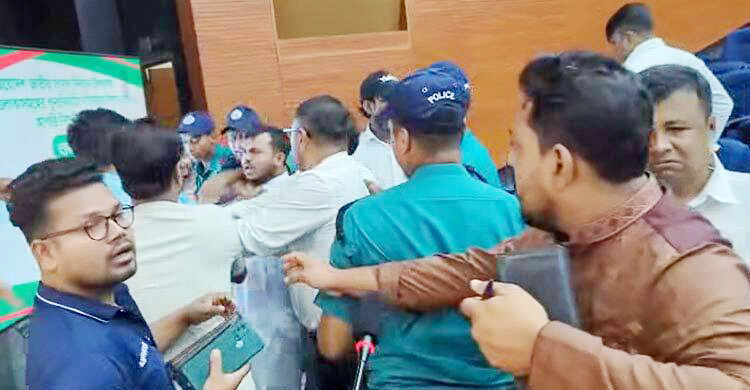
The Election Commission (EC) is facing unprecedented turmoil over the ongoing process of redrawing parliamentary constituency boundaries, raising serious concerns about the law and order situation ahead of the planned 13th parliamentary elections in February 2026.
The interim government has directed the EC to complete the delimitation process in time for the polls, but violent clashes, heated confrontations, and even the breaking of the EC’s main gate have cast a shadow over the credibility and authority of the electoral body.
Hearings on 1,760 claims and objections regarding the boundaries of 83 parliamentary constituencies began on August 24 at the Nirbachan Bhaban in Dhaka and are scheduled to continue until August 27. However, the very first day of proceedings descended into chaos when a violent scuffle erupted between supporters of BNP joint international affairs secretary and former MP Barrister Rumin Farhana and activists of the National Citizens Party (NCP) right in front of Chief Election Commissioner (CEC) AMM Nasir Uddin.
Eyewitnesses and officials reported that the confrontation quickly escalated into physical altercations and verbal abuse, with EC Secretary Akhtar Ahmed failing to restore order despite attempts.
The CEC expressed visible anger over the incident, underscoring the gravity of the breakdown in decorum at the highest level of the electoral process.
Adding to the gravity, the main gate of the EC headquarter was reportedly damaged during the clash, an unprecedented breach of security and institutional sanctity.
The violence occurred during hearings on the Brahmanbaria-2 and Brahmanbaria-3 constituencies, where competing claims have sparked intense rivalry.
NCP leader Engineer Aminul Haque Chowdhury, one of the alleged victims, told Jago News that he and two other party members, Mustafa Sumon and Ataullah, were injured in the attack. “We came peacefully with our claims, but Rumin Farhana’s people attacked us, right under the EC’s roof,” he said. “If this is how we’re treated over a boundary issue, what will happen during the actual election? We are deeply concerned about the future.”
BNP leader Rumin Farhana, while denying responsibility, echoed fears about pre-poll violence. “The national election hasn’t even begun, yet people are being beaten over a boundary dispute in Brahmanbaria-3,” she said. “They’re forcing confessions and intimidating locals. We’ve submitted a formal complaint to the EC. If this is happening now, imagine what might unfold during the election.”
Hasnat Abdullah, chief organiser of the NCP’s southern region, described the incident as a “test match” for future polling station occupations, suggesting that political muscle is already being flexed. “The current EC was formed on a pick-and-choose basis. Its neutrality is questionable,” he claimed. “Today’s violence has revealed exactly how the next election could be manipulated and what role the BNP might play in it.”
He further warned: “A BNP leader even said they could have brought goons if they wanted. We saw people practicing with sticks outside the EC. This is the same path Sheikh Hasina once spoke of where 10 or 20 goons could ‘cool’ an election. Now, others are walking that road.”
The escalating political interference has exposed what critics are calling a critical weakness in the EC’s authority.
Muhammad Rashed Khan, General Secretary of the Gono Odhikar Parishad, condemned the involvement of parties in the delimitation process. “Boundary demarcation is the EC’s constitutional duty. Political parties should not interfere,” he said. “This clash shows the EC’s inability to maintain order. That’s deeply concerning.”
However, Rashed Khan expressed hope that the government would take firm action during the actual elections. “The army will be deployed. No one will be allowed to get away with such acts. If any party disrupts the process, the EC has the power to cancel voting, and that would hurt the instigators the most.”
As the hearings continue, the EC faces mounting pressure to assert its authority and ensure a transparent, peaceful delimitation process. With the 2026 national election already shadowed by fears of violence and manipulation, the current crisis over constituency boundaries has become a litmus test for Bangladesh’s democratic institutions, and a warning of what may lie ahead.