
Most banks lag on cyber security, leaving customer data at risk: Faiz

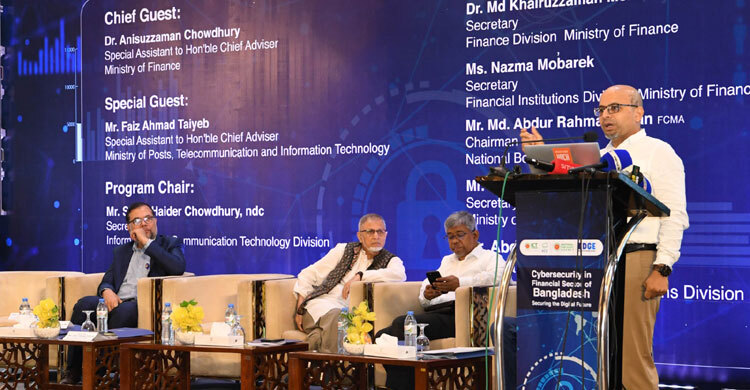
The cyber security posture of most banks in Bangladesh remains alarmingly weak, leaving customers’ personal and financial data vulnerable to breaches and misuse, warned Faiz Ahmed Tayyab, Special Assistant to the Chief Adviser.
Faiz, who is in charge of the Ministry of Posts, Telecommunications and Information Technology, came up with the warning while speaking as a special guest at a national seminar titled ‘Cyber Security in the Financial Sector of Bangladesh: Securing the Digital Future’ held at Hotel Sonargaon in Dhaka on Tuesday, August 19.
Faiz revealed that only a small number of banks have achieved a satisfactory cyber security rating. For the majority, he said, data protection is inadequate – and in many cases, customer information is effectively exposed.
“In many banks, people’s data is not just unsafe - it’s open,” Faiz said. “This vulnerability is being exploited by some unscrupulous bank officials who are now involved in cyber-crimes. As a result, the safety and privacy of millions of customers are at serious risk.”
The event was jointly organised by the National Cyber Security Agency (NCSA) under the ICT Division and the EDGE Project, with the aim of addressing growing digital threats in the financial sector.
Faiz highlighted several critical vulnerabilities plaguing the banking sector, including: outdated or unpatched software; weak file transfer protocols; risks in data centres; Distributed Denial-of-Service (DDoS) attacks; and rising incidents of financial fraud and illegal online gambling.
He stressed that without urgent upgrades to cyber defences, the rapid digitisation of banking services could become a liability rather than an asset.
Dr Anisuzzaman Chowdhury, Special Assistant to the Chief Adviser on the Ministry of Finance, delivered the keynote address, urging financial institutions to strengthen their cyber defences.
“Our current cyber security framework must be enhanced,” he said. “Public-private partnerships are essential to raise awareness, share threat intelligence, and build a resilient financial ecosystem.”
Najma Mobarek, Secretary of the Financial Institutions Division, called for intensified cyber security training, particularly in state-owned banks, and greater coordination between IT departments and core business operations.
Meanwhile, NBR Chairman Md Abdur Rahman Khan proposed enhancing tax administration through secure data exchange between banks and tax authorities, while ensuring privacy and compliance.
Investigation Challenges Due to Underreporting
CID Chief M Sibgat Ullah shared troubling statistics: 884 cyber-crime complaints have been filed with law enforcement since January 2025. However, he pointed to a major obstacle – banks’ reluctance to report cyber incidents, which is hampering investigations and allowing criminals to operate with impunity.
“Without timely reporting, we cannot track, trace, or prosecute offenders,” he said. “Banks must see cyber-crime reporting not as a reputational risk, but as a national responsibility.”
Representatives from leading banks, including BRAC Bank, IFIC Bank, and City Bank, shared insights on technical challenges and recommended solutions, such as adopting international security standards, implementing real-time monitoring systems, and conducting regular penetration testing.
The seminar was chaired by Sheesh Haider Chowdhury, Secretary of the Information and Communication Technology Division, and attended by senior officials from across the ICT sector, financial regulators, cybersecurity experts, and development partners.
Speakers unanimously agreed that securing the financial sector’s cyber infrastructure is not just a technical necessity, but a cornerstone of public trust and economic stability.
As Bangladesh accelerates toward a cashless, digital economy, the message was clear: without robust cyber defences, no transaction is truly safe – and no customer can feel secure.