
Pran clinches $1.5m orders at Malaysia’s halal products fair, eyes deeper ASEAN market

Published: 20 September 2025, 06:01 PM
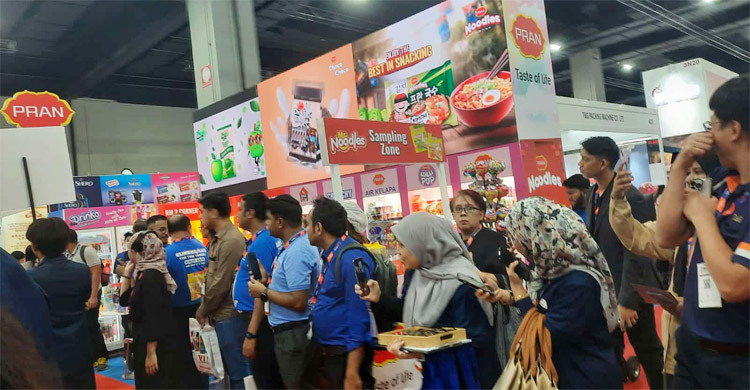
Bangladeshi food processing giant Pran has bagged $1.5 million in new export orders at Malaysia’s International Halal Showcase (MIHAS), strengthening its foothold in Southeast Asia’s booming halal food market and positioning Bangladesh as a rising player in the global halal economy.
The 21st edition of MIHAS, held from September 17 to 20 at the Malaysia International Trade and Exhibition Centre (MITEC), brought together over 2,300 exhibitors from 90 countries, with halal-certified food, pharmaceuticals, cosmetics and lifestyle products on display. More than 30,000 visitors attended, including wholesalers, supermarket chains, distributors, and investors.
Pran’s showcase and orders
Pran presented nearly 500 consumer food products at its pavilion — juices, noodles, confectionery, sauces, bakery items, biscuits, chocolates and ready-to-eat foods. Visitors showed particular interest in Korean-style noodles, premium biscuits and basil seed drinks, which Pran executives believe will become growth drivers in ASEAN markets.
The biggest breakthrough came when Malaysian supermarket giants Ecosave and Ecoshop committed to stocking 60 new Pran products across their outlets. These chains cater to middle-class and price-conscious consumers, offering Pran an extensive retail platform. “The response at MIHAS exceeded expectations,” said Touhiduzzaman, Deputy General Manager (Public Relations) of PRAN-RFL Group. “This deal not only strengthens our position in Malaysia but opens the door to wider ASEAN penetration.”
Bangladesh’s halal export push
Bangladesh’s halal-certified food exports have been growing steadily in recent years, but the sector has yet to fully realise its potential in the $3 trillion global halal economy. Pran’s success is being seen as a benchmark, demonstrating how Bangladeshi firms can capture a larger slice of this expanding market.
The company already exported $30 million worth of food products to Malaysia in the last fiscal year and $315 million globally, the highest consumer goods export from Bangladesh. It currently exports to 148 countries, including India, the UAE, Oman, Australia, the United States and the United Kingdom.
Industry insiders note that Malaysia, with its central role as a halal certification hub, is a gateway to the wider ASEAN halal economy, which is projected to grow rapidly with rising demand from Indonesia, Thailand, Brunei and Singapore.
Global market context
According to the State of the Global Islamic Economy Report, Muslim consumer spending on food and beverages is expected to exceed $1.5 trillion by 2025. Malaysia, Indonesia and the Middle East remain key demand centres, while halal-certified products are also seeing rising popularity among non-Muslim consumers for their perceived quality and safety.
Bangladesh, with its large agro-based manufacturing base, competitive labour costs and growing export expertise, is increasingly well-placed to expand in this space. However, exporters often face challenges such as certification delays, limited branding, and lack of targeted government incentives.
Pran’s strategy going forward
Pran executives said their MIHAS participation was aimed at long-term positioning rather than short-term sales. The company distributed product samples to nearly 10,000 visitors, a move designed to strengthen brand familiarity. Its marketing strategy is to combine aggressive retail expansion with consumer engagement, particularly through localised product innovations.
“The MIHAS experience has proven once again that buyers in Southeast Asia are open to Bangladeshi brands, provided we maintain quality and consistency,” Touhiduzzaman said.
The bigger picture for Bangladesh
For Bangladesh, the success of companies like Pran could serve as a model to reduce over-dependence on ready-made garment exports, which still account for over 80 percent of the country’s export earnings. Diversifying into processed foods, halal products, IT and services is seen as a key economic priority.
Experts argue that if Bangladesh strengthens its halal certification infrastructure, supports exporters with logistics and branding, and invests in product innovation, the country could position itself as a significant halal food supplier globally.
For now, Pran’s $1.5 million in fresh orders at MIHAS is being seen not only as a corporate win but also as a broader signal of Bangladesh’s export ambitions in a fast-growing global industry.