
An unreachable dream: War blocks Palestinian students with scholarships to Bangladesh

Maha Adnan Shbair holds a full scholarship to study for a master’s degree in public health at North-South University. She has even been offered a job, as a research assistant, before her first class begins.
But Maha cannot take her seat in a Dhaka classroom. She is trapped in southern Gaza, where bombs still fall, hospitals are rubble, and survival is measured in meals, not months.
She received the good news in January: “Congratulations. You’re in.” But the message came with no way to act on it. There is no Bangladesh embassy in Palestine. To get a visa, she must apply in person at the Bangladesh embassy in Jordan.
And to reach Jordan, she must first cross through Israel – a journey that is not just dangerous, but nearly impossible.
A scholarship in one hand, a war in the other
Maha is not alone.
Every year, dozens of Palestinian students win full scholarships to study at public and private universities across Bangladesh – from Chittagong University to Sher-e-Bangla Medical College. These opportunities are lifelines: a chance to build a future beyond war, displacement, and trauma.
But since the outbreak of the Gaza-Israel conflict in October 2023, those lifelines have been cut.
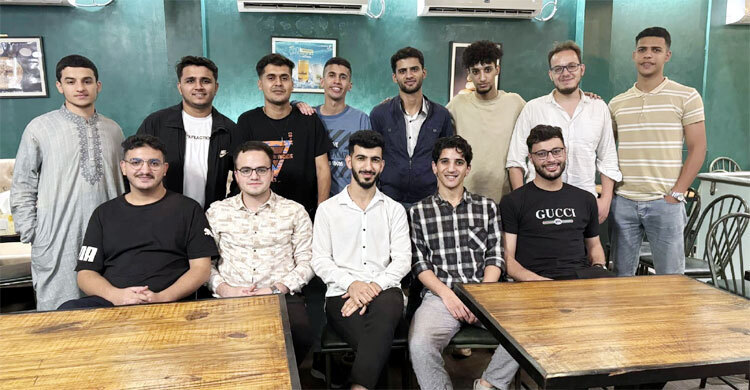
Badwi Ahmed, president of the General Union of Palestine Students in Bangladesh, says that last year, 220 Palestinian students who received scholarships were unable to come to Bangladesh due to border restrictions. Currently, only about 80 Palestinian students remain in the country.
“Many of us are stuck between two worlds,” Badwi said. “One where we’ve been given hope, a scholarship, a future, and another where we’re just trying to survive.”
The impossible journey
The only exit from Gaza for civilians is through the Karem Abu Salem crossing, under Israeli military control. Even then, Palestinians must first obtain permission from Israeli authorities – a process that is arbitrary, slow, and often denied.
Once approved, they must travel through occupied territory, cross into Jordan via the Allenby Bridge, and finally reach the Bangladesh embassy in Amman – all while carrying valid visas and documents.
But Bangladesh does not offer e-visas, and the embassy in Jordan has told Maha it cannot assist in securing Israeli exit permits.
“I emailed them,” Maha said from a shelter in Khan Yunis. “I explained that I cannot reach the embassy without Israel’s permission – and that they would need to coordinate with international actors to make this happen. But they said they couldn’t help.”
She paused. “Other countries are doing it. A friend of mine got a scholarship to France. The French embassy helped him get out. Why can’t Bangladesh?”
"We are practically in captivity"
For Maha, the pain is personal. Her house in Gaza was destroyed in an airstrike. She and her family, parents, siblings, nieces, nephews, aunts, have been displaced six times since May 2024. They now live in a makeshift shelter, surrounded by ruins.
“There is no peace here,” she said. “Every day brings death, fear, hunger. And still, I dream of studying. Of becoming a public health expert who can help rebuild Gaza. But how can I help anyone if I can’t even leave?”
She added, voice breaking: “We will never forgive those who call themselves Muslims but stay silent while our children are buried under rubble. This suffering – it’s not just Israel’s doing. It’s also the silence of those who should stand with us.”
Diplomatic deadlock
Bangladesh has no diplomatic relations with Israel, which officials say limits their ability to negotiate for student exits.
Nazrul Islam, Additional Secretary at the Ministry of Foreign Affairs, told Jago News that while Bangladesh cannot directly coordinate with Israel, visa-on-arrival options exist for special cases – if universities formally request approval from the Ministry of Home Affairs.
But Palestinian students argue this is not enough.
“The embassies of France, Turkey, Malaysia – they’ve evacuated students through coordination with the UN, MSF, or Egyptian and Jordanian authorities,” said Aihaw Al-Aiyamal, a fourth-year medical student on a full scholarship. “Bangladesh doesn’t need to talk to Israel directly. It just needs to act.”
Palestinian Ambassador to Bangladesh, Yousef SY Ramadan, echoed this: “Bangladesh has always supported Palestine. But now, we need action, not just words. The Rafah border, our only southern exit, is under Israeli control. They are not just blocking movement. They are executing a plan to erase us from our land.”
He warned: “Israel wants to make Gaza uninhabitable, so Palestinians can never return. When students leave through Israeli crossings, they are often not allowed back. This is ethnic displacement under the guise of ‘evacuation’.”
A call for compassion and coordination
Back in Gaza, Maha still checks her email daily. She still believes, somehow, that she might one day walk into a classroom in Dhaka.
“I don’t want special treatment,” she said. “Just the same chance that students from other countries get. A visa. A safe route. A way out.”
She asked simply: “Can the Bangladesh embassy please stand with us – like other countries are doing? We are not asking for charity. We are asking for the opportunity we’ve already earned.”
The world watches, the clock ticks
As universities in Bangladesh prepare for a new academic year, lecture halls will sit empty – not for lack of qualified students, but because war and bureaucracy have conspired to keep them away.
Maha’s story is not just about one scholarship. It’s about what Bangladesh stands for – a nation that has long championed the Palestinian cause, that calls for justice, solidarity, and Muslim unity.
Now, it faces a test: Will it open not just its universities, but its diplomatic doors, to those who need it most?
For Maha, and hundreds like her, the answer could mean the difference between a future – and a life spent in the shadow of war.