
Baaji: Hashim Mahmud’s epic comeback

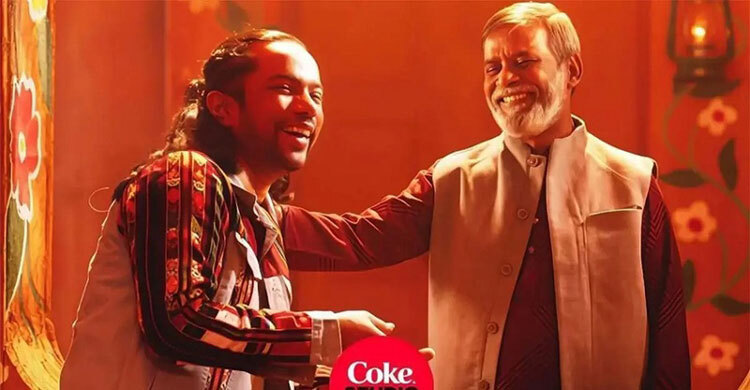
When the first notes of ‘Baaji’ echoed through Coke Studio Bangla Season 3, the show’s long-awaited return after more than a year, fans braced for another genre-bending masterpiece. What they got instead was something far deeper: a moment of pure, unscripted humanity.
At the 4:12 mark, the camera gently shifts. The music softens. And there, seated in quiet dignity, is Hashim Mahmud, the poet whose words have haunted Bangladesh’s soul for decades, but whose face most never knew.
His voice, thin and trembling with age, rises into the song. Not as a guest. Not as a legend being honoured. But as the source.
And in that instant, the studio didn’t just play a song.
It bore witness to a resurrection.
For years, Hashim Mahmud existed in the space between sound and silence. His lyrics, raw, poetic, drenched in the soul of urban Bengal, travelled far and wide. “Sada Sada Kala Kala” from Mejbaur Rahman Sumon’s Hawa became an anthem of pain and resistance. “Kotha Koiyo Na” went viral on college campuses, sung by thousands who didn’t know the name behind the words.
Yet the man himself had all but vanished.
Once a familiar figure at Dhaka University’s Faculty of Fine Art and the iconic Chhobir Haat, Mahmud was known as the wandering bard, scribbling verses on verandas, humming melodies under monsoon skies. Peers called him a “modern urban poet”, one who turned street slang into poetry and sorrow into song.
But life turned cruel. A degenerative illness began erasing his memory, the very thing that defined him. Lines he once recited with pride slipped away. Conversations ended in silence. By 2022, when journalists finally tracked him down in Narayanganj, he was frail, living with his elderly mother, unaware of the cultural storm his words had ignited.
“It’s like watching a painter lose their sight,” said composer Emon Chowdhury, who has led the revival of Mahmud’s work. “For an artist whose entire world was language, to lose that… it’s devastating.”
‘Baaji’ was born in 1996, half composed during a trip to Boga Lake in Bandarban, the rest completed months later on St Martin’s Island. Like much of Mahmud’s work, it was written in fragments, shaped by movement, memory, and melancholy.
Now, nearly three decades later, Coke Studio Bangla has resurrected it not as a tribute, but as a collaboration. With lush arrangements by Emon Chowdhury, the song swells with orchestral depth, yet never drowns out Mahmud’s voice. Because this time, he is in it.
And that changes everything.
Emon Chowdhury, who first discovered Mahmud through Hawa, has long dreamed of bringing him into the studio.
“I felt a strange connection with Hashim bhai,” Emon told UNB. “From the start, I wanted him in the song, not just as a name in the credits, but as a presence.”
When Mahmud finally arrived on set, something shifted.
“The entire energy changed,” Emon recalled. “I can’t explain it. It was like the room bowed to him.”
The resulting performance is not polished. It’s not perfect.
It’s real.
His voice cracks. His hands tremble. But his spirit, unbroken, defiant, sings on.
In a touching interview, Mahmud’s younger brother, Belal Ahmed, shared updates on his condition.
“He doesn’t use a phone, so I read him the messages – the love, the praise, the tears people shed for his music. He smiles. He’s happy. He’s doing well.”
Belal also confirmed the song’s long, fragmented creation, a testament to Mahmud’s nomadic creativity. “He never wrote a song in one go. It was always pieces of journeys, stitched together by time.”
And now, thanks to Coke Studio Bangla, those pieces are whole again.
‘Baaji’ is more than a track. It’s an act of cultural reparation.
In an industry that often sidelines its pioneers, Coke Studio Bangla did something radical: they gave the poet his voice back.
No fanfare. No pity. Just a chair, a microphone, and the right to sing his own words.
In the Behind The Magic documentary released on 28 August, Mahmud speaks softly: “Will this song last forever? If a song doesn’t last, what’s the point of singing it?”
His question hangs in the air.
And now, the world has answered.
Emon Chowdhury put it best:“For the sake of our music, this man needs to be celebrated. I’m just glad he’s being celebrated now.”
Because in that 16-minute video, in that fragile voice at 4:12, something miraculous happened.
The forgotten poet was found.
And this time, we’re not letting him go.
‘Baaji’ isn’t just a song.
It’s a promise:
Art outlives memory.
And love outlives time.