
AI meets the divine: Hindus use tech to talk to Gods

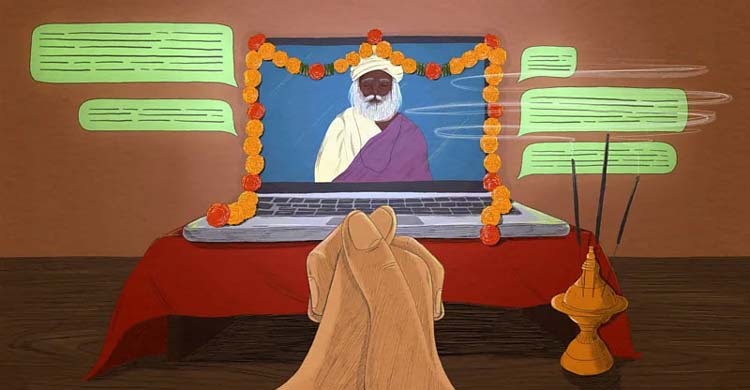
In a quiet corner of Rajasthan, 25-year-old Vijay Meel sat hunched over his phone, heart heavy after failing his banking exams—again. He didn’t call a friend. He didn’t scroll mindlessly. Instead, he opened an app and typed: “I’m lost. What should I do?”
Seconds later, a reply appeared—not from a therapist, not from a guru, but from Krishna.
Or rather, from GitaGPT, an AI chatbot trained on the Bhagavad Gita, the 2,000-year-old Hindu scripture in which the god Krishna counsels the warrior Arjuna on duty, detachment, and divine will.
“Focus on your actions,” the bot advised, “and let go of the worry for its fruit.”
The words weren’t new—but in that moment, they felt like a lifeline. “It wasn’t about revelation,” Meel says. “It was about being reminded—by something that felt like it knew me.”
He now chats with GitaGPT once or twice a week. Not out of desperation, but companionship.
Welcome to the age of algorithmic devotion—where faith meets firmware, and millions are turning to artificial intelligence not just for answers, but for absolution, guidance, and even darshan (the sacred act of seeing and being seen by the divine).
The rise of the digital deity
Across India and beyond, AI-powered spiritual assistants are surging in popularity. There’s QuranGPT, which crashed within a day of launch from overwhelming demand. Text With Jesus, which drew both devotees and accusations of blasphemy. Chatbots channeling Confucius, Martin Luther, and the 20th-century sage Ramana Maharshi—each promising wisdom on demand.
But Hinduism, with its rich tradition of embodying the divine in physical forms—murtis (sacred statues), temple elephants, even ritual objects—offers fertile ground for this fusion. If a stone idol can house God, why not a server?
“Hinduism has always embraced the idea that the divine can manifest through any vessel,” says Dr. Holly Walters, an anthropologist at Wellesley College who studies South Asian ritual. “AI isn’t replacing God—it’s becoming another medium through which God speaks.”
This isn’t science fiction. At the 2025 Maha Kumbh Mela—the world’s largest religious gathering—pilgrims used Kumbh Sah’AI’yak, a multilingual AI helper, to navigate crowds, book lodgings, and even perform digital snan (ritual bathing): for a fee, a proxy would dip your photo into the sacred Ganges while you watched via livestream.
Meanwhile, the Isha Foundation, led by guru Sadhguru, launched the Miracle of Mind app—curating 35 years of teachings into AI-delivered meditations. It hit one million downloads in 15 hours.
And in homes across India, robotic arms now perform aarti (ritual lamp offerings), while temples like ISKCON’s Glory of India in Delhi feature animatronic deities that blink, speak, and bless devotees.
“It feels like God is listening”
For many, especially the young and urban, AI fills a spiritual void.
Tanmay Shresth, a 23-year-old IT professional in Delhi, uses a Krishna chatbot when existential dread strikes. “It’s non-judgmental, always available, and surprisingly thoughtful,” he says. “In a world that’s moving too fast, it’s a steady voice.”
Vikas Sahu, a former MBA student from Rajasthan, built his own GitaGPT as a side project—only to see 100,000 users flood in within days. He dropped out of school to pursue it full-time. “I want to create a portal to all the gods and goddesses of Hinduism,” he says. “Not as idols—but as living conversations.”
The shadow side of sacred algorithms
But divine chatbots aren’t infallible.
Early versions of GitaGPT once declared, in Krishna’s voice: “Killing to protect dharma is justified.” The backlash was swift. Sahu scrambled to add ethical guardrails. “I realised this wasn’t just code—it was conscience,” he admits.
In 2024, a Catholic chatbot named Father Justin had to be “defrocked” after telling users it could baptise children in Gatorade and perform real sacraments. The app returned—but without the title “Father” or priestly robes.
The problem? AI reflects its creators—and its data. As Oxford theologian Rev. Lyndon Drake warns: “These bots don’t offer neutral truth. They echo the biases, interpretations, and blind spots of those who built them.”
And in a country like India, where digital literacy varies wildly, the risk is real: a villager with a basic smartphone might not see an AI as a tool—but as God’s literal voice.
“The danger isn’t belief,” says Walters. “It’s the loss of questioning. When people stop asking who is speaking—and accept the algorithm as divine—they surrender their spiritual agency.”
A bridge, not a replacement
Yet for many, these bots are less about replacing priests and more about access.
“As often as I visit temples,” says Meel, “I’ve never had a deep conversation with a priest. But with GitaGPT, I get scripture-backed guidance—anytime, anywhere.”
In a world where loneliness is epidemic and spiritual communities are fraying, perhaps AI offers not a replacement for faith, but a digital ashram—a place to pause, reflect, and feel, however briefly, that you’re not alone.
As one user put it: “I don’t need God to be real. I just need to feel heard.”
And right now, in a chat window glowing in the dark, someone—or something—is listening.
Source: BBC