
Kuki students warn of ‘deterrent action’ declare ‘black day’ as Modi visits Manipur

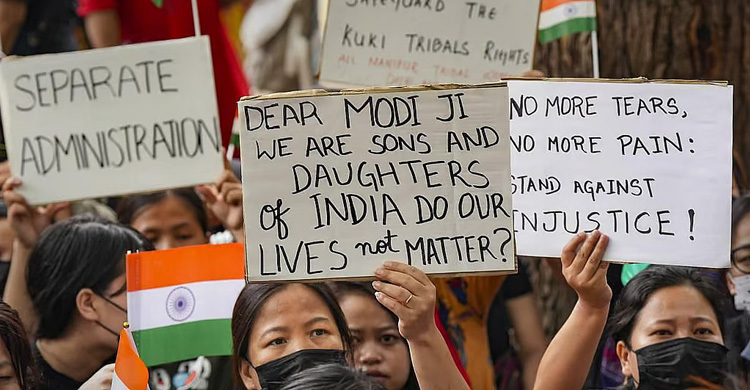
As Indian Prime Minister Narendra Modi arrives in Manipur for a high-profile visit, the Kuki Students’ Organisation Sadar Hills (KSOSH) has declared Saturday, September 13, a “Black Day” demanding a complete shutdown across Kangpokpi district and warning of “deterrent action” against any institution or individual failing to observe the day of mourning.
The move casts a sombre, politically charged shadow over the Prime Minister’s trip, intended to project stability and reconciliation, as grief and anger remain raw among the Kuki-Zo community more than a year after ethnic violence erupted in May 2023.
KSOSH has ordered all government and private offices, schools, and colleges in Kangpokpi to remain shut. Citizens are expected to participate in memorial prayers, silent vigils, and remembrance rallies to honour the hundreds killed, thousands displaced, and countless homes and churches razed in clashes primarily between Kuki, Meitei, and Naga groups.
“The grief has not faded. The wounds have not healed,” said a KSOSH spokesperson. “This is not a day for celebration, it is a day to remember what we have lost. Those who ignore this call will bear full responsibility for the consequences.”
The ultimatum underscores the deepening chasm between official narratives of peace and the lived reality of communities still reeling from trauma. While the state and central governments have attempted to project normalcy ahead of Modi’s visit, even planning cultural performances, many Kuki-Zo groups have rejected such displays as insensitive and premature.
The Imphal Hmar Displaced People’s Committee issued a poignant statement: “Our mourning is not yet over, our tears are not yet dried, our wounds are not yet healed. We cannot dance with joy.” The group urged authorities to cancel all celebratory events, calling them a “mockery of our suffering.”
Meanwhile, the broader Kuki-Zo Council, while acknowledging the historical significance of Modi’s visit, used the moment to reiterate long-standing political demands. In a carefully worded statement, the Council welcomed the Prime Minister’s presence but insisted that “symbolic visits” must be followed by “concrete justice.” Central to their demands is the creation of a separate administrative structure for Kuki-Zo-inhabited areas under Article 239A of the Indian Constitution, a proposal they argue is essential for lasting peace and self-governance.
Security has been heightened across the state, particularly in Kangpokpi and other Kuki-majority districts, with paramilitary forces deployed to prevent unrest. Local administrators have appealed for calm, while quietly urging institutions to comply with KSOSH’s directive to avoid escalation.
Observers note that the convergence of Modi’s visit and Black Day has turned Saturday into a litmus test, not just for law and order, but for the government’s willingness to confront the unresolved political and humanitarian crisis in Manipur.
As the Prime Minister addresses crowds in Imphal, just miles away, Kuki families will gather in makeshift camps and shattered villages, lighting candles, reciting prayers, and demanding not applause, but accountability.
In Manipur today, two realities exist side by side: one dressed in ceremonial garlands, the other draped in mourning cloth. How long the state can sustain this duality remains an open. and increasingly urgent, question.
Source: Sentinel Assam