
Taliban forbids 18 topics to study, bans books by women and Islamist thinkers

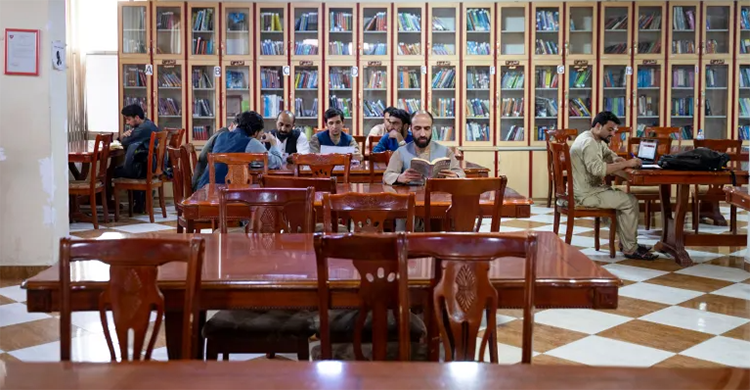
On a late August afternoon in Kabul, a professor at the city’s main university leafed through a worn copy of Social Justice in Islam by Sayyid Qutb. For years, he had used the book to spark heated classroom debates about religion, politics, and the role of the state. Now, the text is contraband. “I keep it hidden,” he says softly, lowering his voice in the echoing corridor. “If the students even ask about Qutb or Maududi, I have to pretend I don’t know.”
Afghanistan today is a country where books—once symbols of intellectual promise—have become targets of fear. Since retaking power four years ago, the Taliban have slowly suffocated academic life, first by barring women from education beyond sixth grade, then by closing midwifery schools, and now by banning entire subjects and purging hundreds of titles from classrooms and libraries.
Perhaps most shocking is the blacklist of Islamist thinkers whose views barely diverge from the Taliban’s own. Front and centre is Abul Ala Maududi—the very ideologue whose books fuelled the Mujahideen in the 1980s and whose party was one of their staunchest allies against the Soviet-backed regime. The irony is stark: the Taliban are now erasing a thinker who once helped lay the very foundations of their struggle.
The edict that silenced women authors
The most recent decree struck a particularly cruel blow: all books written by women are forbidden in universities. That means not only memoirs or feminist works, but even scientific texts such as Safety in the Chemical Laboratory, authored by a female Afghan scientist. In total, 140 books by women have been blacklisted.
“The logic is chillingly simple,” says Zakia Adeli, former deputy justice minister and herself among the banned authors. “If women cannot study, then their ideas must also disappear.”
This blanket erasure came alongside a sweeping ban on 18 academic subjects deemed “against Sharia and state policy.” Six of these are directly related to women:
Gender and Development
Women’s Sociology
The Role of Women in Communication
Women’s Leadership in Islamic Society
Women’s Rights and Justice
Theories of Women’s Participation in Politics
Other outlawed fields include Human Rights, International Law, Democracy Studies, Secular Government Structures, and Sexual Harassment Awareness. With one stroke, entire disciplines have been struck from the Afghan curriculum.
From Dante to Maududi: a paradox of censorship
The bans extend well beyond women and human rights. When the Taliban’s supreme leader, Mullah Hibatullah Akhundzada, issued a directive in July to cleanse Afghanistan of “deviant” texts, the purge reached both West and East.
On the Western side, titles such as Dante’s Divine Comedy, Yuval Noah Harari’s Sapiens, Joseph Smith’s Book of Mormon, and Kahlil Gibran’s The Prophet disappeared from shelves. Afghan librarians quietly mourned. “These books connected our students to world literature, philosophy, and history,” one said.
But the more surprising targets were the very ideologues who once inspired Islamist movements across the Muslim world. The banned list includes:
Kitab al-Tawhid by Mohammed ibn Abd al-Wahhab, the 18th-century preacher whose strict doctrines formed the basis of Wahhabism in Saudi Arabia.
Four Reforms in the Qur’an by Sayyid Abul A’la Maududi, the South Asian thinker whose writings animated Jamaat-e-Islami and shaped modern political Islam.
Social Justice in Islam by Sayyid Qutb, the Egyptian whose vision radicalised generations of Islamists.
Works of Jamal al-Din al-Afghani, Abdullah Azzam, and modern Iranian intellectuals such as Ali Shariati and Morteza Motahari.
For decades, these names have been lightning rods of debate across Muslim societies—praised, condemned, but never ignored. That the Taliban now place them alongside secular historians and women’s studies texts exposes a telling paradox: this is not a purge of un-Islamic thought, but of any thought not sanctioned by the Taliban themselves.
Control disguised as piety
Taliban officials defend the bans as necessary protection against “cultural invasion.” Noor Mohammad Saqib, the Minister for Religious Affairs, insists Afghanistan has long suffered from “foreign plots to undermine Islamic and Afghan values.” Committees of clerics now roam bookstores and libraries, confiscating anything that feels “suspicious.”
Yet the arbitrariness is striking. A Kabul publisher describes border agents blacking out images of people in imported Iranian texts, while local clerics—many without higher education—decide whether a book should be burned or shelved. “There is no process,” the publisher says. “It depends on the mood of the inspector.”
A void in Afghan education
The consequences are devastating. Iranian publications, once the primary source of textbooks for Afghan universities, are restricted. Professors are told to produce their own teaching chapters—without guidance, resources, or academic freedom. Students who once debated international law or gender theory now copy lecture notes about “obedience to the Emirate.”
“It is like being cut off from the world’s bloodstream,” says a professor in Herat. “We are left to survive on scraps.”
For women, the picture is even darker. Excluded from classrooms, silenced as authors, erased from textbooks, they are now excluded not just from education but from memory itself. “It is an attempt,” Adeli warns, “to create a future where Afghan women never existed.”
The narrowing horizon
By striking both liberal and Islamist thinkers from the shelves, the Taliban have revealed their strategy: to monopolise interpretation of Islam and Afghan identity. Neither Maududi’s reformism nor Ibn Wahhab’s puritanism is safe; only the Taliban’s voice may remain.
In the quiet of Kabul’s shrinking libraries, this truth is clear. Books—those of women, of reformers, of poets, of secular historians—are no longer sources of inquiry. They are evidence. And possession can be a crime.
Afghanistan, once a crossroads of scholarship and culture, is now being remade as a fortress of enforced silence. Its universities stripped of women and its bookshelves emptied of ideas, the country risks producing a generation that knows little beyond what the Taliban decree.
The professor in Kabul closes his copy of Qutb and hides it in a drawer. “We used to argue about whether Islam was compatible with democracy, or whether Maududi was too rigid,” he says with a sad smile. “Now the question is simpler: are we even allowed to think?”
Source: BBC, the Independent