
From fields to fortune: Women drive bean revolution in Ishwardi

Published: 15 February 2025, 03:07 PM
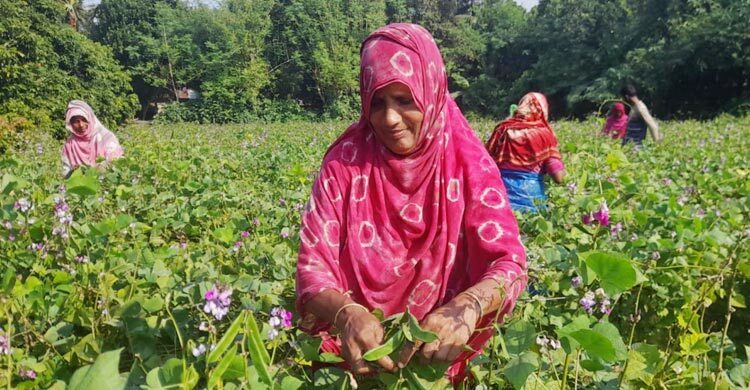
For nearly 25 years, Ishwardi in Pabna has been at the forefront of commercial bean cultivation, transforming the region into a thriving agricultural hub.
Behind this success lies the untold story of women—both farmers and labourers—who contribute approximately 70% of the effort to nurturing this valuable crop.
Farmers and agricultural officials alike acknowledge that women are the backbone of Ishwardi's bean revolution, playing an indispensable role in every stage of cultivation.
Bean farming is both capital-intensive and labour-demanding, requiring meticulous care throughout its growth cycle. While male farmers handle tasks like preparing seedling beds, planting, and spraying fertilizers and pesticides, the bulk of the maintenance work falls on women. From irrigation and vine management to harvesting and marketing, female workers shoulder the responsibility for ensuring a successful yield.
Abida Parveen, a seasoned bean farmer from Sheikh Para in Muladuli, shared her experiences with Jago News. "Beans are now the primary crop in our area," she said. "Cultivation begins in Jyaishta and continues until Chaitra, keeping us busy for 8-9 months each year."
Despite the high costs—around Tk 35,000 to Tk 40,000 per bigha — a good harvest can fetch profits up to Tk 1.5 lakh to Tk 2 lakh, significantly benefiting farmers. This year, favourable market prices have brought additional joy; Abida sold her one-bigha yield for Tk 1.7 lakh.
"Women work harder than men in bean cultivation," Abida noted. "Men handle initial planting, but women take over everything else—from watering and caring for the plants to picking flowers, removing dead leaves, and even negotiating sales with wholesalers."
She added that advancements in marketing have made life easier for women, as beans are now purchased directly from the fields, eliminating the need for manual transportation to markets.
Selina Khatun, a daily wage worker in the bean gardens, earns Tk 300 per day, working from dawn till early afternoon. "This income helps me pay for my children's education and buy goats," she explained. "It also supports my family during lean times." With prolonged employment opportunities spanning several months, Selina and others can make meaningful contributions to their households, improving living standards and economic stability.
Milan Hossain, another local bean farmer from Jhajharpara in Muladuli, confirmed the preference for hiring women workers due to their affordability and efficiency. "If a woman works from 7:00am to 2:00pm, we pay her Tk 300, whereas hiring a man for the same work would cost Tk 600-700," he revealed.
Consequently, women dominate the workforce in bean maintenance, creating a win-win situation where farmers save costs while women gain steady incomes.
Rumana Parveen, Agricultural Assistant for Muladuli Union, emphasised the critical role of women in driving Ishwardi's bean farming. "Except for sowing seeds, applying pesticides, and initial planting, women manage all aspects of bean cultivation," she said. Their involvement extends beyond traditional boundaries, encompassing intricate tasks such as selecting vines, pruning plants, and ensuring optimal irrigation.
According to Upazila Agriculture Officer Mita Sarkar, Ishwardi is renowned for its early bean production, with crops currently covering around 1,400 hectares of land.
"Women workers are integral to every step of the process, from preparation to harvest," she observed. "Their participation in agriculture is growing steadily, reflecting a positive shift in gender dynamics and contributing to the nation's economic development."
The bean industry not only boosts rural economies but also empowers women by providing them with financial independence. Many of these workers are homemakers or students seeking supplementary income, making bean cultivation a vital source of livelihood for families across Ishwardi.
Mita Sarkar highlighted the dual benefits of this trend: "Farmers benefit economically by utilizing women workers, while women gain skills, confidence, and financial security." As more women enter the agricultural workforce, their contributions to household finances and community development grow, signalling a promising future for gender equality in rural Bangladesh.