
Beijing assures Dhaka of no water withdrawal from Brahmaputra
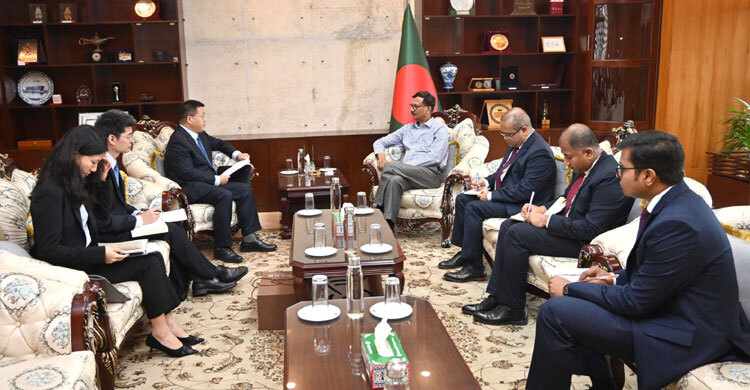
Beijing has formally assured Bangladesh that its massive new hydropower project on the Yarlung Zangbo River in Tibet, upstream of the Brahmaputra, will not involve water withdrawal or irrigation schemes, and therefore poses no threat to downstream flow.
Foreign Affairs Adviser Md Touhid Hossain shared this assurance on Thursday evening during a media briefing at the Ministry of Foreign Affairs.
The clarification came in response to growing concerns in Bangladesh over China’s construction of what is set to become the world’s largest hydroelectric project, located in southern Tibet.
“The Chinese ambassador met with me and provided detailed explanations,” Adviser Touhid Hossain said. “He clarified that this is not a conventional dam project aimed at storing or diverting water. Instead, China is using a new technology that harnesses the river’s flow in stages for power generation—without impounding or withdrawing water.”
He added: “He has assured us there is no irrigation component, and no plan to withdraw water from the river. Therefore, Bangladesh has no reason to be alarmed at this stage.”
The project, which is under construction on the Yarlung Zangbo River, known as the Brahmaputra once it enters India and Bangladesh, is expected to have a production capacity surpassing even the Three Gorges Dam , currently the world’s largest hydropower station.
According to Chinese state media, once fully operational, the Tibet-based plant could generate enough electricity to meet the annual demand of the entire United Kingdom. The estimated cost of the project is around $170 billion.
While acknowledging China’s assurances, Touhid Hossain emphasized that Bangladesh remains vigilant.
“Our rivers do not originate in our territory,” he noted. “Upstream, various structures have been built—and more will be built. We cannot stop these projects, but we must ensure they do not harm us.”
He reiterated Bangladesh’s official stance:
“We want hydrological data to be shared with our experts. Any project affecting transboundary rivers must be reviewed carefully and scientifically. Our goal is not to halt development, but to minimize or eliminate potential harm to our water security, agriculture, and millions who depend on the Brahmaputra.”
He also noted that India, another major downstream country, is closely monitoring the project and has expressed its own concerns.
The Yarlung Zangbo or Brahmaputra is one of South Asia’s most vital waterways. It flows from Tibet through Arunachal Pradesh (India), into Assam, and finally into Bangladesh as the Jamuna River, merging with the Ganges and Meghna to form one of the world’s largest delta systems.
Millions of farmers, fishermen, and communities across Bangladesh and northeastern India depend on its seasonal flow for irrigation, navigation, and livelihoods. Any significant alteration in flow—especially during the dry season—could have devastating consequences.
Bangladesh has committed to maintaining continuous dialogue with both China and India on transboundary river issues. The government will continue to advocate for transparency, data sharing, and sustainable practices in upstream projects.
“We are not against development,” said Touhid Hossain. “But development must be cooperative, not at the expense of others. Our message is clear: keep the river flowing for peace, for people, for the future.”