
Beyond the past: How far can Bangladesh and Pakistan progress?

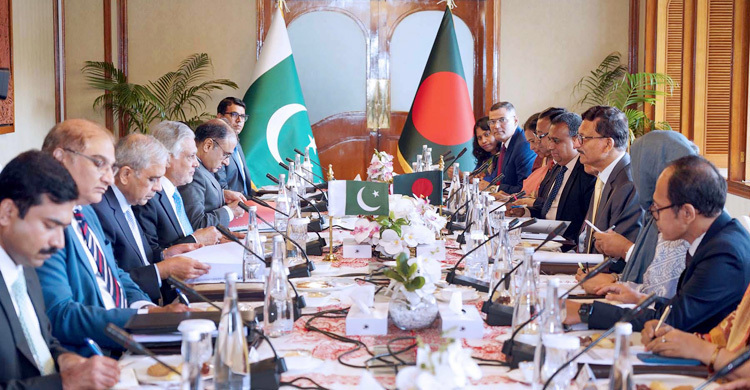
The recent visit of Pakistan’s Foreign Minister Ishaq Dar to Dhaka has sparked both cautious optimism and deep reflection within diplomatic circles, raising fundamental questions about the future trajectory of bilateral relations between Bangladesh and Pakistan.
While the trip yielded several agreements and institutional mechanisms aimed at enhancing cooperation, underlying historical grievances and structural challenges continue to cast a long shadow over prospects for meaningful reconciliation.
Agreements and institutional momentum
During his two-day visit last week, Foreign Minister Dar participated in the signing of one agreement, four memorandums of understanding (MoUs), and a joint programme of cooperation.
Notably, both sides agreed to establish a Bangladesh-Pakistan Trade and Investment Commission, while also resolving to reactivate the long-dormant Joint Economic Commission, last convened over 15 years ago, during the upcoming visit of Pakistan’s Commerce Minister Jam Kamal Khan.
These developments mark a notable uptick in diplomatic engagement, particularly after years of limited high-level interaction. Analysts acknowledge that such institutional frameworks could lay the groundwork for enhanced economic ties, including trade, investment, and connectivity.
However, as many foreign policy experts stress, technical cooperation alone cannot substitute for the deeper political and historical reconciliation necessary to build enduring trust.
The unresolved legacy of 1971
At the heart of the current diplomatic discourse lies the unresolved legacy of 1971, the year Bangladesh emerged as an independent nation following a brutal liberation war against Pakistan. For Dhaka, the events of that year remain a cornerstone of national identity, encompassing immense human suffering, widespread atrocities, and the struggle for self-determination.
Professor Dr Imtiaz Ahmed of the Department of International Relations at Dhaka University observed that Pakistan has consistently used the term “regret” rather than offering a formal apology, a distinction with significant moral and diplomatic weight.
“From the Simla Agreement to General Musharraf’s visit in 2002, there has never been a direct acknowledgment or apology,” Dr Ahmed noted.
“True reconciliation cannot be achieved by bypassing history. If the issues were truly settled, they would have been formally closed in a summit-level joint declaration.”
He drew comparisons with global precedents: “Germany apologised to Israel; France acknowledged its colonial past; Japan expressed remorse for wartime actions. Why can Pakistan not extend a similar gesture to Bangladesh?”
Former Ambassador M Shafiullah echoed this sentiment, emphasising that sustainable relations must be rooted in mutual recognition of historical truth. “The wounds of 1971 are embedded in our collective memory,” he said. “Without a clear, formal apology, trust cannot be built. Words like ‘regret’ are diplomatic evasions, they do not heal.”
Ambassador Shafiullah also questioned the claim, repeated by Ishaq Dar during his visit, that the issues stemming from 1971 have been “resolved twice.” He pointed to outstanding matters, including the distribution of assets from the pre-1971 period, the use of international aid intended for victims of the 1970 Bhola cyclone, and the repatriation of stranded Pakistanis still residing in Bangladesh.
“The Simla Agreement touched upon these issues, but they were never fully implemented,” he said. “When President Pervez Musharraf visited in 2002 and said, ‘If anything happened, we regret it,’ it was a political maneuver to avoid accountability. The current rhetoric follows the same pattern.”
Tensions beneath the surface
According to diplomatic sources within Bangladesh’s Ministry of Foreign Affairs, while the visit adhered to formal protocol and maintained a cordial tone, bilateral discussions became strained when Dhaka raised unresolved historical issues.
“In one session, the Pakistani delegation appeared visibly uncomfortable when war crimes, genocide, and pending claims from the 1971 period were brought up,” a senior official disclosed. “Despite Bangladesh presenting documented evidence and legal arguments, Pakistan offered no new response, only restatements of past expressions of sorrow.”
It was during a post-meeting press briefing that Foreign Minister Dar stated the 1971 issues had been “resolved twice”, a claim swiftly rejected by Bangladesh’s Foreign Affairs Adviser, Touhid Hossain.
“Such assertions do not reflect the reality on the ground or the sentiments of the Bangladeshi people,” Dr. Hossain said. “We agreed to continue dialogue on these matters, but closure has not been achieved.”
Beyond geopolitical calculations
A key concern among Bangladeshi policymakers is the perception that Pakistan’s renewed outreach is driven less by a desire for genuine reconciliation and more by strategic calculations, particularly its tense relationship with India.
Professor Imtiaz Ahmed warned against allowing bilateral ties to become “India-centric.”
“Pakistan should not view Bangladesh as a counterweight to India,” he said. “Our relationship with India is a separate matter. We will pursue regional peace and cooperation on our own terms, not as a proxy in another country’s geopolitical game.”
There has also been quiet concern regarding the reported role of China in facilitating Pakistan’s diplomatic overtures. While Beijing maintains strong ties with both nations, Foreign Affairs Adviser Touhid Hossain stressed that Bangladesh prefers direct, bilateral dialogue without third-party mediation.
Next steps: A cautious outlook
Diplomatic sources indicate that discussions are underway for a visit by Pakistan’s Finance Minister to Dhaka, which could focus on economic collaboration and debt restructuring. In return, there are tentative plans for Bangladesh’s Home Minister or the Secretary of Public Security Division to visit Islamabad, an effort to reciprocate the recent visit of Pakistan’s Interior Minister.
However, a senior Foreign Ministry official cautioned that the timing remains uncertain. “Bangladesh is currently in an election-sensitive period. While dialogue is welcome, the pace and depth of engagement will depend on domestic priorities and the sincerity of Pakistan’s long-term commitment.”
Relations at a crossroads
The Dar visit has rekindled diplomatic momentum between Bangladesh and Pakistan, but the path ahead remains complex. While new economic frameworks offer potential, the absence of a sincere reckoning with history continues to hinder deeper trust.
For relations to move beyond symbolism and protocol, analysts agree that Pakistan must move beyond expressions of regret and engage meaningfully with the historical, legal, and humanitarian dimensions of 1971.
As Dr Imtiaz Ahmed put it: “You cannot build a future on unhealed wounds. True friendship begins with truth.”