
Farhad Mazhar wants nurses’ inclusion in health decision-making

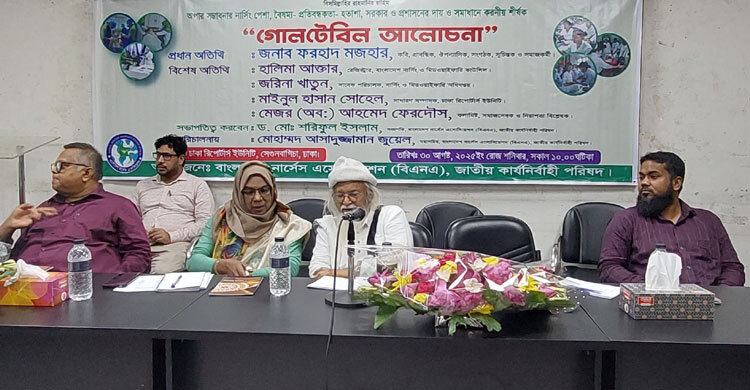
Thinker Farhad Mazhar has urged that nurses be brought into the heart of healthcare decision-making to improve and strengthen Bangladesh’s public health system.
Speaking at a roundtable discussion in Dhaka on Saturday, August 30, he stressed that relying solely on doctors for decisions is insufficient and called for a more inclusive, people-centred approach.
“The health system cannot be truly reformed without involving nurses in policymaking,” Mazhar said at the event, titled ‘Nursing Profession: Immense Potential, Discrimination, Obstacles and Despair – The Responsibility of Government and Administration, and the Way Forward’.
“We must remember that healthcare is about serving the people, not serving the medical industry. A public-friendly health service council must be established. If we fail to prioritise service, the public will no longer support us. Nursing must become central to the health system,” he said
Mazhar highlighted the indispensable role of nurses, noting that medical work, especially surgery, is impossible without skilled and trained nursing staff. “Doctors and nurses work together, yet doctors cannot function without nurses,” he said. “Surgical procedures cannot be performed without competent nursing support.”
He also pointed to longstanding challenges within the nursing profession, including issues related to job placements, promotions, and internal divisions. “I’ve heard there are groupings and factions among nurses,” he said. “But if nurses can unite and speak with one voice, decision-makers will listen, including Dr Yunus. Nurses must be formally integrated into the national health system, given due respect, and provided proper training. Without improving the nursing profession, there can be no meaningful improvement in healthcare.”
Mazhar also criticised the prevailing mindset that views nursing as a secondary profession. “When nursing education is so text-based, students aspire to become doctors, not nurses,” he said. “We need to change this perception and elevate the dignity of the profession.”
He further warned against the influence of the private sector, where he believes nurses are often undervalued and exploited. “Most doctors prescribe medicines based on what pharmaceutical companies promote,” he said. “And in the private sector, nurses are not seen as professionals—they are used as mere labour.”
The event also heard from Mainul Hasan Sohel, General Secretary of Dhaka Reporters Unity, who raised serious concerns about corruption within the Department of Nursing and Midwifery.
“This is the most corrupt institution in the health sector,” Sohel alleged. “No service is provided without money. I’ve been approached at least 20 times to help secure the transfer of a nurse in distress, but nothing can be done without paying bribes. Work simply doesn’t happen without financial transactions.”
He urged nurses to overcome internal divisions. “Fragmentation is holding back professional progress. If you unite and move forward collectively, you will achieve results.”
The discussion was chaired by Dr Md Shariful Islam, President of the Bangladesh Nurses Association (BNA), and moderated by BNA General Secretary Md Asaduzzaman Jewel. Other participants included Zarina Khatun, former Director of the Department of Nursing and Midwifery, and representatives from nursing and media organisations.