
Civic forum seeks plan to lower road fatalities in election manifestos

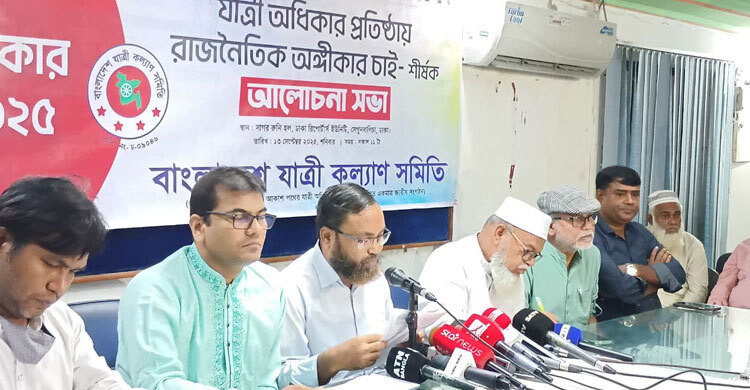
As Bangladesh prepares for its next national election, the Bangladesh Jatri Kalyan Samiti has issued an urgent call for all political parties to include concrete, actionable plans in their election manifestos to curb the country’s spiralling road accident fatalities and crippling traffic congestion — crises that have claimed tens of thousands of lives and cost the economy nearly Tk 100,000 crore annually.
Speaking at a discussion on “Passenger Rights Day” held at the Dhaka Reporters Unity on Saturday morning, the association’s Secretary General, Md Mozammel Haque Chowdhury, revealed that over the past 11 years, 86,690 people have lost their lives in road accidents, while another 1,503,257 have been injured. He stressed that these are not just statistics — they represent a national emergency demanding immediate political will and systemic reform.
Citing World Bank data, Chowdhury said that in Dhaka alone, 3.2 million working hours are wasted every day due to traffic gridlock — translating into an annual economic loss of approximately Tk 98,000 crore. Fuel wastage alone amounts to around Tk 11,000 crore per year. But beyond the financial toll, he warned of a deeper, more insidious cost: the devastating impact on public health.
“Prolonged exposure to traffic jams isn’t just costing us time and money — it’s eroding our physical and mental wellbeing,” Chowdhury said. “Health experts confirm that chronic traffic stress is weakening our immune systems, triggering high blood pressure, respiratory illnesses, heart disease, kidney dysfunction, and even reproductive harm. Noise and air pollution from idling vehicles are compounding these risks. And psychologically, citizens are becoming increasingly irritable and anxious — so much so that studies suggest the risk of family breakdown rises by 50 per cent due to daily commuting stress.”
He added that children are not spared: “There is growing evidence linking traffic-induced stress and pollution to impaired cognitive development in children and neurological damage. Many now believe the frustration and idleness bred by endless traffic jams are contributing factors behind rising youth risk-taking, unemployment, and social unrest.”
Chowdhury criticised the 2018 Road Transport Act as a failed legislative effort, arguing that it ignored the voices of passengers and civil society and failed to address root causes. “Without a robust, efficient public transport system, citizens have been forced into unsafe, unregulated alternatives — ride-sharing motorcycles, easy-bikes, and auto-rickshaws now dominate our roads. Fifty-six per cent of commuters rely on private vehicles simply because there is no viable public option.”
He blamed “corruption and misguided policies” of the previous administration for allowing traffic chaos to metastasise from urban centres to villages and port cities. More troubling, he noted, is the silence of the current interim government. “The ‘new Bangladesh’ that emerged at the cost of thousands of student and civilian lives has yet to initiate a single meaningful reform in the road transport sector,” he said.
In light of this inaction, the association is now demanding that every political party contesting the upcoming national election include specific, measurable strategies in their manifestos to reduce road fatalities and alleviate traffic suffering. “We are not asking for vague promises. We want commitments: investment in mass transit, strict enforcement of traffic laws, redesign of urban mobility, and accountability for transport operators. Thousands of lives depend on it.”
The meeting was attended by a cross-section of civil society and political leaders, including Professor Dr. Major (Retd.) Abdul Wahab Minar, Senior Vice Chairman of the AB Party; Faruk Hasan, Senior Vice President of the People’s Rights Council; Deepak Roy, Central Secretary of the People’s Solidarity Movement; Ariful Islam Adeeb, Senior Joint Convener of the National Citizens Party; former association chairman Sharif Rafiquzzaman; and Supreme Court lawyers Md. Yasin Chowdhury and Md. Billal Hossain, among others.
As election manifestos take shape in the coming weeks, pressure is mounting on political parties to move beyond rhetoric — and finally confront one of Bangladesh’s most persistent, deadly, and economically draining crises.