
Jamdani: Woven air, living heritage – Bangladesh’s first-ever exposition in Delhi

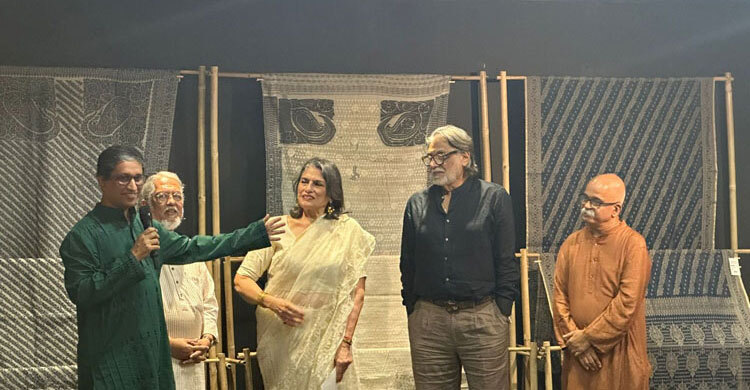
Bangladesh High Commission has opened the doors to a rare cultural offering in the Indian capital: the first-ever Bangladeshi Jamdani Exposition at the National Crafts Museum.
Running until September 23, the five-day showcase brings audiences face to face with one of South Asia’s most celebrated textile traditions, a fabric that has been called “woven air.”
Curated by Indian textile revivalist Chandrashekhar Bheda, the exhibition places Bangladesh’s Jamdani at the centre of artistic dialogue.
From contemporary masterpieces by master weavers to two rare 150-year-old saris, the display testifies to a craft that has defied time and mechanisation. “Jamdani cannot be replicated by machine,” Bheda declared at the opening. “Its sheer transparency and delicacy are like weaving magic that floats in the air.”
Adding to this depth, Bangladeshi craft pioneer Chandrashekhar Saha drew a historical arc. “Once, Bengal’s muslin reigned supreme,” he reminded. “Jamdani stands on that same pedestal — an art that can only be understood by seeing and touching. It is our duty to ensure its legacy endures.”
Echoes of admiration
The evening resonated with voices from India’s cultural world. Designer and Padma Shri awardee Sunita Kohli described Jamdani as “woven air” and elaborated: “Emperors coveted it, traders carried it across seas, and poets tried to capture its fineness. UNESCO calls it intangible cultural heritage — I call it intangible luxury, measured not by price, but by patience, time, and human hands.”
For filmmaker and designer Muzaffar Ali, Jamdani represented a bridge: “A true delight of light and texture — beauty that can unite nations through a shared appreciation of craft.”
An inspiration born of celebration
High Commissioner Riaz Hamidullah, who conceived the initiative, said the idea took root during Bangladesh’s Independence Day celebrations earlier this year. “We displayed Jamdanis then, and the response was overwhelming,” he noted. “Through this exposition, we hope more people discover the timeless beauty of Jamdani.”
Visitors also had the chance to witness the weaving process firsthand. National award-winning artisans Mohammad Jamal Hossain and Mohammad Sajeeb demonstrated the intricate art live, their looms revealing how motifs emerge slowly, almost imperceptibly, over weeks and months.
A collector’s wisdom
Among the attendees was Delhi-based textile collector Asaf Ali, who brought along two vintage Jamdani sarees. Holding up one, he said with quiet pride: “This is not just fabric. It is history. Look at the floral motifs, the paisleys, every pattern drawn by hand. The cotton is so fine, it feels like silk, yet it breathes. Queens and nobles once wore this. It travelled the world.”
He spoke of heritage with reverence: “Every thread tells a story. These were woven in small Bangladeshi villages, often by women, the skills passed from mother to daughter. Natural indigo, pure cotton, no chemicals — and months of labour for a single piece.”
For him, Jamdani is more than cloth: “When you wear it, you wear tradition. You carry the legacy of hundreds of artisans. That is why people still love Jamdani today — because it is not just clothing, it is art. It is a piece of living heritage.”
A cultural bridge
The inauguration drew diplomats, artists, filmmakers, and textile connoisseurs from India and beyond, turning the exposition into more than an exhibition: it became a cultural bridge. Each Jamdani on display stood as a testament to the patience of artisans and the shared heritage of the subcontinent.
Until September 23, visitors to the Crafts Museum can trace the delicate threads of a tradition that has survived empires, colonialism, and industrialisation, and continues, still, to float like air.