
Yunus urges fair tax rules and debt reform to unlock $4tr SDG gap

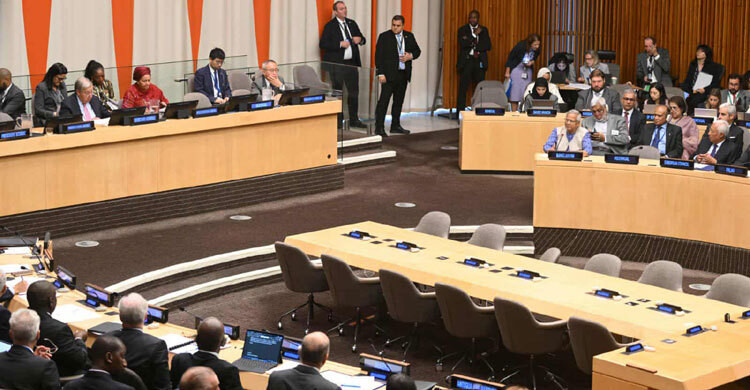
At the United Nations on Wednesday, Bangladesh’s Chief Adviser Professor Muhammad Yunus warned that global promises on sustainable development risk becoming “empty words” unless wealthy nations and multinationals shoulder their share of responsibility.
Speaking at the First Biennial Summit for a Sustainable, Inclusive and Resilient Global Economy in New York, Yunus demanded progressive global tax rules, fair debt governance, and stronger aid commitments, warning that UN budget cuts and shrinking official development assistance (ODA) would be “catastrophic” for vulnerable nations.
“Tax systems must be transparent and ensure multinational corporations pay their share,” Yunus said. “Debt should be a tool for resilience and development, not austerity.”
He called for negotiations under the UN Framework on International Tax Cooperation to address systemic inequities that disadvantage poorer countries.
A $4 trillion gap
Yunus underscored the scale of the challenge: an annual $4 trillion financing gap for the Sustainable Development Goals (SDGs). He said the Seville Commitment offers a path forward by tackling illicit flows, strengthening development banks, and demanding accountability from global institutions.
Bangladesh, he noted, is hosting 1.3 million Rohingya refugees while grappling with climate shocks and economic turbulence — a burden that, he argued, underscores why global solidarity cannot be allowed to falter.
Social business and innovation
Highlighting Bangladesh’s experience with microfinance, renewable energy and social business, Yunus urged greater support for innovative financing models and citizen participation, stressing that youth engagement and transparency are crucial for trust.
He laid out five priorities: fair taxation, protecting aid flows, scaling up social business, reforming global finance, and directing investment to the most vulnerable through climate-smart agriculture, resilient housing, healthcare and education.
“An economy of dignity”
Closing his address, Yunus framed the agenda in moral terms: “The Seville Commitment charts the course; our humanity calls us to journey on it. Let us build an economy of dignity, shared prosperity, and resilience, ensuring no one is left behind.”
The summit, attended by heads of state, finance ministers and development leaders, is seen as a test of whether the international community can overcome geopolitical divides to finance the 2030 Agenda.