
‘One in five disaster victims develops mental disorder’


Disasters or emergency situations not only cause physical harm but also significantly affect mental health. One in every five people impacted by such situations develops a mental disorder, particularly those with pre-existing conditions.
Retired psychiatrist Professor Dr. Nilufar Akhter Jahan of the National Institute of Mental Health and Hospital made these remarks at a roundtable discussion titled “Mental Health Services in Disaster and Emergency Situations.” The event was organised on Thursday (October 9) at Jago News’ office in Middle Badda, Dhaka, ahead of World Mental Health Day.
Nilufar Akhter said almost everyone experiences some form of mental health reaction during disasters or emergencies, including anxiety, depression, anger, sleep disturbances, loss of interest in work, and physical symptoms. For most, these reactions improve over time. However, she cautioned that one in five may go on to develop a mental disorder, especially those already struggling with mental health issues.
Types and Symptoms of Disorders
Citing studies, she noted that nearly 22 percent of people face mental health problems after disasters. Of them, 13 percent suffer from mild disorders such as anxiety disorder, depressive disorder, acute stress disorder, and post-traumatic stress disorder (PTSD), while 9 percent are affected by severe conditions like schizophrenia or bipolar disorder.
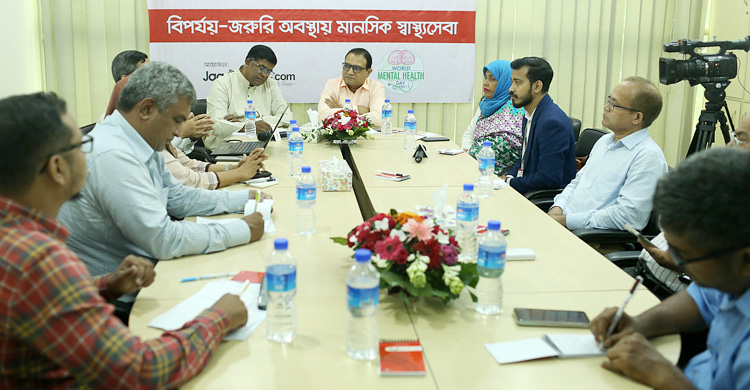 Jago News Editor KM Zeaul Haque chairs a roundtable discussion titled ‘Mental Health Services in Disaster and Emergency Situations,’ held on Thursday at the news portal’s Jago News office in Middle Badda, Dhaka.
Depressive disorder can cause prolonged sadness, loss of interest in work, and even suicidal thoughts. Anxiety disorder manifests as excessive worry, anger, sleep problems, and physical symptoms such as chest tightness and shortness of breath.
Acute stress disorder and PTSD often follow major accidents or disasters. If acute stress disorder persists beyond a month, it may develop into PTSD. Patients typically experience recurring flashbacks, repetitive dreams, and avoidance of situations related to the incident. Professionals frequently exposed to life-threatening events, such as journalists or police officers, are also at higher risk of PTSD.
Treatment and Services
Professor Jahan underscored the need to strengthen Bangladesh’s mental health system to ensure timely care after disasters. She called for initiatives in both public and private sectors to provide immediate mental health support and stressed the importance of forming specialised teams of trained psychiatrists and setting up dedicated service centres.
She further emphasised that anyone affected by situations impacting mental health must receive appropriate care. To that end, the country should expand mental health units and services to ensure no one suffers from psychological distress when facing a disaster.