
New strategic heat: How Dhaka-Ankara ties transform from friendship to partnership

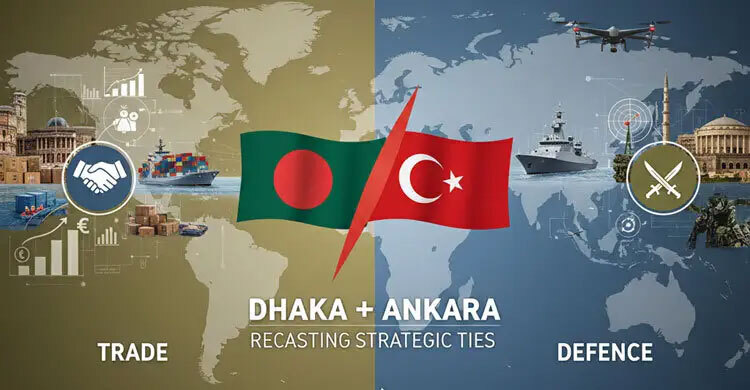
After years of polite but distant diplomacy, Bangladesh and Turkey are suddenly rediscovering each other—this time, with purpose and precision.
Since the political transition in Dhaka, bilateral ties have shifted gears dramatically, gaining new life through high-level visits, strategic discussions, and a bold new vision: to move beyond rhetoric and build a defense and development partnership anchored in trust, trade, and technology.
From dialogue to deals: A defense framework in the making
For years, the two countries have signed small defense-related memorandums of understanding. Now, they’re preparing to gather those fragments under a single roof.
According to diplomatic sources, preparations for a landmark “Defense Framework for Cooperation” are nearly complete. The draft has already been finalized and sent to Ankara, and the issue will take center stage during Bangladesh Army Chief General Waker-uz-Zaman’s visit to Turkey in November.
The proposed framework would pave the way for joint production, training, and technology exchange—potentially transforming Bangladesh from a defense buyer into a defense partner.
Turkey’s head of Defense Industries, Haluk Görgün, who visited Dhaka in July, pledged support for Bangladesh’s growing defense industry, including technical and strategic assistance for the modernisation of the Bangladesh Ordnance Factory (BOF).
A senior Bangladeshi official hinted that a joint production plan with Turkish participation is already being discussed:
“Our goal isn’t just to buy weapons—it’s to build capacity. If we can produce locally, even export someday, that would be a breakthrough.”
Turkey, a NATO member and one of the world’s top 15 arms exporters, offers high-quality systems with strong after-sales support—a combination that Bangladeshi officials say gives Ankara an edge over traditional partners like China.
A new warmth in diplomacy
Behind the defense talks lies a deeper political thaw. After a decade of quiet distance, the two countries have found new alignment following the change of government in Dhaka.
Turkish First Lady Emine Erdoğan was among the first world figures to congratulate Chief Advisor Dr. Muhammad Yunus after his swearing-in. President Recep Tayyip Erdoğan followed up with a personal phone call.
Within weeks, delegations began shuttling between Dhaka and Ankara. Turkish officials visited Bangladesh to review development sectors, while Bangladeshi teams traveled to Turkey to explore cooperation in defense, trade, and governance.
“Earlier, relations were cordial but static,” a senior Foreign Ministry official admitted. “Now, there’s genuine warmth and a shared sense of opportunity. Ankara sees Bangladesh as a rising partner in the region.”
Faith, politics, and pragmatism
Diplomats say this renewed enthusiasm is driven by more than economics. It’s also ideological and personal.
President Erdoğan and Dr Yunus share a long acquaintance—rooted in Yunus’s pioneering work with microcredit programs in Turkey years ago. Ankara, meanwhile, envisions a more cohesive Islamic world, with Bangladesh as an important voice within it.
During the previous government, Turkey perceived Dhaka as leaning away from the Islamic bloc. “That has changed,” says a senior Bangladeshi diplomat in Ankara. “Now, Turkey feels it can have open conversations with all political forces in Bangladesh, including Islamic parties.”
Diplomacy in overdrive
The past year has seen an unusually high number of bilateral visits—more than in the previous five years combined.
January 2025: Turkish Commerce Minister Omer Bolat visits Dhaka, meeting Chief Adviser Dr Yunus to discuss trade expansion.
February: Foreign Secretary (East) Nazrul Islam travels to Ankara for talks on finance, defense, and industry.
April: Foreign Affairs Advisor Touhid Hossain meets Turkish Foreign Minister Hakan Fidan at the Antalya Diplomacy Forum.
July: Defense Industries head Haluk Görgün visits Dhaka, followed by Bangladesh Youth and Sports Adviser Asif Mahmud Sajib Bhuiyan’s trip to Ankara.
October: Turkish Deputy Foreign Minister A. Beris Ekinci arrives in Dhaka for the first Foreign Office Consultation (FOC) in six years.
November (upcoming): Bangladesh Army Chief’s official visit to Turkey, expected to seal new defense agreements.
Building economic and cultural bridges
Trade and investment are emerging as the second pillar of this new partnership. The Bangladesh Investment Development Authority (BIDA) and Turkish business forums are now exploring joint ventures in energy, textiles, and shipbuilding. The Bangladesh–Turkey Joint Economic Commission is scheduled to meet in February 2026 to push these plans forward.
Ambassador Amanul Haque, Bangladesh’s envoy to Ankara, says the renewed engagement signals “confidence and commitment.”
“The Turkish government’s trust in Bangladesh’s interim administration has opened doors for concrete cooperation—especially in defense, technology, and trade.”
Strategic convergence in a shifting world
Geopolitically, this warming of ties comes as both nations seek to diversify alliances. Bangladesh wants to reduce overdependence on traditional defense suppliers like China and Russia, while Turkey is looking eastward—to South Asia—for new partners in production and trade.
Former ambassador Shafiullah summed it up: “Islamists have gained new visibility in Bangladesh’s politics. Turkey, as a NATO member and a major OIC player, sees this as an opportunity to build deeper, values-based ties. For Bangladesh, stronger relations with Turkey mean access to modern defense technology and new diplomatic leverage.”
The bottom line: From symbolism to substance
After years of polite exchanges and stalled initiatives, Bangladesh–Turkey relations are finally in motion—anchored not just in faith or friendship, but in shared strategic interests.
If the Defense Framework for Cooperation is signed later this year, it will mark a turning point: Bangladesh’s emergence as a proactive defense partner, and Turkey’s return as a trusted ally in South Asia.
What began as a quiet thaw has turned into a strategic embrace—a partnership that could reshape not just bilateral relations, but the regional balance of diplomacy itself.