
Back-to-back fires ‘not accidents, possibly sabotage’: Ex fire chiefs warn

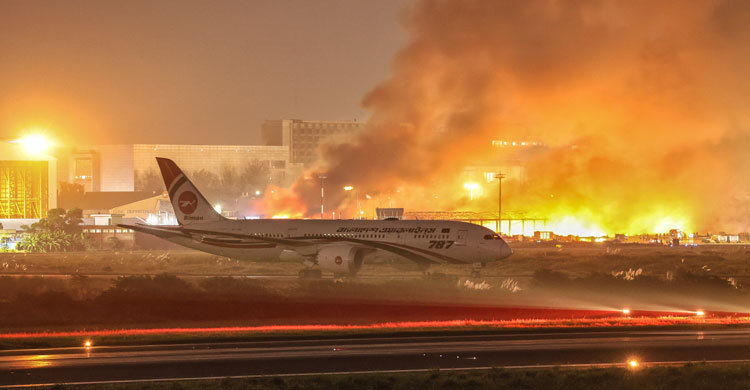
As flames continued to rage for hours at the Cargo Village of Dhaka’s Hazrat Shahjalal International Airport — following another massive blaze just days earlier at Chattogram EPZ — questions are burning louder than the fire itself.
Two former Directors General of the Fire Service suspect that these back-to-back infernos may not be coincidences at all, but signs of “planned sabotage” aimed at destabilizing the country.
“Fires of this scale are never Normal”
Former Fire Service DG Brigadier General (Retd.) Engineer Ali Ahmed Khan told Jago News that such large-scale fires occurring in quick succession cannot be treated as routine accidents.
“Especially at Shahjalal Airport — a Key Point Installation (KPI) — where 24-hour surveillance is mandatory, this kind of fire should not have burned for so long,” he said.
He pointed out that the airport has its own dedicated Fire Service unit, capable of handling aircraft fires. “Even with such a strong team present, the fire taking hours to control signals serious negligence by the authorities,” he said, calling for a swift, transparent investigation.
“The cause, the delay in response, and the failure to contain it — everything must be clarified,” Khan emphasized. “These incidents are not just property losses; they damage Bangladesh’s global image and economy.” He further warned that, with national elections approaching, the fires could be part of a broader attempt to shake internal stability.
Signs of sabotage can’t be ruled out
Echoing similar concerns, another former Fire Service DG, Brigadier General (Retd.) Abu Nayeem Md Shahidullah, said, “The frequency and timing of these fires suggest the possibility of sabotage. It’s unusual and alarming that a well-equipped facility like Shahjalal Airport failed to contain the fire quickly.”
He added, “Given how one major fire after another is breaking out, we must consider whether there’s a deliberate effort to weaken the economy. Sabotage may be hiding behind the façade of ‘accidents’.”
‘Weak management is the first spark’
Shahidullah pointed to management failure as a major cause behind the escalating disasters.
“Initial response, fire alarms, and water supply coordination — all of these fall under management. The lack of preparedness is visible,” he said. “There should be no room for such lapses at a national installation like the airport.”
He also stressed the need to verify whether joint drills between Fire Service and airport authorities are being held regularly. “Without drills, coordination collapses in real emergencies,” he noted.
Urgent call for a transparent, tech-based probe
Both former fire chiefs have demanded an immediate, neutral and technology-driven investigation into the successive fires. “Unless we know who or what is behind these incidents — or whether they’re truly accidental — such disasters will keep recurring,” they warned.
The blaze at Shahjalal Airport’s Cargo Village began around 2:30 pm on Saturday (October 18). Thirty-seven units from 13 fire stations, along with the Bangladesh Air Force and Navy, rushed to the scene. A remote-controlled firefighting robot was deployed to tackle the flames up close.
Just two days earlier, a devastating fire had engulfed Adams Caps & Textile Ltd. and Zhihong Medical Company at the Chattogram Export Processing Zone. It took 17 hours to control. Both factories, located in a seven-story building, lacked a fire safety certificate. Explosions were heard through the night, and the heat was so intense that firefighters couldn’t approach the source directly.
“Two sides of the building had no access space — a clear violation of fire safety codes,” said Lt. Col. Mohammad Tajul Islam Chowdhury, Fire Service Director (Operations & Maintenance). “That’s why it took so long to control.”
A pattern too alarming to ignore
With two of the nation’s most critical installations — an international airport and an export hub — suffering devastating fires within days, experts say Bangladesh can no longer dismiss these as mere accidents. Whether due to negligence, mismanagement, or orchestrated sabotage, the flames have already scorched public trust — and raised fears of something far more dangerous smoldering beneath.