
Earthquake leaves deep scars across Narsingdi, buildings tilt, ground splits

Published: 22 November 2025, 04:20 PM
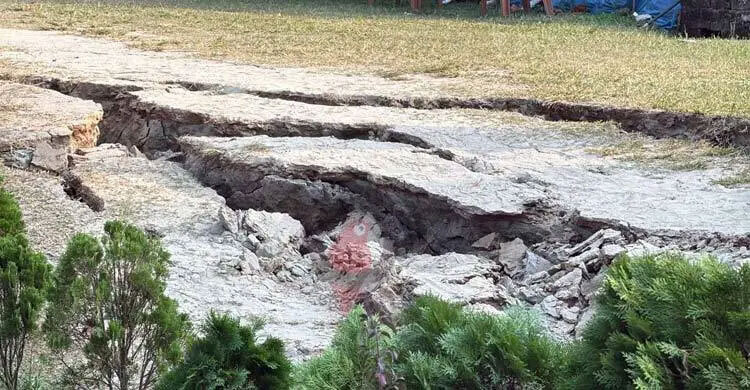
Narsingdi continues to grapple with shock and devastation after Friday’s massive earthquake – the strongest ever recorded in the district’s history.
The tremor struck with such ferocity that the ground in several areas split open, buildings tilted on their foundations and key installations suffered heavy damage.
Though two days have passed since the quake, fear remains deeply rooted among residents who are still spending nights outdoors, afraid their already weakened homes may collapse.
Authorities have so far confirmed five deaths in the district. Many others have been injured, while countless families remain displaced or too traumatised to return indoors.
Epicentre in turmoil
In Palash and Madhabadi – areas closest to the epicentre – scenes of destruction stretch across roads, courtyards and neighbourhoods. What once looked like ordinary urban landscapes now resemble disaster zones.
At Palash Residential Model College, the courtyard has visibly sunk, creating uneven ground and sudden depressions. A corrugated-sheet-roofed structure near the main entrance sits precariously on a cracked concrete slab, its floor visibly split.
Students and staff who visited the site on Saturday were left stunned by the scale of damage.
Inside the sprawling Ghorashal Dairy Farm, the earthquake tore through the earth with exceptional force.
Several parts of the ground have collapsed into gaping pits, leaving cracks between 6 and 8 inches wide. Farm workers said the ground “moved like waves” during the quake.
Key infrastructure damaged
The Ghorashal Thermal Power Plant, one of the district’s most vital installations, experienced a transformer fire triggered by the violent shaking. Flames and smoke rose from the substation shortly after the quake, damaging critical components.
Most other transformers had to be disconnected, plunging parts of the district into power disruption and raising concerns about longer-term outages.
Engineers assessing the site said the tremor may have compromised some internal structures, though a complete evaluation is still ongoing.
Homes and markets hit hard
In surrounding residential areas, especially Ghorashal, numerous houses have developed long cracks along walls and floors. Six homes have been marked as severely damaged.
SA Plaza, a seven-storey shopping mall, now stands with visible structural fractures spreading across its facade – prompting authorities to restrict access until safety tests are completed.
Ghorashal Bazar, normally busy with shoppers, now bears signs of the quake’s fury.
Bricks and concrete chunks fell from the roofs and parapets of several shops, damaging goods and injuring some residents. Traders spent Saturday sweeping up debris while trying to gauge the losses.
Reports from Madhabadi, Palash and multiple parts of Narsingdi town indicate that several buildings have tilted slightly – a worrying sign that structural integrity may have been compromised.
Authorities race to assess damage
Deputy Commissioner Anwar Hossain said the administration has mobilised field teams to collect detailed damage reports. “Every UNO and municipal administrator has been instructed to conduct a thorough assessment. We are expecting consolidated reports by tomorrow,” he said.
The district administration has already provided Tk 25,000 to each bereaved family, along with funeral support. Medical treatment has been arranged for the injured, and local hospitals have been put on alert for potential aftershocks.
Lingering fear clouds the district
Despite official reassurance, residents remain deeply shaken. Families in the worst-hit areas spent Friday and Saturday nights outdoors, fearing their weakened homes could collapse at any moment. Many have set up makeshift shelters in fields, schoolyards and open spaces.
Parents are afraid to send children near cracked buildings, while traders say customer turnout has sharply dropped as people hesitate to enter enclosed spaces.
Seismologists have warned that aftershocks may continue, further heightening anxiety among locals.
As Narsingdi begins the painful process of recovery, the psychological scars may take longer to heal than the physical ones. For many, the earthquake was not just a natural disaster – it was a haunting reminder of how suddenly life can shift beneath their feet.