
Foreign hands in Dhaka: Role of diplomacy in Bangladeshi politics

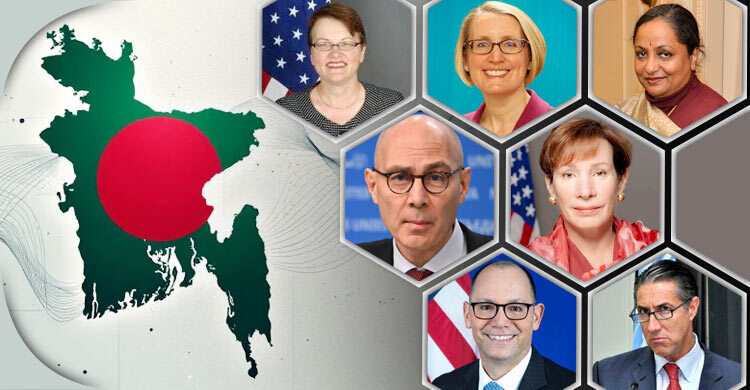
Recent diplomatic activity in Dhaka has set political circles abuzz. What might once have been dismissed as routine embassy work is now sparking heated debate.
From secret meetings in London to quiet dinners in Dhaka, diplomats are once again at the centre of speculation.
Analysts warn that the growing activism of foreign representatives suggests not only heightened international concern, but also the possibility of another political crisis brewing.
For a country that fought a bloody war of independence to secure its sovereignty, the persistent shadow of external influence in its politics remains a deeply uncomfortable reality.
A history of activity
The story of foreign involvement in Bangladesh’s politics is not new. Its roots can be traced back to the early 1990s, when the country returned to parliamentary democracy after a mass uprising toppled General Ershad’s military regime.
Back then, Bangladesh’s fragile institutions and zero-sum political rivalry created repeated stalemates. Into this void stepped diplomats, initially Western, later joined by India and the UN, keen to prevent instability in a strategically important South Asian state.
By the late 1990s, the notion that ambassadors in Dhaka could act as informal mediators was well established. Both the Awami League and the BNP, while publicly denouncing foreign meddling, quietly sought outside support when it suited their cause.
The pattern was firmly set: Bangladesh’s democratic crises would be managed not only in parliament or on the streets, but also in drawing rooms of embassies and hotel suites.
The ghost of 1/11
The most notorious example of this dynamic remains the crisis of 2006-07, culminating in the army-backed caretaker government installed on January 11 – forever known as “1/11”.
In the months leading up to that day, diplomats played unusually visible roles. Patricia Butenis, the US Ambassador, Anwar Chowdhury, the British High Commissioner, and Renata Locke Dessalines, the UN’s representative, were regularly in the headlines.
They were accused of leaning on political leaders, shaping electoral decisions, and ultimately paving the way for military intervention.
Later revelations confirmed these suspicions. Leaked US cables published by WikiLeaks revealed the existence of the “Coffee Group”, an informal gathering of Western diplomats in Dhaka.
Representatives from the US, UK, Canada, Germany, Japan, and the UN would meet regularly to “review” the politics of Bangladesh – an extraordinary example of coordinated external oversight.
Former US diplomat Jon F Danilowicz, who served in Dhaka at the time, recently reflected on that period.
While denying that the US or its allies “engineered” 1/11, he admitted American policy gave undue weight to the opinions of senior generals. “There was a big mistake in US policy towards Bangladesh at that time,” he acknowledged.
The caretaker government that followed, led by technocrat Fakhruddin Ahmed, enjoyed initial support from Western capitals. But its legitimacy quickly eroded as it overstayed its mandate, and the heavy hand of the army became evident.
BNP leader Moudud Ahmed later wrote that there was a “widespread perception” that the US and UK ambassadors actively encouraged the cancellation of elections and declaration of emergency.
Whether accurate or not, the belief that diplomats had midwifed 1/11 has remained etched in the political consciousness of Bangladesh.
The new players: Jacobson, Lewis, Huma
Today, parallels are being drawn with those turbulent days.
At the heart of current debate is Tracey Anne Jacobson, the US Chargé d’Affaires in Dhaka. Her July meeting in London with BNP acting chairman Tarique Rahman has been described as unprecedented. Rarely has a serving US diplomat travelled to a third country specifically to meet a Bangladeshi political leader in exile.
The meeting, confirmed by BNP, triggered speculation that Washington is once again playing a more activist role. On her return to Dhaka, Jacobson widened her outreach – holding talks with a spectrum of parties, right-wing groups, the National Consensus Commission and even the Chief Justice.
The UN has been equally active. Gwen Lewis, the UN Resident Coordinator, and her senior human rights adviser Huma Khan have engaged with BNP, Jamaat, and smaller Islamist parties. Critics claim these interactions are thinly veiled political lobbying. Khan, however, insists the UN’s engagement is humanitarian: “We are not in touch with political parties, but with victims of human rights violations. Just because a person is in politics does not erase their victimhood.”
For sceptics, such justifications echo past diplomatic interventions dressed up in the language of democracy and rights.
The leverage of peacekeeping
The UN’s influence in Bangladesh has always rested heavily on peacekeeping. As one of the world’s largest troop contributors, Bangladesh’s armed forces prize these missions for both prestige and financial reward.
That leverage was again visible this year, when UN High Commissioner for Human Rights Volker Turk warned that any attempt to suppress mass protests could threaten Bangladesh’s peacekeeping role. The military swiftly dismissed the statement, but the reminder was pointed.
Back in 2006, UN envoy Craig Janes issued similar warnings, with the implicit threat that soldiers might lose their peacekeeping opportunities if elections were not credible. In his memoir, former army chief Moeen U Ahmed later admitted that the risk of losing peacekeeping posts made it “difficult to control” the army rank-and-file.
For a force whose officers rely heavily on these missions for career and income, such warnings carry enormous weight.
Familiar names, familiar tactics
Bangladesh’s political crises have long attracted shuttle diplomacy.
In 2013, when BNP protests paralysed the country, US ambassador Dan Mozena tried, and failed, to broker compromise. UN envoy Oscar Fernandez Taranco went further, even hosting Awami League and BNP leaders at the same table. But both sides held firm.
India, too, has intervened. Former foreign secretary Sujata Singh’s one-day visit to Dhaka in 2013 reportedly convinced the Jatiya Party to contest elections, providing Awami League with a legitimising opposition.
Earlier, Commonwealth envoy Sir Ninian Stephen in 1994 and former US President Jimmy Carter in 2001 both attempted to defuse tensions, with limited success.
These interventions often reflect not just concern for democracy, but also geopolitical calculations. For the US, Bangladesh matters as a strategic counterweight to China. For India, it is about regional stability and security. For the UN, it is about peacekeeping credibility.
The colonial critique
Not everyone views diplomatic activism as benign.
Dr Imtiaz Ahmed, an international relations scholar, argues that foreign diplomats continue to act with “a colonial mindset”. “They interfere in our internal affairs as though it were their responsibility,” he says. “But they can only do so because our political leaders allow it, out of self-interest.”
This critique touches on Bangladesh’s deepest dilemma: sovereignty versus dependency. Both Awami League and BNP have sought foreign backing at different times. BNP has leaned on Western sympathy, while the Awami League has drawn on Indian support and, more recently, China’s economic partnerships. Each side condemns interference when it disadvantages them, only to welcome it when it helps their cause.
Between legitimacy and survival
For diplomats, the temptation to intervene in Bangladesh’s polarised politics is obvious. A country of 17 crore, located at the crossroads of South and Southeast Asia, matters for security, trade, and migration. Its contribution to UN peacekeeping makes it indispensable to multilateralism.
For political leaders, foreign approval provides a badge of legitimacy in a domestic landscape where mistrust runs deep. To one party, an American handshake may signal recognition; to another, an Indian nod may ensure survival.
This mutual dependency creates space for diplomats to act not merely as observers, but as players.
Looking ahead
As the country faces yet another cycle of confrontation, the memory of 1/11 looms large. The flurry of meetings, warnings, and interventions by diplomats may or may not lead to another dramatic turn. But the pattern is unmistakable: Bangladesh’s politics, for all its claims of independence, remains entangled with the agendas and anxieties of external powers.
For ordinary citizens, this raises uncomfortable questions. If democracy is constantly mediated by outsiders, where does real sovereignty lie? And if political leaders cannot trust each other enough to negotiate without foreign supervision, can Bangladesh ever escape the shadow of external influence?
For now, the foreign hands remain, sometimes guiding, sometimes pushing, shaping a political story that is as much international as it is domestic.