
Women nearly erased from Bangladesh’s election stage

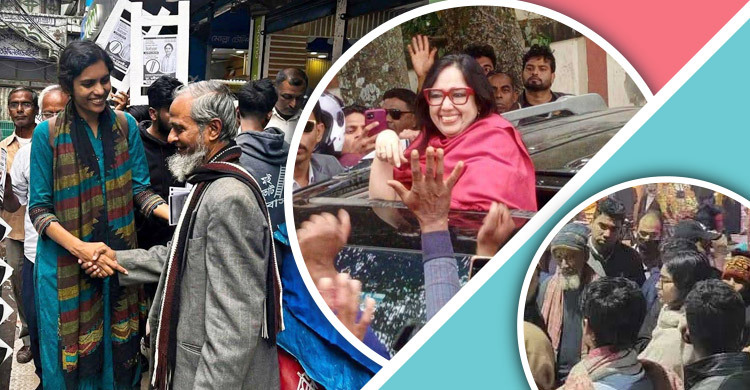
For more than three decades, Bangladesh was a global anomaly: a nation consistently led by women. From Sheikh Hasina to Khaleda Zia, female prime ministers shaped the country’s political identity and represented Bangladesh on the world stage.
Yet, as voters prepare for the 12 February parliamentary elections, women are almost entirely absent from the ballot, signalling a sharp retreat from decades of symbolic female leadership.
Of the 1,981 candidates contesting 300 parliamentary seats, only 76 are women – less than four per cent. Major parties, including the Bangladesh Nationalist Party (BNP) and resurgent Islamist groups, have overwhelmingly fielded male candidates.
Even student-led parties formed during the 2024 uprising, which toppled Hasina’s government, have largely sidelined women: the National Citizen Party (NCP) has nominated just two women out of 30 candidates.
“I used to be proud that, even though my country is not the most liberal, we still had two women figureheads at the top,” said Ariana Rahman, a 20-year-old first-time voter. “Whoever won, the prime minister would be a woman. Now, it feels like we’ve been pushed back decades.”
A history of limited representation
Women’s political participation in Bangladesh has always been constrained. Since independence, reserved seats were created to give women a foothold in parliament, but critics argue these seats often reinforce tokenism rather than genuine empowerment. Even when Hasina and Khaleda held office, both ascended largely through family connections, highlighting systemic barriers that prevented broader female engagement.
During past elections, the highest number of directly elected female MPs was 22 in 2018, underscoring the chronic underrepresentation of women despite their symbolic prominence at the top. Analysts say that while female prime ministers created an image of progressive politics, it masked the persistent exclusion of women from mainstream party structures and decision-making processes.
Revolution’s promise unfulfilled
The 2024 youth-led revolution that ousted Hasina raised hopes of a political culture more inclusive of women. The interim government of Nobel laureate Muhammad Yunus established a Women’s Affairs Reform Commission to address gender disparities, but the body was largely ignored, and key decisions were made without consultation with female officials.
At the same time, Islamist groups have openly sought to restrict women’s public participation, emboldened by the political vacuum. Restrictions have been imposed on women’s involvement in religious commemorations, cultural events, and even sports such as football, signalling a broader societal pushback against female visibility.
“Historically, women’s participation has always been low,” said Mahrukh Mohiuddin, spokesperson for the Women’s Political Rights Forum. “There was hope after the uprising, but that change never materialised. Women are still relegated to the sidelines and expected to remain silent in decision-making.”
Hostility and tokenism
Many female activists report harassment, censorship, and vilification simply for engaging in politics. Umama Fatema, a prominent figure in the 2024 uprising, said, “Women are censored, vilified… judged for simply being part of a political party. That is the reality.”
The Jamaat-e-Islami, one of the country’s major parties, has openly excluded women from leadership roles. “In an Islamic organisation, there can’t be any women leaders,” said Nurunnesa Siddiqa, secretary for women's department in Jamaat’s central committee. Assistant Secretary General Ahsanul Mahboob Zubair added that society is not yet “ready and safe” for women in politics.
Even parties seeking to promote female candidates struggle against internal barriers. Manisha Chakraborty of the Bangladesh Socialist Party, whose party has the highest female representation in this election with 10 women among 29 candidates, said, “Reserved seats are insulting. Lobbying, internal preference, and nepotism all limit women’s participation. Often, it’s just a formality.”
Selima Rahman, the only woman on BNP’s standing committee, pointed out that promising female leaders frequently “fade away” due to a lack of party support and mentorship, leaving the political arena overwhelmingly male.
Looking ahead
As Bangladesh approaches the elections, young women like Ariana Rahman fear the hard-won progress of the past decades may be lost. “More women in this election would have made me feel better represented,” she said. “The next few years are likely to be more hostile towards women.”
Analysts warn that the near-erasure of women from the current ballot could entrench male dominance in parliament for years, reversing decades of symbolic female leadership. While Bangladesh once stood out globally for its women leaders, the 2026 election may cement a political landscape almost entirely defined by men – leaving ordinary women on the margins of the country’s governance.
This election serves as a stark reminder that symbolic victories at the top do not necessarily translate into systemic gender equality in politics. Despite decades of female figureheads, the structural barriers remain, and women must continue to fight for a genuine voice in Bangladesh’s political future.
Source: AFP