
Fakhrul wonders why graft, injustice thrive in a nation full of ulema, mosques and madrasas

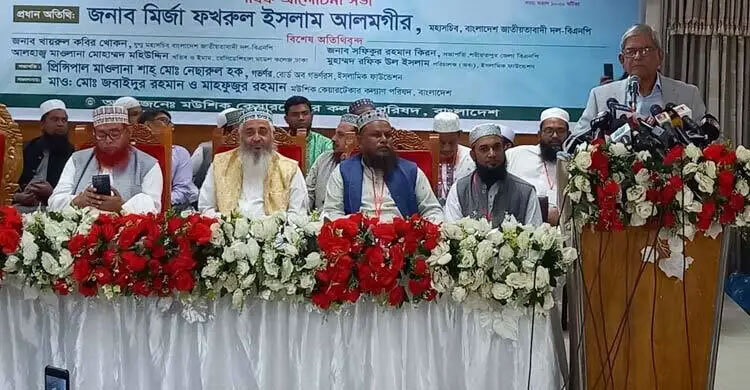
BNP Secretary General Mirza Fakhrul Islam Alamgir on Saturday lamented at the persistence of injustice, corruption, theft and money laundering in Bangladesh having “countless Muslims, madrasas, mosques, imams and ulema.”
“I fail to understand why the zeal for constructing mosques does not carry over to shaping good human beings,” he said.
Fakhrul was speaking at a discussion organised by Caretakers of Mosque-Based Mass Education Programme of the Islamic Foundation at the Diploma Engineers Institution Auditorium in Dhaka.
He stressed the need for deeper national dialogue on how religion and morality can be meaningfully implemented in society.
Citing Indonesia as an example, he noted that no major government decision there is taken without consulting the influential Association of Ulema – an institutional religious authority he said Bangladesh lacks.
Calling the BNP a “liberal democratic party,” Fakhrul argued that no community’s rights – religious or otherwise – can be protected in the absence of democracy.
He alleged that under the Sheikh Hasina administration, spanning 15-16 years, citizens have lost both their voting rights and, in some cases, even the freedom to practise religion.
He further criticised certain scholars who have conferred the title ‘Qawmi Janani’ on Sheikh Hasina, saying such endorsements raise serious questions.
Fakhrul claimed that state institutions have been weakened by partisan appointments and vowed that a future BNP government would rebuild the Islamic Foundation as a fully functional state institution and bring it under the revenue sector.
Highlighting rising crime and social decay, he said moral education must be prioritised, as values originate from madrasas, schools, teachers and families. “Had we strengthened these pillars, murder, rape and crime would have decreased significantly,” he said.
He urged the nation to unite and ensure a free, fair and credible election, which he said is essential for forming a truly democratic government and parliament – one where national problems can be debated and solved “based on the people’s mandate.”