
The great egg-layoff: Plover halts football for 28 days

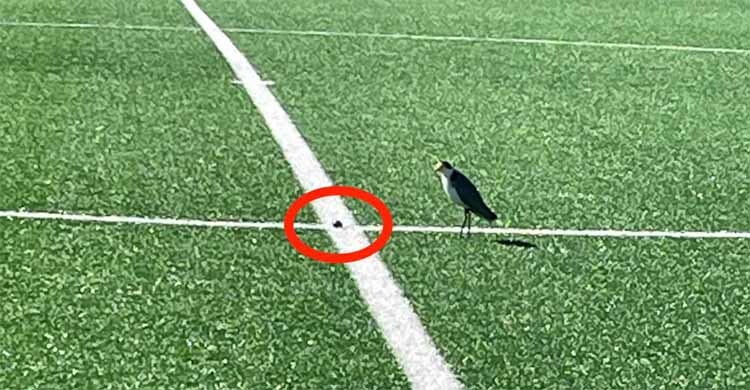
In a dramatic twist on the football pitch, the beautiful game had to take a backseat this weekend as nature scored a stunning victory in regional Australia. A protected native bird, the masked lapwing, affectionately known as the plover, laid a single egg right in the heart of the action: the centre circle of Jerrabomberra Regional Sports Complex, just 20 minutes from Canberra.
Saturday morning kick-arounds were abruptly postponed when players arrived to find not goalposts and cones, but an unexpected occupant of the field: a well-camouflaged egg nestled proudly on the halfway line.
“It was surreal,” said local referee Mark Tran, who arrived early to set up flags. “I almost stepped on it. Then I saw the plover watching me from the sideline like a feathered referee enforcing the rules of nature.”
The discovery brought weekend sport to a halt after the Queanbeyan-Palerang Regional Council, following urgent advice from Wildcare Queanbeyan, made the call to suspend all games on the affected pitch. The reason? The masked lapwing is a protected native species, and disturbing its nest, even moving the egg, could lead to abandonment or legal consequences.
A delicate standoff between sport and survival
“We must be proactive in protecting native species,” a council spokesperson told Nature Today. “If moving the egg becomes necessary, we’ll need specialists and proper permits. For now, the field is under avian occupation.”
The egg could take up to 28 days to hatch, but the real challenge lies beyond that. Wildcare experts warn that plover families often remain near their nesting sites long after hatching, meaning the synthetic turf may stay out of bounds well into May.
“The parents are fiercely protective,” said Dr Eliza Finch, wildlife biologist with Wildcare. “They’ll dive-bomb intruders, honk like car alarms, and if they sense disturbance, they may abandon the chicks. That’s why we can’t risk any foot traffic. This isn’t just about one egg, it’s about giving a native family a fighting chance.”
Nature’s unlikely nesting grounds
While the location might seem bizarre to humans, it’s classic plover behaviour. According to BirdLife Australia, masked lapwings are notorious for choosing flat, open spaces,like sports fields, rooftops, and even car parks, for their nests. The lack of natural predators (in urban areas) and wide visibility make these spots ideal… much to the dismay of weekend athletes.
“They don’t read the rulebook,” joked local coach Amina Patel, whose under-12s had to relocate to a muddy alternate field. “But honestly? The kids were more excited about the plover than the penalty kicks. We turned it into a biology lesson.”
This isn’t the first time Australian sport has been paused for wildlife. In 2023, an exclusion zone was set up near the Great Ocean Road when a pair of endangered hooded plovers nested on a popular beach. Last summer, a golf course in Newcastle delayed a tournament after a bush stone-curlew began calling from a bunker.
A symbol of coexistence
As spring deepens and breeding season heats up across the country, authorities are urging residents and recreational users to stay alert. NSW Wildlife Information Rescue and Education Service (WIRES) recently issued a warning: “Keep your eyes open. These birds are masters of camouflage. A nest can look like a few pebbles in a grassy patch.”
Locals in Jerrabomberra have embraced the interruption with a mix of frustration and pride. A handmade sign now guards the field: “Closed for Plover Parenting. Please respect the nest.” Some fans have even started a social media campaign #PloverPower tracking the egg’s progress with daily updates and illustrated cartoons of “Kevin the Kick-Stopper.”
“It’s a reminder that we share this land,” said Councilor Lisa Nguyen. “Sometimes, the most important games aren’t the ones we play, they’re the ones nature wins.”
So while the scoreboard remains blank, something far more valuable is being nurtured on that synthetic turf: a moment of harmony between humans and habitat, one fragile egg at a time.