
Pro-Palestinian protests disrupt Spain’s Vuelta cycling race

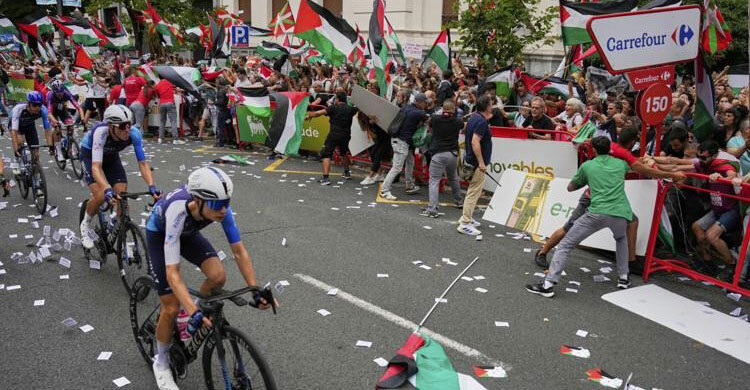
Protests against Israel’s military campaign in Gaza have repeatedly disrupted Spain’s prestigious Vuelta a España cycling race, turning the sporting event into a global flashpoint for political dissent — and triggering a sharp diplomatic rift between Madrid and Tel Aviv.
Over the past 10 days, hundreds of demonstrators waving Palestinian flags have lined the race route — including in small towns like Rosana Prieto’s village in northwestern Spain — deliberately positioning themselves to capture the attention of international television audiences. In one alarming incident, a protester came so close to the peloton that several cyclists crashed, though no members of the Israeli-owned team, Israel Premier Tech, were injured. Five stages have been interrupted or shortened, and more than 20 protesters have been detained by Spanish authorities.
Far from condemning the disruptions, Spain’s government has offered tacit — and at times explicit — support. Prime Minister Pedro Sánchez has repeatedly denounced Israel’s actions in Gaza as “genocide,” while Foreign Minister José Manuel Albares publicly backed calls to expel the Israeli team from the race. Government spokesperson Pilar Alegría — who also holds the sports portfolio — declared that “neutrality is impossible” in the face of what she described as widespread death and destruction in Gaza.
The stance has drawn fierce condemnation from Israel. Prime Minister Benjamin Netanyahu accused Spain of fostering “antisemitism” and labelled the protests a “blatant genocidal threat,” in a statement that escalated tensions between the two nations. Meanwhile, Spanish activists, undeterred, have chartered a ship loaded with humanitarian aid bound for Gaza — aiming to challenge Israel’s naval blockade in a symbolic act of solidarity.
The unrest has left riders and teams on edge. In an emergency meeting, cyclists reportedly voted to withdraw from the race if safety could not be guaranteed. Israel Premier Tech, while choosing to continue competing, has removed its team name from jerseys in a bid to lower its profile. Several riders have reported direct threats from protesters — including attempts to strike them with flagpoles and the placement of tacks on the race course.
Political analysts say the Vuelta protests are emblematic of a broader swell of public anger in Spain over the Gaza conflict — and suggest Prime Minister Sánchez is strategically aligning his government with grassroots movements to reinforce Spain’s increasingly vocal opposition to Israeli policy. As the race nears its climax, authorities have mobilised 1,500 police officers to secure Sunday’s final stage in Madrid — a show of force signalling both the government’s determination to see the event through, and its recognition of the volatile political undercurrents now woven into the fabric of the race.
What began as a sporting spectacle has become a global stage for protest — and a test of how far democratic societies will go to accommodate political expression, even at the cost of international friction and athletic safety.