
AI’s avian advantage: China uses AI to map, protect birds with facial recognition

Every winter, the skies over Kunming turn white with wings. Tens of thousands of black-headed gulls arrive from the icy expanses of Siberia, following an age-old migratory route that ends at the tranquil Dianchi Lake in China’s southwestern Yunnan Province. For locals, their arrival marks not just a change in season but the return of beloved guests, symbols of purity, persistence, and peace.
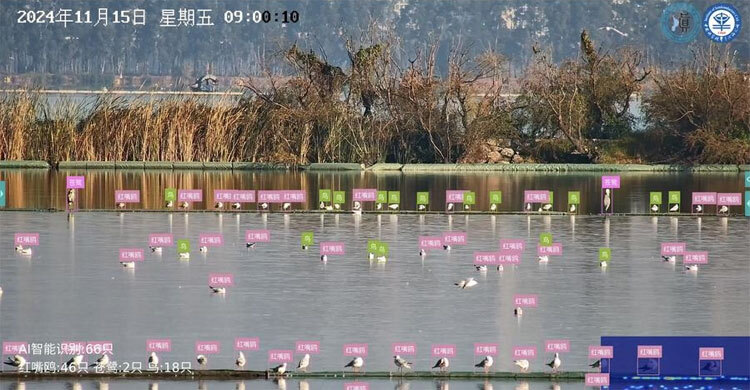
But this year, as the gulls circle above the lake, something new is watching them from below, a network of high-definition cameras, drones, and sensors humming quietly, their lenses fixed on the flock. These aren’t mere spectators; they are part of an ambitious scientific project.
Kunming’s cherished winter visitors are now subjects of one of the world’s first AI-powered “bird facial recognition” systems, designed to study and protect migratory species with precision once impossible through human observation alone.
The city of eternal spring and its winged guests
Kunming has long been known as the “Spring City,” a place where the temperature is gentle enough for flowers to bloom year-round. Its relationship with the black-headed gulls stretches back to the 1980s, when a few early migrants stopped by Dianchi Lake and locals, charmed by their snowy plumage and shrill cries, began feeding them.
What started as a small seasonal curiosity has since evolved into an annual celebration. Each winter, people flock to the lakeside to toss breadcrumbs, take selfies, and share in a uniquely Kunming tradition that blends ecology, tourism, and affection.
“The gulls are not just birds here; they are part of our emotional landscape,” said Pan Min, deputy director of the Kunming Dianchi Plateau Lake Research Institute. “They arrive like clockwork, and every generation of Kunming residents grows up with them.”
But beneath the poetic familiarity lies a pressing scientific concern. Climate change, urbanisation, and shifting ecosystems have begun to alter migration patterns. And understanding those changes demands something more than binoculars and notebooks.
From field notes to facial recognition
In October 2022, researchers at the Dianchi Institute began deploying an AI-based intelligent observation system at a monitoring station near Haigeng Dam. The goal was simple yet revolutionary: to automate what used to take entire teams of experts days or weeks to accomplish.
By 2024, after two full years of continuous tracking, the results were already illuminating. “We found that the main flock’s arrival in Kunming was about ten days later than in previous years,” the institute noted. “Such variations tell us a great deal about how climate and environmental changes affect migratory patterns.”
The system uses a sophisticated mix of deep neural networks, computer vision, and acoustic analysis. Cameras and drones capture ultra-high-resolution images, while algorithms identify each bird by subtle details, plumage colour, beak shape, wing span, and body size, creating a kind of digital fingerprint.
In parallel, microphones and acoustic sensors record the birds’ calls, allowing AI models to match sounds to specific species. Together, these systems deliver real-time data on population size, flight behaviour, feeding habits, and roosting preferences, building a living archive of Dianchi’s avian residents.
“Previously, the same work required at least two trained birders to spend a whole day collecting data from just one area,” Pan explained. “Now, AI does it in hours faster, more accurately, and without disturbing the birds.”
A database that breathes
Over the past two years, Kunming’s AI system has identified 17 bird species across several demonstration sites, collecting hundreds of thousands of photos, videos, and sound samples. The technology doesn’t just recognise species, it tracks individuals and communities over time, creating a detailed record of migratory life that evolves with every flight and landing.
According to Zhang Zhizhong, an engineer at the institute, the resulting data helps scientists assess wetland biodiversity and ecosystem health more effectively. “By observing changes in bird activity, we can detect early signs of environmental imbalance,” Zhang said. “Birds are nature’s messengers — when their habits change, something deeper is shifting.”
The institute’s work was validated in May 2025, when findings on “bird facial recognition” were published in the Journal of Environmental Management. The paper outlined how AI-driven monitoring could replace traditional, error-prone manual surveys and lay the groundwork for a nationwide digital conservation network.
Beyond Kunming: China’s digital dawn in bird science
Inspired by Kunming’s success, other provinces have begun adapting the model.
In Chongqing’s Shuangguihu National Wetland Park, AI systems now scan real-time video streams to identify multiple bird species simultaneously. Meanwhile, in Shandong’s Yellow River Delta Nature Reserve, cameras installed in 2022 have already logged more than 1,200 birds, including endangered oriental white storks and whooper swans.
These networks feed into a growing national database that could one day offer a live map of China’s avian biodiversity, a “Google Earth for birds,” as one researcher called it.
Watching without disturbing
For all its high-tech sophistication, Kunming’s project has a surprisingly gentle ethos. The aim isn’t surveillance but coexistence.
“The beauty of AI monitoring is that it allows us to see more while interfering less,” Zhang said. “The system observes continuously, even at night or in harsh weather, without human presence that could frighten the birds.”
That minimal intrusion is crucial. Many migratory species are sensitive to human proximity, and excessive fieldwork can inadvertently drive them away. By replacing binoculars with algorithms, Kunming’s scientists have found a way to listen to nature without interrupting its rhythm.
Where tradition meets technology
Every winter, at the banks of Dianchi, families still gather to feed the gulls. Children laugh as the birds swoop down, white wings gleaming against the sky. What they don’t see are the invisible circuits above, drones tracing arcs of data, sensors translating chirps into numbers, and algorithms quietly cataloguing life.
It’s a moment where tradition meets technology, and where affection meets analytics.
In Kunming, the gulls have always been more than just birds. Now, in the age of artificial intelligence, they have become ambassadors of a new harmony, one where human curiosity and machine learning work together to keep the skies alive.
As the sun sets over Dianchi Lake and the gulls settle on the water, their reflections ripple softly in the golden light. Above them, the quiet hum of data collection continues proof that even in a digital age, the story of migration, memory, and belonging can still take flight.
Source: UNB/Xinhua