
Tomato growers concerned over 15% VAT on paste, ketchup, sauce

The VAT department of the National Board of Revenue, NBR, on January 9 increased the value added tax (VAT) and supplementary duties on over a hundred goods and services.
VAT has been increased from 5% to 15% on products such as pickle, biscuit, cake, chutney, tomato paste, tomato ketchup, tomato sauce, mango, pineapple, guava and banana pulp. As a result, there is a fear of increasing the price of these products. If the price increases, consumers will consume less of those products or refrain from using them.
As a result, the demand for the raw materials used in the production of these processed products is feared to decrease. Farmers, involved in the production of these agricultural products, will suffer the most if demand falls. They demanded that the increased VAT and customs duties should be withdrawn to protect the farmers from losses. If not, the common farmers of the country as well as the agro-processing industries of the country will suffer. At present, the demand for processed agricultural products outside the country is increasing day by day. Exports of processed agricultural products have already crossed the USD 1 billion milestone.
Around 30 to 35 percent vegetables and fruits loses annually in Bangladesh due to the absence of proper storage and lack of food processing facility, according to a study conducted by the Food and Agricultural Organization (FAO) of the United Nations. That’s why farmers are deprived of getting fair price of their produces. Tomato is such kind of crops that brings lose to the farmers due to lack of preservation facility and processing.
PRAN Group, the country's largest agricultural products processing company, has been preparing various food products from tomatoes Since 2002 so that agricultural products are not wasted due to lack of proper storage and processing. PRAN always gives highest importance to quality of products. the quality of a product largely depends on the raw materials. Considering this, PRAN had started contractual cultivation of tomato in 2010.
PRAN has about 100,000 contract farmers. The food processor collects tomato, mango, bean, peanut, milk and cassava from its contract farmers. Its contract farmers in Rajshahi, Bagherhat, Goplaganj, Khulna, Chapainawabganj, Dinajpur, Panchagarh and Thakurgaon, are producing tomato. This year, around 10,500 contract farmers have cultivated tomato in 2800 Bighas of land. PRAN aims to collect 22,000 tons of tomato this season.
Last year, around 10,000 contract farmers have cultivated tomato in 2500 Bighas of land. PRAN collected 20,000 tons of tomato in the season.
According to the last several year’s data, PRAN’s contractual farmers has been increased around 10 percent on average. The reasons behind it include providing training and consultancy and provides instrument related support to the farmers. As a result, PRAN’s contractual farmers are getting more crops. PRAN is providing all sorts of training to selective tomato farmers (more than 5000) with the collaboration of International Finance Corporation under “PRAN Assured Scheme”.
PRAN ensures buy-back guarantee to the farmers against their crops. Pran buys tomatoes from farmers at market price. PRAN is bound to purchase produce from contract growers, but contract farmers are not bound to sell produce to PRAN. Marginal farmers become financially benefited through PRAN’s contract farming as it gave assured income. In some cases, the tomato gets damaged or the farmers are forced to throw away tomato on the streets failing to sell in fair price. Tomato farmers across the country undergo almost same experience every year. But the PRAN’S contract farmers don’t face difficulties in selling tomato they produce. As a result, farmers of Rajshahi and Natore areas are getting inspired to grow tomato more. It also put a positive impact on the socio-economic condition of the areas.
The contract farmers of PRAN usually collect 5-6 tons of tomatoes from per bigha. They sell it in existing market price in several phases. Farmers can be able to collect Tk 60,000-70,000 and their cost is around tk 25,000 to Tk 30,000 for per bigha. So, they are able to manage profit at least Tk 30,000 per bigha.
In Bangladesh, winter season is suitable for cultivating tomato. Tomato seed is planted in September to November. Crops are ready for harvest in 2-4 months depending on varieties and time of plantation. PRAN’s contract farmers generally grow VL-642 hybrid varieties. The farmers who are harvesting hybrid varieties generally get 15 to 20 percent crops more than the general farmers who are harvesting ordinary varieties. So PRAN’s farmers get more profit.
At Present, PRAN Group is collecting tomato and make pulping through its Barind (Varandra) Industrial Park-BIP, Rajshahi and PRAN Agro Natore factory. This season, PRAN has started collecting and pulping the tomato in its factories on January 15 and it will run till the availability of tomato in the land. Around 500 local workers are working directly in two plants of PRAN for the whole process and around 2500 people are working indirectly including supplying of tomatoes and its transportation.
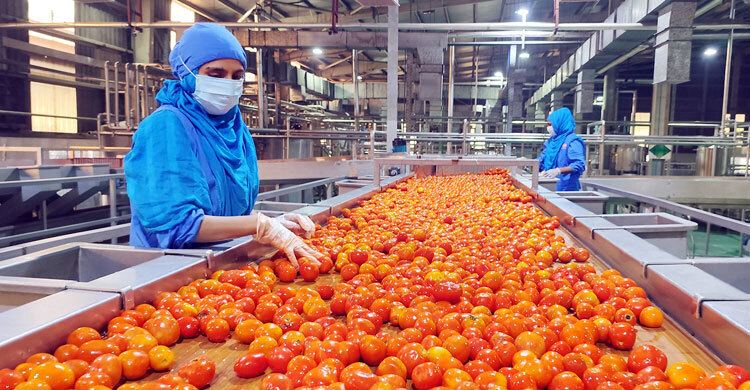
Tomatoes are taken to washing plant through automatic machine after purchasing it from farmers. Later, the tomato goes to crushing plant which later turns into tomato paste. The paste is preserved in aseptic system. Later, sauce and ketchup are made from paste as per demand. For the reason, PRAN Sauce, ketchup and tomato paste are healthy as well as nutritious. Tomato pulp, preserved in aseptic way, can be used for two years.
Sauce and ketchup, manufactured from tomato, is very popular in Bangladesh and many other countries. The market size of tomato related products is around Tk 600 crore. The market has been increasing at the rate of 10 percent every year. However, the government increased the duty on products like tomato, mango, pineapple, guava and banana pulp from 5% to 15% recently. Moreover, the government has also proposed to increase the price of gas. Marginal farmers will suffer greatly. Now, if the price of these products increase due to VAT and gas prices, many people will refrain from buying these products. Besides, if the factory is closed due to this, the life of many workers will be uncertain.
PRAN is the market leader in the sector and the food processor has capacity to produce 30,000 tons of sauces every year. Currently 11 variants are available in the market. The price ranges from Tk 3 to Tk 1070.
PRAN’s sauce and ketchup have good market across the world. Presently, PRAN exports its sauce and ketchup to 20 countries including USA, UK, Italy, France, Malaysia. The food processor is also trying to spread the market. At present, products of PRAN are regularly exported to 145 countries. So, there is an opportunity to export sauce to 125 more countries. If the demand increases more in world market, farmers will be able to earn more.