
WB projects Bangladesh GDP 4.8% in FY26, 6.3% in FY27

After a turbulent first half of FY25, Bangladesh’s economy rebounded strongly in the second half, driven by robust exports, record remittances, and rising foreign exchange reserves, the World Bank said in its latest Bangladesh Development Update released on Tuesday.
The report highlighted that the country is expected to maintain an upward growth trajectory in the medium term, but urgent reforms are needed to sustain growth and create jobs, particularly for youth and women. It projects the country’s GDP growth to rise to 4.8 percent in FY26 from 4.0 percent in FY25 and reach 6.3 percent in FY27.
External pressures eased in FY25 as a market-based exchange rate was adopted, foreign exchange reserves stabilized, the current account deficit narrowed, and exports grew strongly. Inflation moderated due to tight monetary policies, lower essential food import duties, and a good harvest season. However, the fiscal deficit widened amid weak tax collection and higher subsidies and interest payments.
The update also pointed to rising social challenges. Poverty increased between 2023 and 2024, while labor force participation fell from 60.9 to 58.9 percent, with women disproportionately affected. Of the three million additional working-age people outside the labor force, 2.4 million were women.
“The economy has shown resilience, but this cannot be taken for granted,” said Jean Pesme, World Bank Division Director for Bangladesh and Bhutan. He stressed that bold reforms and faster implementation are necessary to strengthen domestic revenue mobilization, address banking sector vulnerabilities, reduce energy subsidies, plan urbanization, and improve the investment climate, ensuring better growth and more jobs.
“The economy has shown resilience, but this cannot be taken for granted,” said Jean Pesme, World Bank division director for Bangladesh and Bhutan.
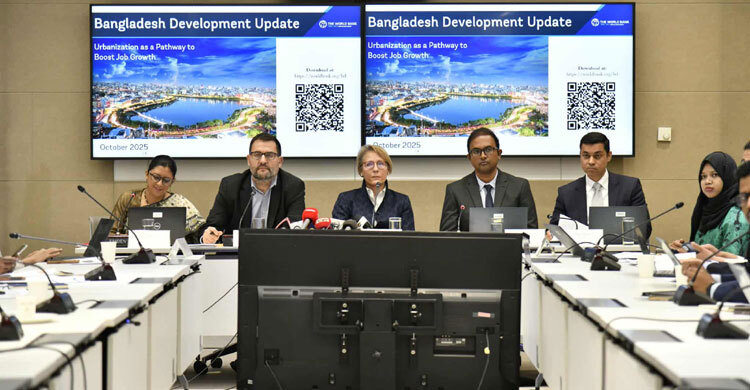
“To ensure a strong growth path and more and better jobs, Bangladesh needs bold reforms and faster implementation to enhance domestic revenue mobilisation, address banking sector vulnerabilities, reduce energy subsidies, plan urbanisation, and improve the investment climate,” he added.
Over the past two decades, industrial jobs have increasingly concentrated in Dhaka and Chattogram, prompting the report to call for rethinking spatial development strategies to reduce regional disparities and support inclusive job creation nationwide.
The Bangladesh Development Update accompanies the South Asia Development Update, which projects regional growth at 6.6 percent in 2025 but warns of a looming slowdown. The report highlights the potential of trade openness and AI adoption to boost productivity, investment, and employment.
“South Asia has enormous economic potential and is still the fastest-growing region in the world,” said Johannes Zutt, World Bank Vice President for South Asia. “Countries can boost productivity, spur private investment, and create jobs by maximizing the benefits of AI and lowering trade barriers, especially for intermediate goods.”
The report also emphasised the transformative potential of AI for productivity and incomes, noting that South Asia’s workforce remains concentrated in low-skill agricultural and manual jobs. Carefully sequenced trade reforms and AI adoption, coupled with policies to reallocate labor to productive sectors, are seen as critical for future growth and job creation, according to Franziska Ohnsorge, World Bank Chief Economist for South Asia.