
Beyond the uniform: What a soldier learned from a CEO

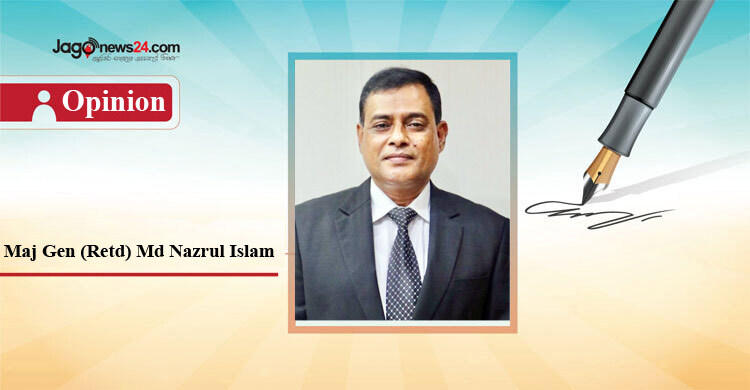
After 36 years in the Bangladesh Army, Major General (Retd) Md Nazrul Islam entered the corporate world, where he found in PRAN-RFL’s CEO Ahsan Khan Chowdhury a leader whose humility, vision and people-first ethos echoed the finest military values. In his reflections, he describes their unlikely mentorship as a revelation: true leadership—whether on the battlefield or in business—stems from service, integrity and an unwavering commitment to national progress.
Beyond the uniform: What a soldier learned from a CEO
By Major General (Retd) Md Nazrul Islam
A soldier’s life is often measured in decades of rigour, service and sacrifice to the motherland. I spent thirty-six years in the uniform of the Bangladesh Army, rising to the rank of Major General. My life was defined by discipline, planning and selflessness. At retirement, many assumed I would settle into quiet reflection after such a demanding career. But fate, as it often does, writes in unexpected ink. Rather than retreat, I stepped into the world of business—a realm that, at first glance, seemed worlds away from the battlefield.
In this transition, I encountered a man who has redefined leadership in Bangladesh’s private sector: Ahsan Khan Chowdhury, Chairman and CEO of the PRAN-RFL Group. Observing him closely, I came to understand that true leadership—whether on the front lines or in the boardroom—rests on the same pillars: vision, courage and humanity. This is not merely a profile of a successful industrialist; it is the story of a leader who has transformed Bangladeshi business while maintaining extraordinary humility.
First Encounter: A lasting impression
In 2021, as Executive Chairman of BEPZA, I met Ahsan Khan Chowdhury for the first time. He arrived with an easy calmness, accompanied by his youngest daughter, who had recently graduated from a university in Canada. What struck me was not their stature or success, but their disarming humility. Despite leading one of Bangladesh’s largest conglomerates, they presented themselves simply, sincerely and without pretence.
As a soldier trained to read people—comrades and adversaries alike—I quickly learned to spot authenticity. In Ahsan Khan, I found a rare blend of warmth and purpose. That first meeting left such a strong impression that I maintained contact with him throughout the remainder of my military service. Little did I know that this connection would profoundly shape my post-retirement journey.
A soldier steps into business
After hanging up my uniform, I faced the classic crossroads: rest or reinvent. Many of my fellow officers chose the former, enjoying the peace they had earned. But I felt restless. Having spent my life pursuing growth—for myself, my soldiers and my country—I was not ready to slow down.
It was the PRAN-RFL Group that drew me in, almost magnetically. What moved me most was not the scale of the enterprise, but the spirit of leadership embodied by Ahsan Khan Chowdhury. When I accepted the role of Director of Corporate Affairs, I knew I had entered a new world—one where I would need to unlearn old habits and embrace an entirely new language.
The Army had equipped me with strategy, logistics and an understanding of human psychology. Decades of experience taught me how to build trust in the trenches, steady nerves under fire and instil confidence in uncertain outcomes. Yet, the corporate world revealed itself as another kind of battlefield. Here, the armour was suits and ties; the weapons were figures, graphs and terms like ROI, bottom line, niche markets and brand equity.
My days soon settled into an unfamiliar rhythm. Mornings that once began with drills or patrols now started with virtual global conferences chaired by Ahsan Khan. One day he would dissect supply chains, the next explain brand positioning, and the following discuss international competitiveness. I took notes like a recruit in training school—each day felt like a lesson in a new language, where every syllable mattered.
Military leadership demanded swift, decisive action. Hesitation could cost lives. It required discipline and the ability to calm fear in the face of potential defeat—a world I knew intimately.
At PRAN-RFL, I witnessed a different kind of leadership—equally demanding, but rooted in patience and persuasion rather than command. Ahsan Khan led not through authority alone, but through trust. He didn’t issue orders; he empowered. He saw potential in people, nurtured their talents and encouraged them to innovate, experiment and excel—even in the most uncertain times. His leadership blended strategic vision with deep empathy, a stark contrast to the rigid hierarchies of military problem-solving.
This was a revelation: leadership adapts to its environment, but its core remains unchanged—to inspire others to rise.
The DNA of simplicity
Ahsan Khan was born into privilege—his father, Major General Amjad Khan Chowdhury, was the visionary founder of the PRAN-RFL Group. Educated in the United States and heir to an industrial empire, Ahsan could have embraced opulence. Instead, he chose simplicity as a guiding principle.
I often observed his grounded, unpretentious way of life. He was, in every sense, a “simple living, high thinking” individual. To him, success was not measured in luxury, but in vision: elevating Bangladesh on the global stage, supporting farmers, creating rural jobs and building export capacity.
Despite his prominence, he remained approachable. I watched him move effortlessly between worlds—discussing crop prices with a farmer in the morning and addressing international investors by afternoon. His ability to connect with people from all walks of life, while balancing humility with ambition, was truly remarkable.
Traits forged in adversity
I saw in Ahsan the same qualities that defined his father: unwavering perseverance, clarity of purpose and the courage to confront challenges head-on. Business, I came to realise, is no less a battlefield than war—competition is fierce, supply chains fragile, and global markets volatile. Yet Ahsan meets every obstacle with quiet resolve.
He does not avoid difficulty; he sees it as an opportunity to grow. This mindset reminded me of the finest military leaders—those who stand firm when others falter, who view adversity not as a barrier but as a test of character.
Humanity at the core
What moved me most was not his strategic brilliance, but his compassion. Time and again, I saw him place people before profit. Whether ensuring fair wages for workers, investing in rural communities or creating opportunities for young graduates, Ahsan demonstrated that business can be a form of national service.
His leadership is not about accumulating wealth, but about distributing opportunity. In this, I recognised the soldier’s ethos: service to something greater than oneself.
PRAN-RFL: A global ambassador for Bangladesh
Under Ahsan’s stewardship, PRAN-RFL has grown into one of Bangladesh’s largest conglomerates, exporting to over 148 countries. Its products—ranging from food and beverages to plastics and electronics—carry the Bangladeshi identity across the globe.
What inspires me most is how the company links industrial success with social impact. Its rural factories employ thousands, creating a direct bridge between economic growth and community upliftment. Farmers gain stable markets, workers secure livelihoods, and the nation earns vital foreign exchange.
This is leadership with vision—not just chasing profit margins, but building shared prosperity.
Recognition and legacy
Ahsan Khan Chowdhury was named ‘Business Person of the Year’ at the 23rd DHL–The Daily Star Bangladesh Business Awards—a fitting tribute to his achievements and leadership style. He has proven that one can build a global enterprise while remaining rooted in local values, generate profit while uplifting others, and think internationally without losing touch with home.
In doing so, he honours his father’s legacy while imprinting it with his own signature: innovation, inclusivity and integrity.
A soldier’s reflection
Looking back, I see how extraordinary my journey has been—marching from cantonments to corporate corridors, from the roar of commands to the quiet hum of boardrooms. Ahsan Khan Chowdhury became a bridge between these two worlds.
Through him, I learned that leadership wears many uniforms. Whether in khaki or a tailored suit, its purpose remains the same: to inspire, to build and to serve.
Working alongside him was not just a second career—it was an education. It taught me that life after service need not mean stillness, but reinvention. And it showed me that Bangladesh’s private sector is home to leaders whose ambitions extend far beyond personal gain.
Conclusion
Viewed through a soldier’s eyes, Ahsan Khan Chowdhury is more than a CEO. He is a commander of industry, a strategist of commerce and, above all, a human being who carries his nation in his heart.
His simplicity humbles me. His dedication inspires me. His humanity reminds me that true leadership is not about titles—it is about service.
For a soldier who once led men into battle, it has been a profound honour to witness another kind of battle—fought not with weapons, but with ideas, innovation and unwavering integrity.
In Ahsan Khan Chowdhury, Bangladesh has not just a business leader, but a national asset. And through him, I have learned a final, vital lesson: even when the battlefield fades, the mission of service never ends.
Major General (Retd) Md Nazrul Islam is the Executive Member (Planning & Development) at the Bangladesh Economic Zones Authority.