
Salehuddin says country's economy stable despite challenges

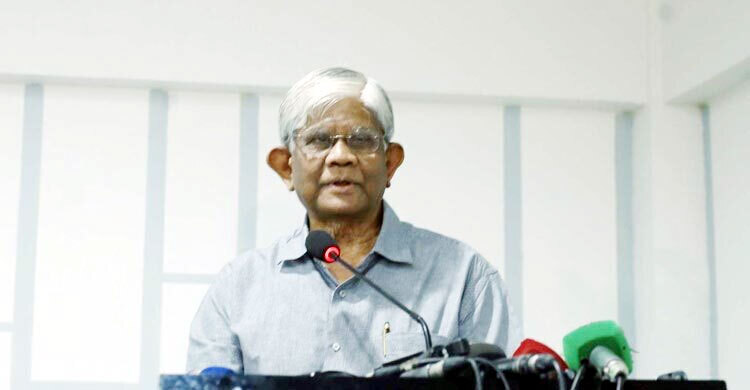
Finance Adviser Dr Salehuddin Ahmed on Monday, February 9, said that Bangladesh’s economy remains largely stable despite significant challenges, emphasising that sustained reforms, stronger institutions and political commitment from the next government are key for long-term growth.
“The economy was on the verge of collapsing. We are managing the situation, but the challenges are real and require careful and consistent policy support,” he said.
Speaking at a discussion meeting titled ‘Macroeconomic Insights: An Economic Reform Agenda for the Elected Government’ held at a hotel in Dhaka this afternoon, he said the country has managed to maintain overall macroeconomic stability amid multiple domestic and global pressures.
He, however, warned that the challenges remain serious and should not be underestimated.
The Policy Research Institute of Bangladesh (PRI) and the Department of Foreign Affairs and Trade (DFAT) of the Australian Government jointly organised the event.
Presided over by Chairman of the PRI Dr Zaidi Sattar, Dr KAS Murshid, Former Director General of Bangladesh Institute of Development Studies (BIDS), Clinton Pobke, Deputy High Commissioner, High Commission of Australia to Bangladesh, spoke as special guests.
Dr Ashikur Rahman, Principal Economist, PRI, made the keynote presentation.
Dr Fahmida Khatun, Executive Director, Centre for Policy Dialogue (CPD), Dr M Masrur Reaz, Chairman and CEO, Policy Exchange Bangladesh (PEB), spoke as distinguished panelists.
Dr Salehuddin noted that Bangladesh has shown resilience in the face of post-pandemic disruptions, geopolitical tensions, energy price volatility and tighter global financial conditions. He said prudent macroeconomic management has helped the country navigate a difficult period without slipping into a deeper crisis.
Referring to inflationary pressure, balance of payments constraints and fiscal stress, the adviser said such issues are not unique to Bangladesh. “Many countries are going through similar problems. What matters most is how we respond through reforms and institutional strengthening,” he added.
He said the interim government has prioritised stabilising the macroeconomy, maintaining fiscal discipline, managing foreign exchange pressures and ensuring that essential economic activities continue without major disruption.
“We have tried to take balanced decisions so that the economy continues to function while also protecting vulnerable groups,” he said.
Highlighting revenue mobilisation as a major concern, Dr Salehuddin pointed out that Bangladesh’s tax-to-GDP ratio remains very low compared to peer economies. He said this limits the government’s ability to finance development and public services.
“It is extremely difficult to run a modern state with such a low level of revenue collection,” he said, stressing the need for comprehensive tax reforms, expansion of the tax base and improved compliance.
The adviser also underscored institutional weaknesses and poor coordination among agencies as key barriers to reform implementation.
“We write reports and make recommendations, but implementation remains the hardest part,” he observed, adding that strengthening institutions is far more challenging than drafting policies.
He said without strong and accountable institutions, even well-designed policies fail to deliver the expected outcomes, emphasising the need for political consensus to carry forward meaningful reforms.
Dr Salehuddin described the banking sector as one of the weakest areas of the economy, citing governance problems, high levels of non-performing loans and lack of accountability as factors that have eroded public confidence over the years.
“These problems have accumulated over a long time. Fixing them will require time, strong oversight and political courage,” he said.
On public expenditure, he stressed the importance of prioritisation, noting that limited resources require careful selection of projects and spending areas.
“Everything cannot be done at once. We must decide what matters most for the country and move forward accordingly,” he said.
The adviser said the government has tried to avoid populist measures and instead focus on maintaining stability and ensuring long-term sustainability.
“Policy-making is never easy. Every decision involves trade-offs,” he added.
He acknowledged that public expectations from the government remain high but warned that unrealistic expectations can create additional pressure.
“Economic recovery and reform require patience, consistency and continuity,” he said.
Dr Salehuddin also highlighted the importance of private sector development, saying entrepreneurs, like farmers, are hardworking and capable but need proper incentives, access to finance and a predictable policy environment to invest and expand. “The government must support productive investment and create conditions where businesses can grow.”
He noted that Bangladesh has made significant progress over the years in poverty reduction, infrastructure development, export growth and improvements in social indicators, adding that these achievements provide a strong foundation for future advancement.
Looking ahead, he said the next elected government will have to focus on deep structural reforms, strengthening governance, improving revenue collection, restoring discipline in the financial sector and enhancing policy coordination.
“The next government must take tough decisions. There is no alternative to reform if we want sustainable growth and stability,” he said.
Expressing optimism, the finance adviser said Bangladesh has the capacity to overcome its current challenges. “We have resilient people, a hardworking workforce and strong potential. With the right policies and political commitment, we can move forward.”
He urged all stakeholders to act in the broader national interest and support necessary reforms, saying the country’s future depends on collective efforts rather than any single government or group.
Source: UNB