
Coordination committee reports major strides in investment, digital, and trade reforms

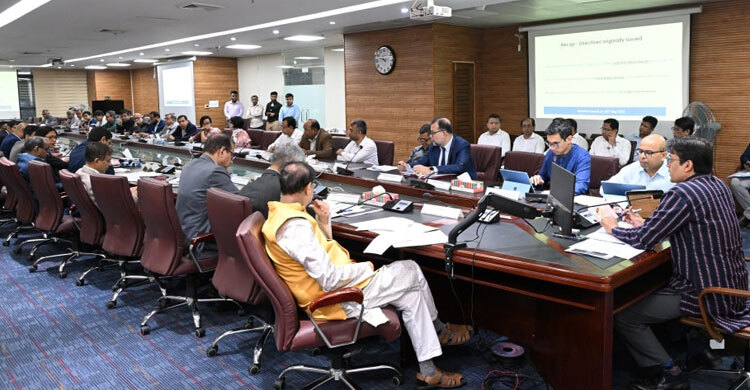
Significant progress has been made across Bangladesh’s investment facilitation and governance landscape, as multiple ministries and regulatory bodies report concrete implementation steps to ease doing business, modernise ports and customs, and streamline trade and financial services.
The updates were shared at the 5th meeting of the Investment Coordination Committee (ICC), chaired by Lutfey Siddiqi, Special Envoy on International Affairs to the Chief Adviser.
“Our focus on execution and holding each other accountable demonstrates our commitment to improving the operating environment for businesses. We have a long way to go, but we are moving with clear intent, rigour, and transparency,” Siddiqi said at the meeting.
Among those present were Bangladesh Bank Governor Ahsan H. Mansur, Special Assistant for ICT Faiz Ahmed Taiyeb, BIDA Executive Chairman Chowdhury Ashik Mahmud Bin Harun, NBR Chairman Abdur Rahman Khan, senior secretaries, and representatives from the private sector.
Trade and import reforms: Removing bottlenecks
A key highlight was the Ministry of Commerce’s decision to amend the Import Policy Order, abolishing quotas for Free of Charge (FoC) imports by 100% export-oriented industries. The amendment, expected within two weeks, is set to cut inventory costs and improve competitiveness.
According to the BGMEA, unconditional implementation of this reform could generate a multi-billion-dollar boost to export revenues.
Digital infrastructure drives reform momentum
A landmark achievement in this reform drive is the launch of Phase 1 of the Bangladesh Business Portal in September 2025—creating a unified digital entry point for investors.
Phase 2, due by December 2025, will introduce a Business Starter Package and Single Sign-On (SSO) feature, integrating 29 government services into one platform.
This will eventually achieve data interoperability with the Bangladesh Single Window (BSW), ASYCUDA, and the Customs Bond Management System (CBMS)—a long-awaited step toward cohesive digital governance.
The initiative aligns with the government’s broader Digital Bangladesh governance strategy, addressing investor calls for faster processing, predictability, and transparency.
Port and customs modernisation accelerates
At Chittagong Port, construction of Laldia Yard and Taltala Container Yard—a 6.25-acre facility set for completion by October 30, 2025—is expected to ease container congestion.
Authorities are clearing more than 6,000 held containers, with 403 already auctioned and a seven-member expert committee drafting disposal protocols for dangerous goods.
The Automated Risk Management Software (ARMS) system is moving into the API installation phase, promising data-driven inspection and faster clearance times.
Additionally, the Central Bonded Warehouse framework has advanced to the draft SRO stage, while new scanner procurement rules now empower the Port Authority to make direct purchases with NBR specifications.
Significantly, the Chittagong Port Authority now communicates directly with the National Board of Revenue, bypassing intermediary channels to accelerate problem-solving.
Banking and financial services reforms
Responding to private sector feedback, Bangladesh Bank has activated Real-Time Gross Settlement (RTGS) services in port-area bank branches and is pursuing 24/7 operational capability to align with international trade demands.
The central bank is also developing visual flowcharts explaining export-import payment processes, to be distributed online for better stakeholder understanding.
Policy reviews are underway on advance payment limits for imports, Export Retention Quota (ERQ) flexibility, and foreign currency transfer rules—all aimed at improving liquidity management and trade financing.
Simplified business registration and licensing
Entrepreneurs can now access Single-Entry Points for business registration in Dhaka North, Dhaka South, Chittagong, and Sylhet City Corporations. The Local Government Division plans to expand this model nationwide to align with BIDA’s digital architecture.
Trade license renewal terms have also been extended from one to five years, reducing annual procedural burdens for small businesses.
PPP strategy and investment pipeline
The draft National Strategy for PPP Model adoption is now complete, with stakeholder consultations done and submission to the Planning Commission pending. This policy is expected to strengthen risk-sharing and institutional clarity for large-scale infrastructure financing.
Meanwhile, BIDA has introduced a monthly data submission system for all investment agencies, tracking pipeline projects, investment conversion ratios, and country-wise trends. This consolidated data enables evidence-based policymaking and greater transparency in investment monitoring.
Environmental integration and sustainability
In December 2025, BIDA, the Department of Environment, and the Forest Department will jointly host a national workshop on carbon trading and climate-linked investment facilitation. The initiative aims to position Bangladesh to benefit from global carbon markets while maintaining ecological integrity and sustainable investment practices.
SME sector empowerment
Acknowledging SMEs as key drivers of innovation and employment, the government is introducing specialised support programmes, including digital marketplaces, direct foreign payment systems via banks, and expanded SME Foundation coordination.
The way forward: Streamlining and digital enforcement
A consistent theme across these reforms is digitalisation and process integration through limited access windows. Officials have emphasised that online services must remain online, discouraging parallel offline practices.
The National Single Window (NSW) alone has already issued over 600,000 permits, most within 24 hours, saving an estimated 1.2 million physical visits to government offices — a striking example of how digital reforms are reshaping Bangladesh’s governance and business landscape.