
Airbus launches diplomatic drive to secure Biman deal

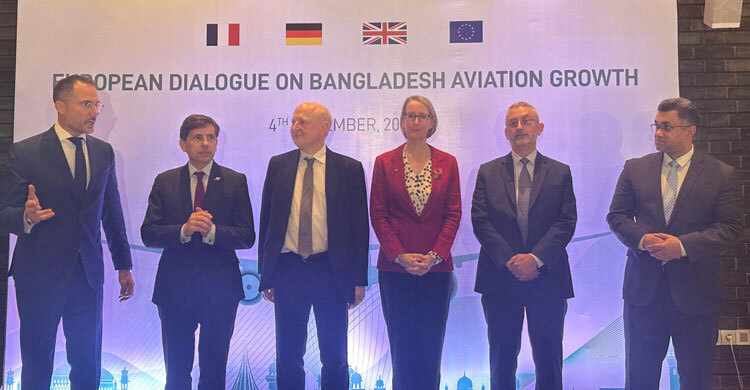
European aircraft giant Airbus has embarked on a high-level diplomatic campaign in Bangladesh, seeking to strengthen its foothold in the country’s growing aviation market and secure a major aircraft deal with Biman Bangladesh Airlines.
The campaign – marked by a discussion titled “Bangladesh’s Aviation Growth” held Tuesday, November 4, at the French-German Embassy in Dhaka – saw coordinated participation from four influential European envoys: French Ambassador Jean-Marc Serre-Charlet, German Ambassador Dr Rödiger Lotz, UK High Commissioner Sarah Cook, and EU Ambassador Michael Miller.
Although officially framed as a dialogue on aviation development, the event was organised by Airbus, signaling a strategic diplomatic effort to persuade Dhaka to consider the European manufacturer’s aircraft in future fleet expansion plans.
Competing for Biman’s fleet expansion
Airbus has offered to sell 14 new aircraft to Biman – 10 A350 wide-body jets and 4 A320neo narrow-body planes – as part of what officials described as a “comprehensive and competitive offer.”
This comes at a time when the interim government has approved a plan to purchase 25 new aircraft from Boeing, aligning with the United States on broader trade and tariff cooperation. Boeing has reportedly offered 14 aircraft to Biman as well, putting the two aviation giants in a high-stakes race for Bangladesh’s skies.
Biman’s management is currently reviewing both proposals, industry insiders confirmed.
Diplomatic chorus for Airbus
During the event, the European diplomats made a coordinated pitch highlighting Airbus’s global reputation, technological innovation, and potential to help Bangladesh position itself as a regional aviation hub.
French Ambassador Jean-Marc Serre-Charlet said: “Airbus stands at the heart of Europe’s aviation industry and represents our technological excellence and reliability. Bangladesh’s strategic location and growing connectivity needs make it an ideal partner for Airbus to support its next stage of aviation growth.”
German Ambassador Dr Rödiger Lotz emphasised that Biman’s next-generation fleet should reflect the country’s evolving market demands: “With Bangladesh’s growing economy and expanding middle class, Biman now needs modern and environmentally friendly aircraft – and Airbus is very well positioned to provide that.”
British High Commissioner Sarah Cook reaffirmed her government’s support for Bangladesh’s ambition to become a regional aviation hub, while EU Ambassador Michael Miller called for deepening commercial partnerships between Bangladesh and the European Union.
Airbus pitches lower costs, regional dominance
Airbus Commercial Sales Director Rafael Gomez Naya, who also serves as the company’s Chief Representative in Bangladesh, outlined the company’s dominance in South Asia, stating that 72 per cent of all commercial aircraft in the region – including Bangladesh, India, and Sri Lanka – are Airbus models.
He added that Airbus has delivered 16,470 aircraft globally out of 25,129 orders, and its aircraft are 20 percent more fuel-efficient than competitors.
“US-Bangla Airlines is already operating three Airbus planes successfully,” Naya said. “We hope Biman Bangladesh Airlines will also make a forward-looking decision by diversifying its fleet with Airbus.”
Strategic implications
Industry analysts view Airbus’s diplomatic outreach as part of a wider European strategy to increase its economic and industrial footprint in Bangladesh – a fast-growing market for aviation, trade, and energy.
If Biman were to select Airbus, it would mark a major shift in its fleet composition, historically dominated by Boeing aircraft. Analysts say such a move could also open the door to European investment in aviation infrastructure, including maintenance facilities and a potential Airbus regional hub in Bangladesh.
As Bangladesh eyes stronger global connectivity and a modernized fleet, the competition between Airbus and Boeing is shaping into a test of not only commercial strategy but also diplomatic influence – with both Europe and the United States vying for dominance in the country’s rapidly expanding skies.