
CPA and APM Terminals ink $550m deal for Laldia container gateway

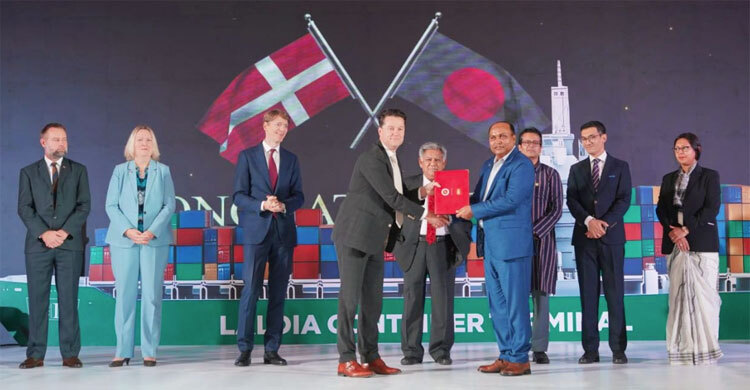
In a landmark development for Bangladesh’s logistics infrastructure, the Chittagong Port Authority (CPA) has signed a 30-year concession agreement – with potential extension contingent upon key performance indicators (KPIs) – with APM Terminals BV, a wholly owned subsidiary of Denmark’s AP Møller-Maersk Group, to design, finance, build and operate the new Laldia Container Terminal.
The public-private partnership (PPP) deal, signed today at the InterContinental Dhaka, marks the single largest European foreign direct investment (FDI) in Bangladesh’s history, with an estimated capital outlay of $550 million (approximately £450 million).
The project is expected to transform the efficiency of Bangladesh’s port operations, reduce freight costs, and position the country as a competitive logistics hub in the post-LDC era.
Shipping Adviser Brigadier General (Retd) Dr M Sakhawat Hussain, who attended the signing ceremony event as the chief guest, hailed the agreement as “a new chapter in national development”.
He emphasised the project’s potential to create thousands of skilled jobs for Bangladeshi youth and reduce reliance on overseas labour.
“Bangladesh’s workforce is among the most hardworking in the world – and now, we are creating opportunities for them at home,” he said. “This is not just a port. It is a statement of confidence in our people, our policies, and our future.”
The terminal will be developed as a greenfield, fully automated, and environmentally sustainable facility on the Laldia waterfront, capable of handling the world’s largest container vessels – nearly double the size of ships currently accommodated at the existing Chittagong Port.
The terminal will feature 24/7 operations with night navigation capabilities – a first for Bangladesh – alongside reduced per-unit freight costs through enhanced efficiency and economies of scale, direct global connectivity that minimises transshipment delays, and state-of-the-art digital systems for real-time cargo tracking, automation, and emissions monitoring, setting a new benchmark for sustainable and high-performance port operations in the region.
Under the concession model, the CPA will retain ownership of the land and port infrastructure, while APM Terminals – in partnership with a local joint venture entity – will assume full responsibility for construction, operation, and management. The revenue-sharing structure minimises public fiscal burden while ensuring long-term, foreign-currency-generating returns for the national exchequer.
Senior Danish officials underscored the strategic importance of the partnership. State Secretary for Trade and Investment, Lina Gandlose Hansen, called the project “a model of public-private synergy and sustainable development”.
“Ports are not just concrete and cranes – they are ecosystems of people, technology, and purpose,” she said. “This terminal will connect Copenhagen to Chittagong through trade, innovation, and shared values.”
Ambassador Christian Brix Møller highlighted Denmark’s five-decade-long development partnership with Bangladesh – now its second-largest bilateral development partner globally. He confirmed that additional infrastructure projects are already in advanced planning stages.
“This is not an isolated investment. It is a signal – to regional and global investors – that Bangladesh is open, reliable, and ready for high-value partnerships,” Møller said.
APM Terminals, operator of over 60 terminals across 33 countries – including 10 of the world’s top 20 busiest container ports (per World Bank 2024) – brings proven expertise from Asia’s most efficient hubs: Singapore, Shanghai, Colombo, and Ho Chi Minh City.
“This project is a critical step in making Bangladesh’s logistics sector future-ready,” said a senior APM Terminals executive present at the signing. “We are investing not just in infrastructure, but in Bangladesh’s integration into global value chains.”
The investment is expected to catalyse broader FDI inflows into manufacturing, warehousing, and ancillary services, reinforcing Bangladesh’s position as the world’s second-largest ready-made garments (RMG) exporter and a rising manufacturing destination.
The deal also validates Bangladesh’s evolving PPP regulatory environment, overseen by the PPP Authority.
PPP Authority CEO Chowdhury Ashik Mahmud Bin Harun, who presided over the ceremony, noted: “This agreement sets a new benchmark for transparency, technical rigour, and international credibility in our PPP pipeline.”
With construction expected to begin in early 2026 and commercial operations targeted for 2029, the Laldia Container Terminal is poised to become a cornerstone of Bangladesh’s economic ambition – turning maritime access into competitive advantage.