
Agriculture needs a hard reset or we starve, warns PRAN CEO

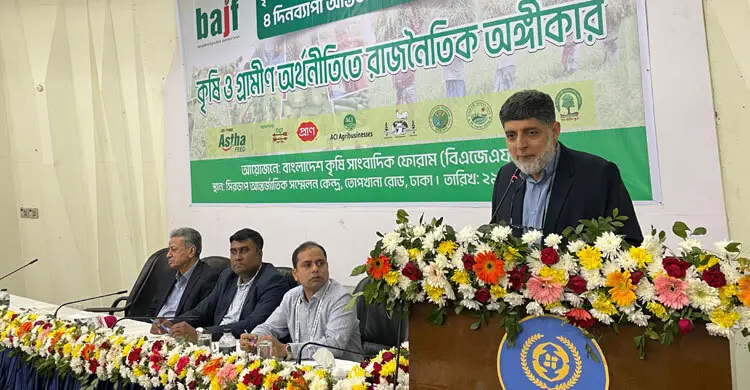
Ahsan Khan Chowdhury, Chairman and CEO of PRAN-RFL Group, has warned that without radical transformation in the country’s agricultural sector, sweeping modernisation, technological adoption, and coordinated political will, Bangladesh will fail to feed its growing population in the coming decades.
Delivering the keynote as special guest on the third day of the four-day international conference “Political Commitment in Agriculture and Food” organised by the Bangladesh Agricultural Journalists Forum (BAJF) Ahsan Khan used unusually direct language: the sector must hit a “reset button” similar to the periodic overhauls seen in industry. Stagnation, he warned, is no longer an option.
The statistics underpinning his alarm are well known but rarely stated so starkly from the corporate platform. Bangladesh’s population is projected to reach 200 million by mid-century while arable land continues to shrink at roughly 1 per cent per year because of urbanisation, industrial zones, and climate-induced salinity. Yield growth in rice – the traditional backbone of food security – has plateaued below 5 tonnes per hectare, far behind Vietnam (6+ tonnes) and barely half of what the Netherlands achieves with vegetables in controlled environments.
Ahsan Khan Chowdhury pointed to the Netherlands as the benchmark. Despite having only a fraction of Bangladesh’s land area and facing similar flooding risks, the Dutch have become the world’s second-largest agricultural exporter by value through precision farming, greenhouse clusters, and seamless cold-chain logistics. Bangladesh, he argued, must close the same gaps in research, infrastructure, and policy continuity.
On the ground, PRAN-RFL is already moving. The group is establishing an 1,800-bigha (approximately 600-hectare) carp farm in Moulvibazar that will deploy In-Pond Raceway System (IPRS) technology – a Chinese innovation new to Bangladesh. In IPRS modules, fish are confined to high-flow raceways within larger ponds, effectively putting them on an aquatic treadmill. The constant swimming improves muscle tone and feed conversion ratios by 30-40 %, while aerators and automated feeders reduce labour and disease risk. The Moulvibazar project will be only the third IPRS facility in the country when completed next year, with a second large-scale unit already under development in Godagari, Rajshahi.
In poultry, the prognosis for smallholders is even grimmer. Setting up a modest 50,000-bird broiler integration now costs Tk 30 crore – an impossible sum for the millions of backyard farmers who still dominate production.
Without structural change, Ahsan Khan Chowdhury predicted, these marginal operators will vanish within a decade, replaced by a handful of corporate giants. His proposed antidote revives the late President Ziaur Rahman’s vision of cooperative farming: district- and upazila-level collective enterprises specialising in high-value fish, broiler, or egg production. Large players such as PRAN-RFL, Kazi Farms, Paragon, and Nourish would provide chicks, feed, vaccines, technical supervision, and guaranteed buy-back while small farmers contribute land and labour.
The overriding corporate goal, Ahsan Khan Chowdhury emphasised, is not profit maximisation but price reduction. Every efficiency gain in fish and chicken will be passed on to bring animal-source protein within reach of the bottom half of the income pyramid. Only then, he argued, can Bangladesh move from chronic malnutrition indicators toward the “healthy Bengali” population required for sustained economic growth.
Thailand’s transformation offered a final cautionary yet hopeful parallel. Thirty years ago its agricultural GDP and productivity mirrored Bangladesh today. A combination of long-term political commitment, public-private research institutes, and massive rural infrastructure investment turned the country into a global powerhouse in rice, shrimp, chicken, and fruit within a single generation.
Ahsan Khan Chowdhury placed particular responsibility on two groups present in the auditorium. To politicians he appealed for stable, decade-long policies rather than five-year electoral cycles that disrupt research programmes and subsidy regimes. To agriculture journalists he assigned the role of knowledge bridge to a farming population where formal literacy remains limited, urging deeper investigative reporting on technology gaps, contract-farming models, and success stories from home and abroad.
While PRAN-RFL and peers will continue handling procurement, processing, branding, and distribution on commercial principles – taking what Ahsan Khan Chowdhury called “moderate and transparent” margins – the structural leap required is beyond private capital alone. Modern seed systems, saline-tolerant varieties, mechanisation hubs, refrigerated transport corridors, and renewable-energy cold stores all demand public investment and regulatory predictability.
Industry watchers described the address as the clearest articulation yet from Bangladesh’s corporate agriculture leadership that business-as-usual will lead to crisis. With climate change accelerating and urban demand for protein soaring, the window for a managed agricultural revolution is closing fast.
As Ahsan Khan Chowdhury concluded, the choice is binary: reinvent farming now through technology, cooperation, and political courage, or face a future where Bangladesh feeds neither its people nor its ambitions.